
Ghana Gold Board to inject $1.4bn into forex market in September, bolstering reserves
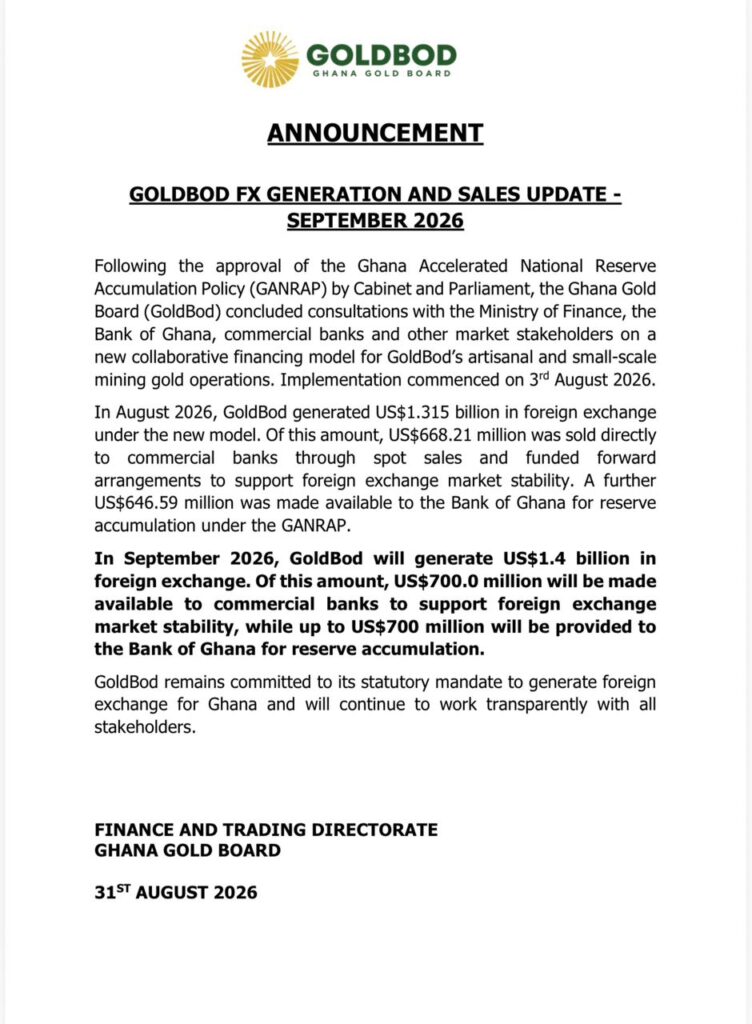
The Ghana Gold Board is set to inject a massive US$1.4 billion into Ghana's foreign exchange market in September 2026, marking a significant boost to the country's currency reserves and financial stability. The funds will be channelled through two parallel mechanisms: direct sales to commercial banks and contributions to the Bank of Ghana's reserve accumulation programme.
Under the arrangement, half of the projected amount—US$700 million—will be made available to commercial banks via spot sales and forward funding agreements, effectively increasing liquidity in the domestic banking system. The remaining US$700 million will go directly to the Bank of Ghana to strengthen Ghana's official foreign exchange reserves, a key pillar of macroeconomic stability.
Strong August performance signals momentum
GoldBod's ambitious September targets are built on a robust August performance, when the organisation generated US$1.315 billion in foreign exchange following the rollout of a revamped collaborative financing model for artisanal and small-scale mining operations. Of that sum, US$668.21 million went to commercial banks and US$646.59 million flowed to the Bank of Ghana's reserves.
The new model, which began implementation on 3 August 2026, represents a departure from previous arrangements and reflects enhanced coordination among key economic stakeholders. The restructuring followed intensive consultations involving GoldBod, the Ministry of Finance, the Bank of Ghana, commercial banks and other sector players, with both Cabinet and Parliament giving their approval to the underlying Ghana Accelerated National Reserve Accumulation Policy (GANRAP).
Why it matters for Ghana
These developments carry significant weight for Ghana's economic outlook. Consistent foreign exchange inflows from gold exports—which remain one of the country's largest sources of external revenue—help stabilise the Ghanaian cedi against major currencies, reduce import costs and build a buffer against external shocks. A stronger reserve position also improves Ghana's creditworthiness with international lenders and financial markets, potentially lowering borrowing costs.
The collaborative model underpinning these flows represents a strategic pivot towards integrating artisanal and small-scale mining (ASM) operators more formally into Ghana's official foreign exchange generation machinery. Historically, a significant portion of Ghana's gold output from informal and semi-formal mining channels has leaked into parallel markets or been smuggled abroad, depriving the state of much-needed forex revenue. By creating financial incentives and formal structures for ASM producers to sell through official channels, GANRAP aims to capture more of this value.
For ordinary Ghanaians, sustained FX inflows can translate into a more stable currency, lower inflation pressures and improved capacity for the central bank to manage monetary policy. Businesses relying on imports face reduced volatility in their foreign currency costs, whilst savers benefit from more predictable exchange rates.
Looking ahead
GoldBod has reiterated its commitment to its core mandate and pledged to maintain close collaboration with all stakeholders to ensure continued market stability and reserve strengthening. If the organisation sustains its current trajectory—generating over US$1.3 billion monthly—it will meaningfully contribute to Ghana's medium-term reserve adequacy and provide breathing room for policymakers navigating the country's fiscal and external challenges.
Source: MyJoyOnline



Comments (0)
Be the first to comment.