Ghana tightens used car imports: 15-year age ban kicks in October 2026

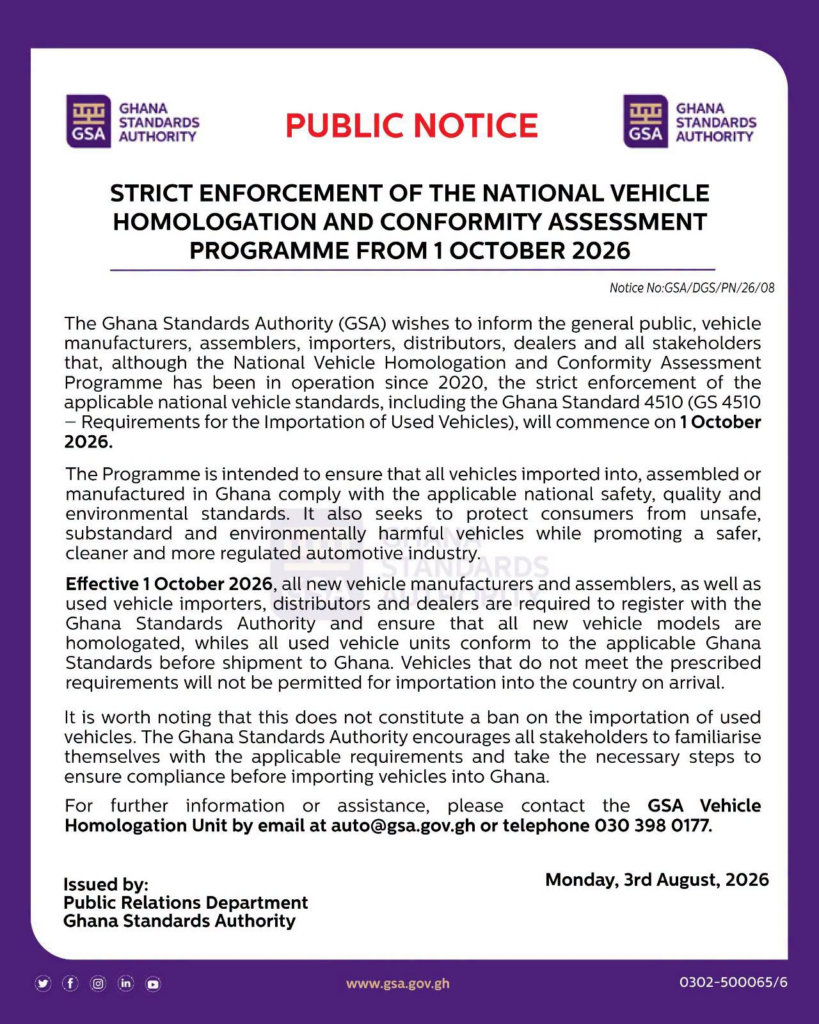
Ghana is set to overhaul its used vehicle import market with strict new regulations coming into force on October 1, 2026. The Ghana Standards Authority (GSA) has announced a revised framework that will ban the importation of used vehicles older than 15 years, replacing an earlier, more restrictive proposal that would have limited imports to vehicles no more than 10 years old.
The new rules mark a significant shift in how Ghana regulates the second-hand car trade, requiring all importers, distributors and dealers to ensure vehicles meet Ghanaian safety and quality standards before shipment. From the enforcement date, every used vehicle entering Ghana must first be inspected in its country of origin by a GSA-approved third-party inspection body, which will issue a Certificate of Conformity (CoC) confirming compliance with national standards.
What vehicles will be banned
Beyond the 15-year age restriction, the GSA has outlined specific vehicle categories that are completely prohibited from importation:
- Vehicles that have been submerged in water or damaged by floods
- Cars damaged by fire or burnt
- Vehicles with broken, cracked, bent or twisted chassis or safety cages
- Cars assembled from spare parts
- Vehicles without speedometers displaying readings in kilometres per hour
The Authority has made clear that any vehicle failing to meet prescribed requirements will not be cleared for entry into Ghana upon arrival at ports. Importers risk financial losses if they ship non-compliant vehicles, adding pressure on the business to verify documentation and condition meticulously before shipment.
Why it matters for Ghana
The policy carries significant implications for Ghana's automotive market and consumer safety. For years, Ghana's ports have been a destination for ageing, poorly-maintained vehicles that other markets rejected, contributing to road safety concerns and increasing accident risks. By enforcing stricter standards, the GSA aims to improve vehicle quality and reduce the number of unsafe cars on Ghanaian roads.
For consumers, the reforms could offer protection against purchasing defective vehicles or paying for cars that arrive only to be seized at the port. However, the stricter regime also presents challenges. Dealers and importers will face higher sourcing and compliance costs, which may eventually be passed to buyers through increased vehicle prices. The narrower pool of eligible vehicles could also reduce choice in Ghana's affordable second-hand car market, where many lower-income buyers rely on imported used vehicles.
The GSA has granted importers a grace period: vehicles already shipped before October 1, 2026 will be exempt from the new rules even if they arrive later, and any used cars already in Ghana before that date will also be grandfathered in. This transition arrangement gives the industry time to adjust operations and comply with new inspection and registration requirements.
The Authority has also signalled broader ambitions to regulate new vehicle imports. Manufacturers and assemblers of new vehicles must now register with the GSA, and new models require homologation—a formal approval process—before importation. These parallel measures aim to create a comprehensive framework ensuring all vehicles sold in Ghana meet minimum safety standards.
Stakeholders, including importers and dealers, have been urged to familiarise themselves with the requirements immediately and register with the GSA's Vehicle Homologation Unit before the October deadline.
Source: The Ghana Report


Comments (0)
Be the first to comment.