Ghana's Teacher Unions Launch Nationwide Strike Over Unpaid Arrears and Stalled Negotiations
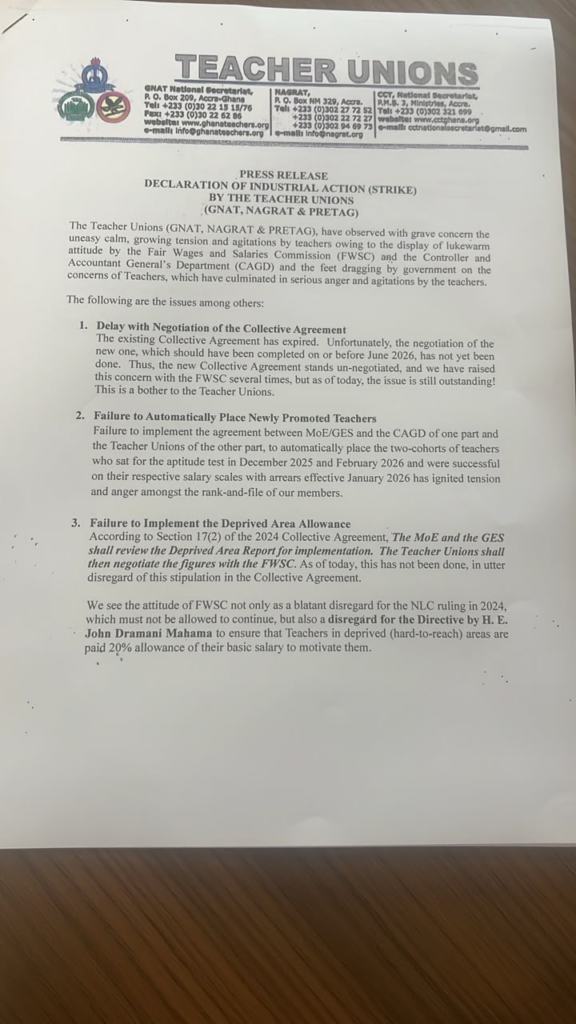
Ghana's three major teacher unions have pulled their members out of classrooms effective Friday, 25 September 2026, in a significant escalation of long-running disputes with government over unpaid promotion allowances, delayed salary negotiations, and unimplemented incentive schemes. The Ghana National Association of Teachers (GNAT), National Association of Graduate Teachers (NAGRAT), and Pre-Tertiary Teachers Association of Ghana (PRETAG) issued a joint statement declaring nationwide industrial action after the government failed to meet their midday Thursday deadline to resolve outstanding grievances affecting thousands of educators across the country.
What the Teachers Are Demanding
The strike centres on three interconnected issues that have festered for months. First, negotiations for a new Collective Agreement—which should have been finalised by June 2026—remain unresolved, leaving teachers uncertain about their employment terms and conditions going forward. The current agreement has expired, creating a legal vacuum that the unions say undermines their ability to protect members' interests.
Second, teachers who successfully passed promotion examinations in December 2025 and February 2026 have not been automatically placed on their new salary scales, nor have they received the back-pay (arrears) owed to them since January 2026. This delay has created acute financial hardship for affected educators and fuelled widespread anger within union ranks.
Third, the unions are demanding implementation of the Deprived Area Allowance—a commitment outlined in the 2024 Collective Agreement to provide additional compensation for teachers working in remote and underserved communities. Despite promises, the Ministry of Education and Ghana Education Service (GES) have not completed the required review of the Deprived Area Report, preventing negotiations on applicable payment figures.
Why This Matters for Ghana
Teacher strikes in Ghana have immediate and widespread consequences for the education system. Millions of primary and secondary students face disrupted learning at a critical juncture in the academic calendar, with potential knock-on effects on exam preparation and academic outcomes. For parents, especially working families, school closures create childcare challenges and economic strain.
Beyond the immediate classroom impact, the strike reflects deeper systemic problems: the Fair Wages and Salaries Commission (FWSC) appears unable to resolve disputes efficiently, government commitments on teacher welfare remain unfulfilled, and the unions argue they have exhausted dialogue channels. The unions' characterisation of the situation as involving "widespread disaffection, anger, and disillusionment" among members signals that frustration extends far beyond individual grievances—it threatens cohesion within the teaching profession and public confidence in government's commitment to education.
Ghana's education sector already faces resource constraints and infrastructure challenges. Teachers themselves, meanwhile, are essential to national development; their morale and financial stability directly influence classroom quality. Unresolved disputes and delayed salaries risk pushing experienced educators out of the profession or into informal arrangements that undermine system integrity.
What Happens Next
The ball is now in government's court. The Ministry of Education, GES, and FWSC must engage urgently with the unions to negotiate settlements on all three fronts. Previous strikes have typically been resolved through direct negotiation and government commitment to timelines, but protracted disputes can harden positions on both sides.
Parents and the general public will be monitoring developments closely. The unions have made their position clear: they will not return to work until concrete commitments are made on arrears payments, salary scale placement, collective bargaining, and the deprived area allowance. Government's response will signal whether it views teacher welfare as a priority or an afterthought.
Source: MyJoyOnline


Comments (0)
Be the first to comment.