Ghana Gold Board smashes September FX target with $1.87bn haul from artisanal mining
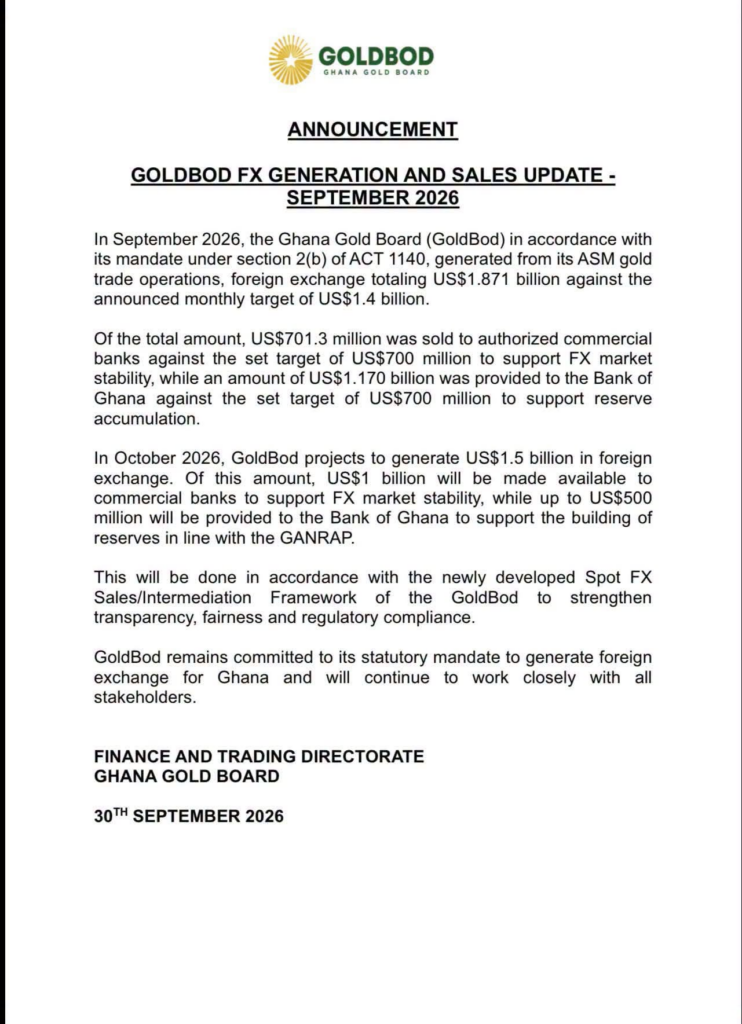
Ghana's Gold Board (GoldBod) has delivered a significant boost to the country's foreign exchange coffers, generating US$1.871 billion from artisanal and small-scale mining operations in September 2026—substantially outperforming its monthly target of US$1.4 billion. The performance underscores the institution's growing importance to Ghana's currency stability and reserve-building strategy at a time when many African economies face external financing pressures.
The windfall demonstrates how formalised, regulated artisanal mining can become a strategic asset for national economic management. GoldBod, operating under its statutory mandate under Section 2(b) of Act 1140, splits its foreign exchange intake between two critical channels: supporting immediate liquidity in Ghana's forex market and accumulating reserves under the government's reserve-building framework.
Where the money went
Of the September proceeds, US$701.3 million was channelled to authorised commercial banks to support foreign exchange market stability—just marginally above the US$700 million target. This mechanism helps prevent sharp currency volatility by ensuring steady supply to the banking system. The remainder, US$1.170 billion, went directly to the Bank of Ghana to bolster the country's foreign exchange reserves, significantly exceeding the central bank's US$700 million allocation target for the month.
The scale of the overshoot is noteworthy: GoldBod delivered an extra US$470 million beyond its monthly target, a 34% surplus. This type of consistent, above-target performance can provide breathing room for Ghana's macroeconomic management, particularly in servicing external debt and maintaining import cover.
Why it matters for Ghana
Ghana has faced recurring foreign exchange challenges, with the cedi experiencing significant depreciation pressures in recent years. The IMF's Extended Credit Facility and ongoing fiscal consolidation efforts have made foreign exchange generation a priority. GoldBod's contribution is particularly significant because it diversifies Ghana's FX sources beyond cocoa exports and remittances, both of which can be volatile. Formalising artisanal gold mining through institutional channels also combats illegal mining and smuggling, which have historically drained Ghana of precious metals and forex.
The performance reflects growing discipline in Ghana's gold supply chain. By channelling artisanal and small-scale production through regulated pathways, GoldBod captures forex that might otherwise leave the country unofficially. This also aligns with international transparency standards and supports Ghana's standing with multilateral partners.
October outlook and new frameworks
Looking ahead, GoldBod has projected US$1.5 billion in foreign exchange generation for October 2026. Of this, US$1 billion will go to commercial banks and US$500 million to the Bank of Ghana under the Ghana Accelerated National Reserves Accumulation Programme (GANRAP)—the government's formal reserve-building initiative.
Significantly, GoldBod is introducing a new Spot FX Sales/Intermediation Framework designed to strengthen transparency, fairness and regulatory compliance in foreign exchange sales. This framework suggests an evolution in how gold-backed forex is managed, moving toward clearer rules and reduced discretion—measures that should appeal to development partners monitoring Ghana's fiscal discipline.
The results position GoldBod as a reliable tool in Ghana's economic stabilisation toolkit, though sustained performance will depend on maintaining production levels and global gold prices. The institution's continued coordination with the Bank of Ghana, commercial banks and other stakeholders will be essential to converting these monthly surpluses into durable gains for Ghana's external position.
Source: MyJoyOnline


Comments (0)
Be the first to comment.