NPP Clamps Down on Early Campaign Trail: Party Orders Aspirants to Halt Activities Ahead of Parliamentary Primaries

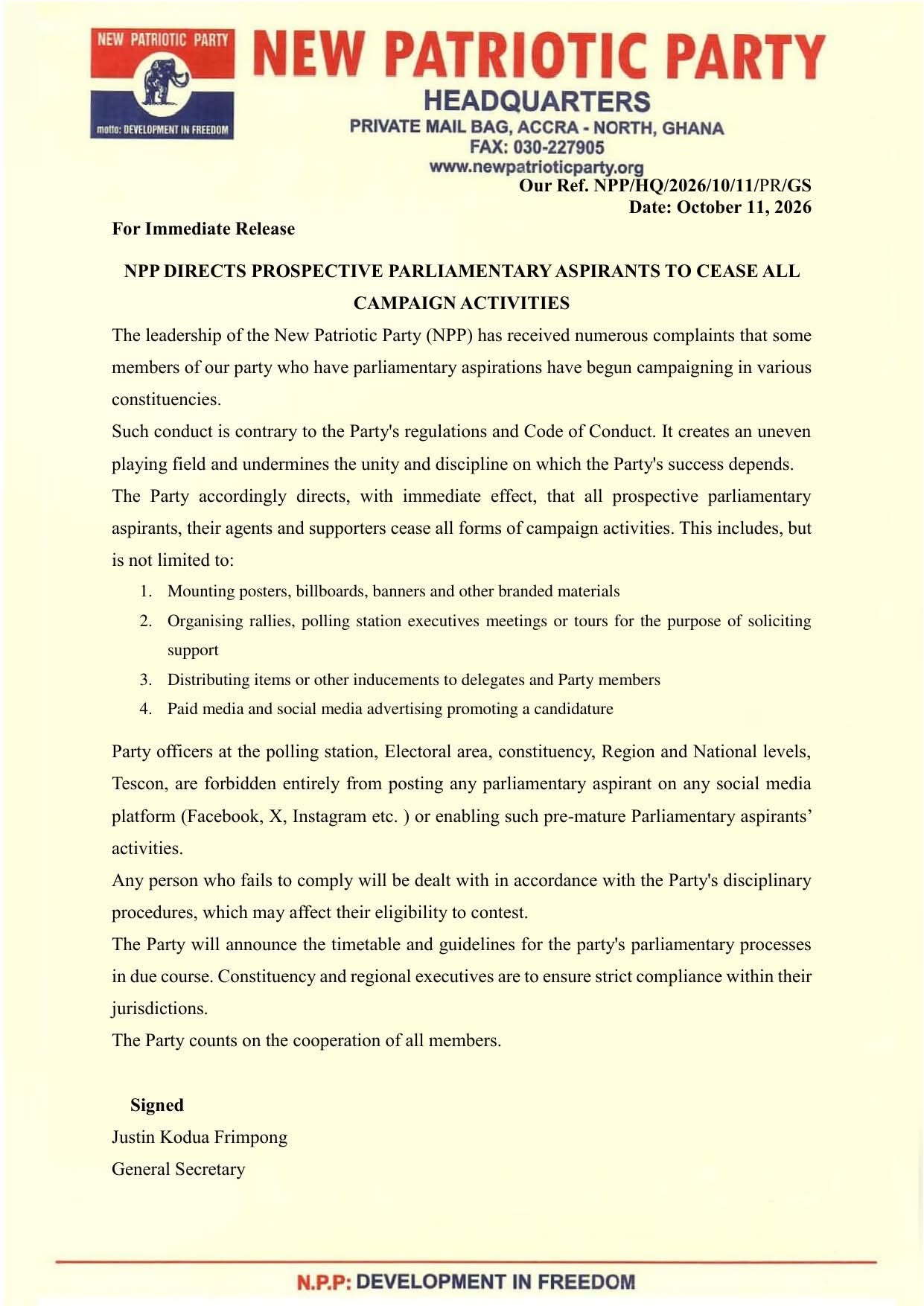
The New Patriotic Party has moved to rein in early campaign enthusiasm among its would-be parliamentary candidates, issuing a blanket directive to stop all campaign activities with immediate effect. The instruction, contained in a statement dated October 11, 2026, and signed by General Secretary Justin Kodua Frimpong, signals the party's determination to control the narrative around its internal selection process and prevent what it views as premature politicking that could fracture party unity.
The move follows what the NPP describes as widespread breaches of party regulations, with several members already engaging in campaign activities across constituencies. The party argues that these early moves violate its Code of Conduct and create an uneven platform for aspiring parliamentarians, potentially disadvantaging those without resources or early momentum.
What the Ban Covers
The directive is remarkably comprehensive in scope. Prospective candidates are prohibited from mounting posters, billboards and banners, organising rallies, holding meetings with polling station executives, and conducting constituency tours to seek support. Additionally, the distribution of items or inducements to delegates and party members is banned, as is paid media and social media advertising on behalf of individual candidates.
Party officials themselves face restrictions too. Officers at polling station, electoral area, constituency, regional and national levels—including members of TESCON (the party's tertiary student wing)—are barred from promoting any parliamentary aspirant on platforms like Facebook, X and Instagram. This attempts to prevent established party figures from leveraging their positions to boost particular candidates before the official process begins.
The party has warned that non-compliance will trigger disciplinary action, which could render offenders ineligible to participate in the parliamentary primaries themselves—a significant sanction given the stakes involved.
Why It Matters for Ghana
Ghana's political parties routinely struggle with internal discipline during candidate selection processes. The NPP's intervention reflects a broader challenge facing the party as it prepares for parliamentary nominations ahead of eventual general elections. How strictly the directive is enforced will test the party's institutional strength and the credibility of its leadership.
For the wider Ghanaian political landscape, the move also signals an attempt by the NPP to project order and unity at a time when internal party dynamics can become fractious. Uncontrolled primary campaigns can deplete party resources, create lingering tensions between candidates, and leave the eventual winners weakened heading into general elections. By asserting control now, the NPP is attempting to prevent the kind of acrimony that sometimes follows bruising internal contests.
The directive also underscores how digital platforms have transformed party politics in Ghana. The specific prohibition on social media activity by party officials reveals the party's concern that informal networks and influence can operate outside traditional hierarchical controls, making it harder to maintain order.
What Comes Next
The NPP has not yet announced a timetable for its parliamentary primaries or the formal guidelines that will govern the process. Aspiring candidates will have to wait for these details before resuming any campaign activities. Party executives at constituency and regional levels have been tasked with ensuring compliance within their jurisdictions, effectively deputising them as enforcers of the directive.
The success of this directive will depend on the party's willingness to investigate breaches and impose sanctions consistently. In Ghana's political environment, where patronage networks are deeply entrenched, such enforcement can be uneven. Nevertheless, the NPP's statement reflects a recognition that poorly managed candidate selection processes can undermine party coherence and electoral performance.
Source: The Ghanaian Times

Comments (0)
Be the first to comment.