NPP threatens to disqualify candidates who ignore campaign suspension order

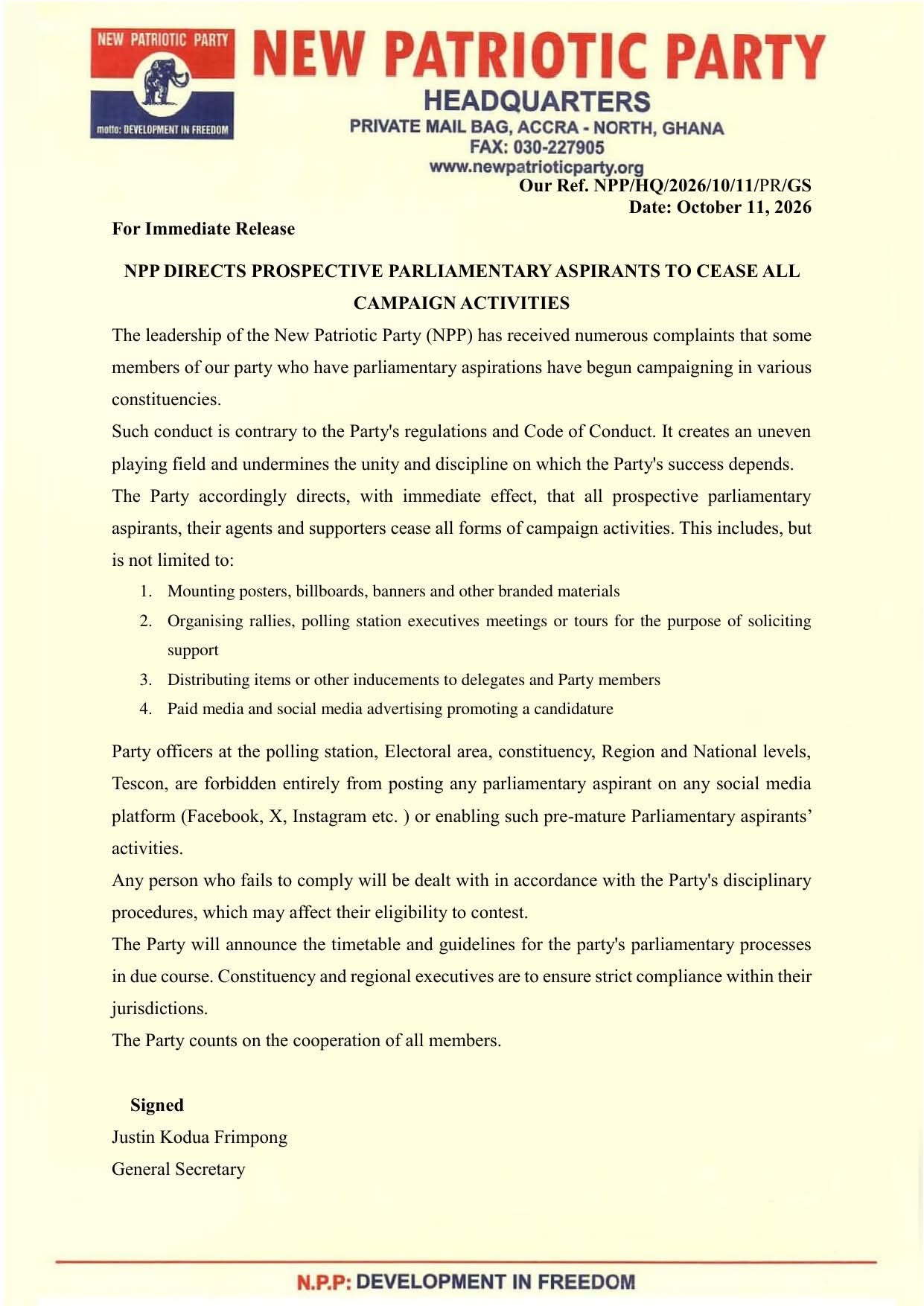
The New Patriotic Party has escalated enforcement of its campaign suspension directive, with party officials warning that parliamentary hopefuls who defy the order risk losing their chance to contest the party's primaries. The stark warning signals the NPP's determination to maintain discipline within its ranks as it prepares for internal candidate selection ahead of upcoming elections.
Dennis Miracles Aboagye, the NPP's Director of Communications, made the announcement during an interview on Sunday, October 11, 2026, emphasising that aspiring candidates must comply with party regulations or face consequences. According to Aboagye, the suspension directive is non-negotiable and applies uniformly to all prospective parliamentary candidates, their campaign agents and supporters.
"If you yourself begin to disregard party directives, then you know, you're not fit to lead a party at any level," Aboagye stated, underscoring the party leadership's expectation that candidates demonstrate commitment to organisational discipline before assuming public office.
Why the NPP imposed the campaign ban
The NPP implemented the directive to achieve several objectives ahead of its parliamentary primaries. The party leadership argues that the suspension prevents premature campaigning that could create unequal advantages among aspirants, promote fairness in the selection process, and preserve internal unity during a critical period.
By restricting early campaign activities, the NPP aims to prevent wealthier or better-resourced candidates from gaining unfair advantages through aggressive groundwork. The directive also allows the party to control the narrative and timing around candidate emergence, ensuring that the selection process follows an orderly framework rather than degenerating into a chaotic scramble for visibility.
The enforcement mechanism outlined by Aboagye indicates that sanctions extend beyond mere warnings. Candidates found in breach face potential disqualification from the parliamentary primaries entirely—a substantial consequence that could end political ambitions within the NPP structure.
What this means for NPP aspirants and Ghana's political landscape
For prospective NPP candidates, the threat of disqualification creates a delicate balancing act. Aspirants must maintain visibility and organisational readiness without appearing to actively campaign, a distinction that could prove murky in practice. Campaign infrastructure—including grassroots mobilisation, constituency visits and media engagement—often operates as an ongoing process rather than a discrete activity with clear start and end points.
The enforcement signal also reflects broader challenges within Ghana's political parties regarding internal democracy and candidate selection. While discipline within party structures is important for operational effectiveness, overly restrictive measures can sometimes be perceived as tools for protecting favoured candidates or suppressing competition.
For Ghanaian voters and observers, the NPP's approach demonstrates how party politics operates backstage, away from public view. The internal rules governing candidate selection shape which aspirants ultimately reach the ballot, influencing the quality and diversity of representation available to constituents.
The party's willingness to impose high-stakes penalties suggests that leadership takes the directive seriously and views compliance as a test of readiness for elected office. However, the actual application of sanctions will determine whether this amounts to meaningful discipline or selective enforcement that favours certain candidates over others.
As the NPP moves toward its parliamentary primaries, the outcome of this enforcement initiative could set precedent for how the party manages internal competition and maintains cohesion during candidate selection cycles in future elections.
Source: The Ghana Report


Comments (0)
Be the first to comment.