
IFEJ and Lands Ministry forge partnership to deepen mining and natural resources reporting in Ghana
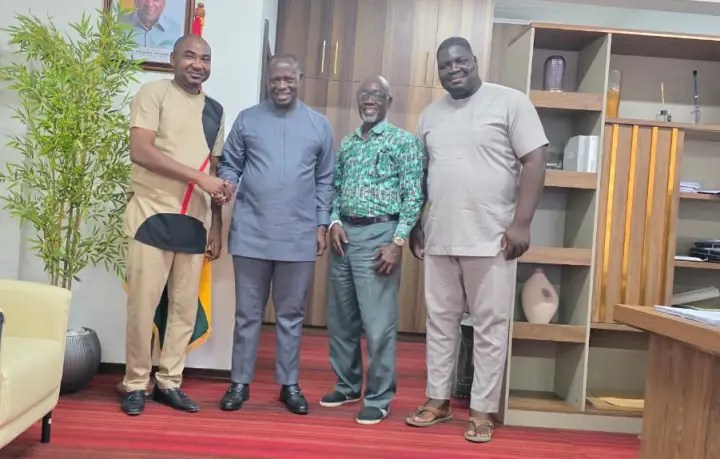
The Institute of Financial and Economic Journalists (IFEJ) and Ghana's Ministry of Lands and Natural Resources have committed to a formal partnership aimed at strengthening how the media reports on mining, forestry, and land administration—three sectors critical to Ghana's economy and environmental future.
The agreement emerged from a meeting in Accra between IFEJ leadership, led by President Roger Agambire Agana, and Lands Minister Emmanuel Armah-Kofi Buah. The partnership will begin with a half-day workshop where the minister and heads of ministry agencies will brief specialist journalists on sector reforms, followed by direct engagement with ministry departments to improve coverage quality and depth.
What IFEJ is pushing for
IFEJ members proposed several concrete measures to deepen the partnership. These include an annual conference on mining and natural resource governance, joint research and publications with technical input from the ministry, and regular site visits to degraded lands undergoing restoration so journalists can document both recovery efforts and the scale of environmental damage. The institute also requested closer access to the ministry's agencies and technical briefings to build journalistic expertise in these complex policy areas.
IFEJ leaders acknowledged that specialised reporting helps explain sector policies to the public and prepares communities for economic transitions—particularly Ghana's shift towards local value addition in minerals extraction, a key government objective.
Major reforms on the table
Minister Buah outlined sweeping changes to Ghana's mining and forestry management. On mining, he announced Cabinet approval of a new mining policy to replace the 2014 framework, alongside new legislation before Parliament requiring community mining agreements. Under these binding commitments, mining companies must deliver community-identified development goals—schools, roads, vocational training—over the life of their concession, framed as contractual obligations rather than corporate charity.
Additional mining reforms include reducing lease terms from 30 years to 20, after which the state will decide on renewal or partnership with Ghanaian investors, tightening controls on reconnaissance licences (holders must show active exploration spending within five years or lose them), and creating a new medium-scale mining tier to help Ghanaian operators scale operations.
On forestry, the minister revealed that 44 forest reserves have been destroyed in recent years, resulting in degraded land equivalent to roughly 13,000 football fields. The state has regained full control of these reserves and is now reclaiming and replanting through the Tree for Life initiative, which leverages schoolchildren and private sector funding to offset budget constraints. The ministry is also modernising land administration through technology to improve service access and transparency.
Why it matters for Ghana
This partnership reflects a growing recognition that Ghana's mining and natural resources sectors require more informed public and media engagement. Mining revenues are crucial to the national budget, yet public trust in the sector remains fragile due to environmental damage, delayed community benefits, and perceived opacity in negotiations between government and companies. Better specialist reporting can help bridge that gap by explaining policy intent and holding both government and industry accountable.
For forestry and land administration, technological reform and restoration efforts represent significant public investment. Media coverage that tracks progress—or shortfalls—helps ensure government commitment and allows citizens to monitor whether recovery is genuine. The partnership also signals that the ministry recognises poor media coverage has undermined public understanding of sector reforms, and that investing in journalist training is a legitimate governance strategy.
The agreement marks a shift from adversarial press-government relations towards collaborative capacity-building, though maintaining editorial independence will be essential as the partnership unfolds.
Source: Ameyaw Debrah



Comments (0)
Be the first to comment.