
STU Vice-Chancellor Makes History as Institution's First Full Professor in Landmark Inaugural Lecture


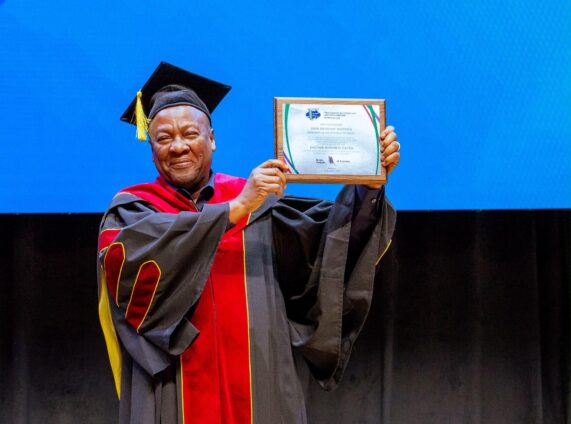
Sunyani Technical University (STU) has marked a significant milestone in its academic history as its Vice-Chancellor, Ing. Prof. Kwadwo Adinkrah-Appiah, delivered the institution's first-ever Professorial Inaugural Lecture — a landmark occasion made all the more historic by the fact that he is the university's first full professor.
The lecture, which drew attention from academia and industry stakeholders alike, centred on a bold call for a fundamental shift in how Ghana approaches its construction industry — a sector that plays a critical role in the country's development agenda.
A Call to Transform Ghana's Construction Sector
At the heart of Ing. Prof. Adinkrah-Appiah's address was a passionate appeal for Ghana to rethink the foundations upon which its construction industry operates. While the specific technical proposals of the lecture reflect years of research and professional engineering expertise, the overarching message was clear: the status quo is no longer sufficient for a nation with Ghana's development ambitions.
Ghana's construction industry has long grappled with challenges including over-reliance on foreign expertise, inadequate use of local materials, poor project delivery timelines, and gaps in quality assurance. Prof. Adinkrah-Appiah's lecture appeared to confront these realities head-on, urging both policymakers and practitioners to embrace innovation, local knowledge, and more rigorous professional standards.
As a trained engineer holding the country's highest academic rank in his field at STU, the Vice-Chancellor's voice carries considerable weight. His dual role as both a scholar and an institutional leader places him in a unique position to influence both education and industry practice.
Why It Matters for Ghana
The significance of this event extends well beyond the walls of Sunyani Technical University. Technical universities in Ghana have often struggled to assert academic credibility on par with their traditional university counterparts. The emergence of a full professor from within STU's own ranks — and one who leads the institution — sends a powerful signal about the growing academic maturity of Ghana's technical university system.
Ghana's technical and vocational education sector has been earmarked by successive governments as a key driver of industrialisation and economic transformation. When senior academics at these institutions engage with real-world industries such as construction, it strengthens the bridge between classroom learning and national development needs.
The construction industry, meanwhile, remains one of Ghana's most economically active sectors, contributing meaningfully to GDP and employing a significant portion of the workforce. Any serious academic discourse on reforming the sector — particularly one led by a credentialed engineer of professorial rank — deserves the attention of policymakers, the Ghana Institution of Engineering, and industry bodies such as the Ghana Real Estate Developers Association.
A Historic Moment for Sunyani Technical University
Beyond the policy implications, the inaugural lecture represents a proud institutional moment for STU and for the Brong-Ahafo region, which the university serves. Sunyani, the capital of the Bono Region, is not always at the centre of Ghana's academic spotlight, making achievements of this nature particularly meaningful for local communities and students who look to the university as a beacon of opportunity.
For students currently studying engineering, construction management, and related disciplines at technical universities across Ghana, Prof. Adinkrah-Appiah's achievement also serves as an inspiring example of what is attainable within the technical education pathway.
- The inaugural lecture is expected to be published and shared with industry and academic stakeholders as part of STU's growing research output.
- Ghana's technical universities have been undergoing reforms in recent years to elevate their research profiles and produce more postgraduate and professorial-level academics.
- The construction industry remains central to Ghana's infrastructure development goals under various national plans.
As Ghana continues to invest in infrastructure — from roads and bridges to affordable housing and institutional buildings — the academic community's engagement with the construction sector could not come at a more relevant time.
Source: 3News




Comments (0)
Be the first to comment.