
Obuasi SHS Headmaster Case Handed to Attorney-General After Police Investigation


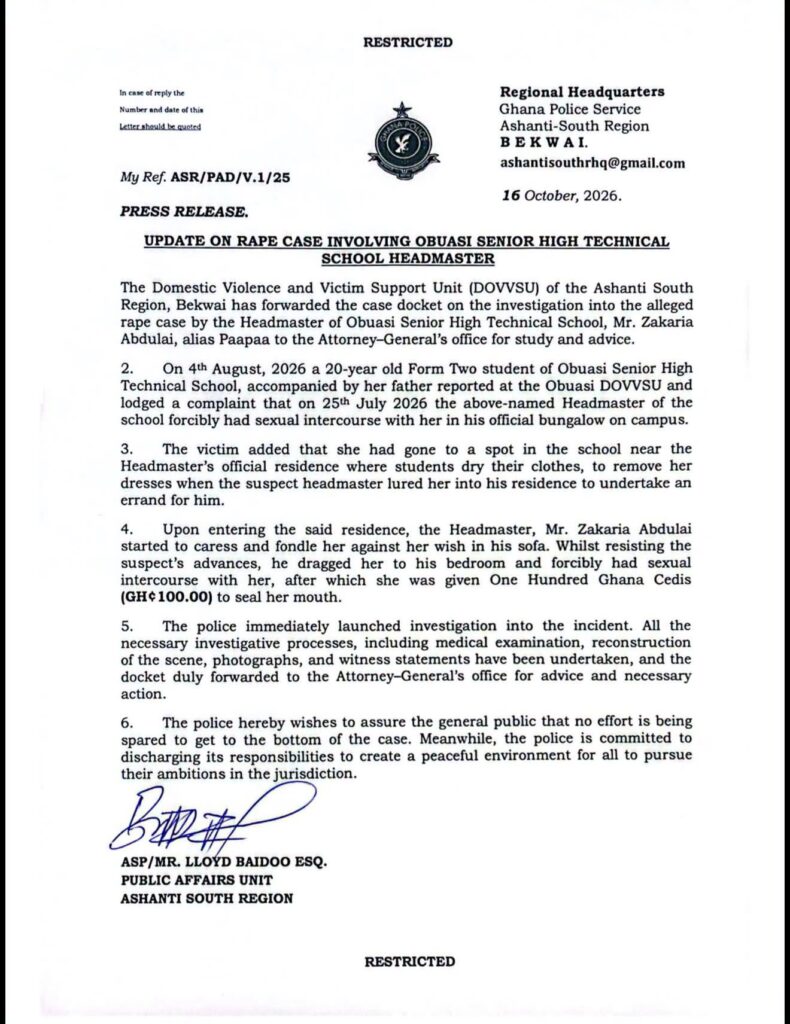
The Ghana Police Service has escalated a serious allegation against Zakaria Abdulai, headmaster of Obuasi Senior High Technical School, by referring the case to the Attorney-General's office for legal review. The referral came after the Domestic Violence and Victim Support Unit (DOVVSU) in Bekwai, Ashanti South Region, completed its investigation into the complaint filed by a Form Two student in early August.
According to police statements, the female student, accompanied by her father, lodged a formal complaint on August 4, 2026, alleging that the headmaster forcibly had sexual intercourse with her at his residence on the school's campus on July 25. The investigation involved standard forensic and evidential procedures, including medical examination of the complainant, scene reconstruction, photographic documentation, and collection of statements from witnesses.
Investigation Process and Police Response
The Police Service emphasised its commitment to thorough investigation, stating that comprehensive procedures were undertaken to establish the facts surrounding the allegation. The case file's forwarding to the Attorney-General represents a critical juncture, as the AG's office will now determine whether there is sufficient evidence to prosecute and what legal charges, if any, should be pursued.
Authorities stated they remain dedicated to uncovering the truth and assured the public that all available resources are being deployed to investigate the matter fully. The referral to the Attorney-General is standard practice in serious criminal cases, particularly those involving allegations of sexual abuse and institutional abuse of power.
Why This Matters for Ghana
This case underscores persistent concerns about child safety in educational institutions and the abuse of authority by school administrators. Ghana's education sector has faced scrutiny in recent years over safeguarding protocols and the treatment of student complaints. Allegations involving headmasters—figures of significant authority within schools—are particularly sensitive, as they reveal potential vulnerabilities in institutional checks and balances designed to protect vulnerable students.
The referral to the Attorney-General signals that police investigations have yielded sufficient material for higher legal consideration, suggesting the case meets preliminary thresholds for serious examination. For Ghanaian parents and students, the case raises important questions about duty of care, reporting mechanisms, and institutional accountability within secondary schools.
The involvement of DOVVSU indicates that domestic and sexual violence units are functioning to receive and investigate such complaints, though debate continues about the adequacy of support services for survivors and the timeliness of justice in sexual abuse cases. The outcome of this case could influence policy discussions around school safety, headmaster conduct codes, and student protection frameworks.
Obuasi SHS, as a technical secondary school, serves hundreds of students and families in the Ashanti Region. Any institutional failure to protect students would have broader implications for public confidence in Ghana's educational system and the welfare of boarding school populations.
Source: Ameyaw Debrah

Comments (0)
Be the first to comment.