
Legal Row Erupts as Coalition Demands Investigation into GoldBod CEO's Alleged Remarks on Unlicensed Mining
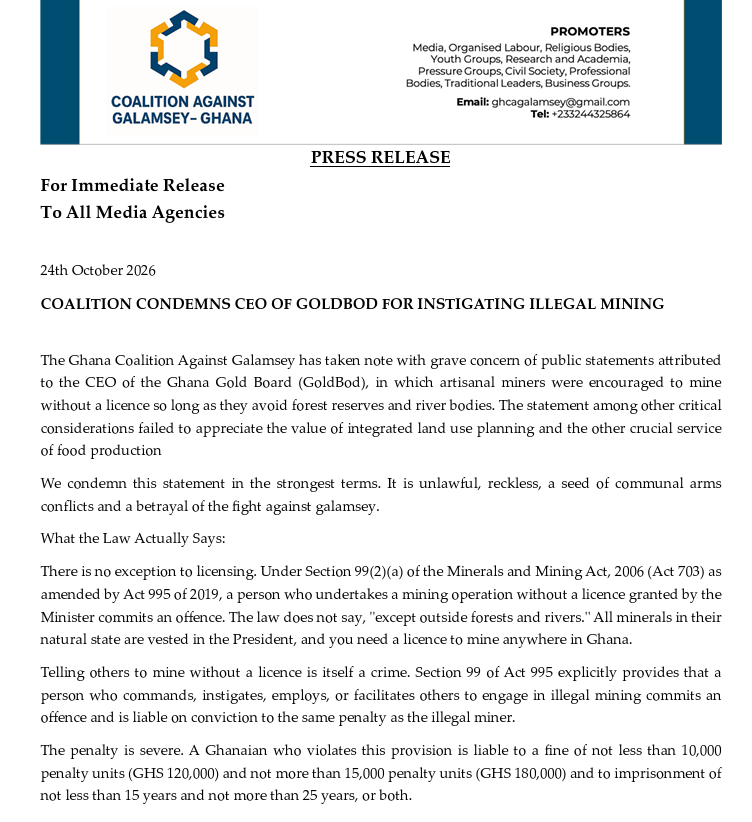

A major confrontation over Ghana's fight against illegal mining has emerged after the Ghana Coalition Against Galamsey (CAGG) formally demanded that the Office of the Attorney-General investigate the Chief Executive Officer of the Ghana Gold Board over alleged remarks that appeared to condone unlicensed mining operations. The coalition, in a statement dated October 24, 2026, accused the GoldBod CEO of making unlawful and reckless comments that could substantially weaken anti-galamsey enforcement efforts across the country.
The controversy centres on reported statements suggesting that artisanal miners could operate without licences provided they avoid forest reserves and river bodies. CAGG has rejected this interpretation entirely, arguing that Ghana's mining legislation contains no such locational exemption from licensing requirements.
The Legal Framework
Drawing on Section 99(2)(a) of the Minerals and Mining Act, 2006 (Act 703), as amended by Act 995 of 2019, CAGG emphasised that anyone undertaking mining without a licence from the Minister commits a criminal offence. The coalition further noted that Section 99 extends liability to individuals who command, instigate, employ or facilitate illegal mining, subjecting them to identical penalties as the primary offender.
The penalties are substantial. Offenders face fines between GH¢120,000 and GH¢180,000, combined with prison sentences of 15 to 25 years, or both. This severity underscores Parliament's intent to treat mining regulation as a serious matter of national interest.
CAGG has formally demanded that the GoldBod CEO issue an immediate retraction of the alleged statement and provide an unqualified public apology to Ghanaians. The coalition has additionally urged President John Dramani Mahama, the Minister for Lands and Natural Resources, and the Minerals Commission to make explicit public statements affirming that mining without a licence is illegal regardless of location.
Why It Matters for Ghana
The dispute reflects broader tensions in Ghana's mining sector, where the distinction between formalised artisanal mining and galamsey remains contested and frequently blurred in practice. GoldBod was specifically established to bring artisanal miners into a regulated, licensed framework—not to create pathways for unlicensed operations. If public officials are perceived to be softening enforcement messages, it undermines this entire regulatory strategy.
Beyond the legal dimension, CAGG has highlighted secondary harms: unlicensed mining encourages encroachment on agricultural lands, displaces farming communities, and contaminates water sources. The coalition has called on the Ministry of National Security, Ghana Police Service and Ministry of the Interior to establish rapid-response mechanisms for reporting land encroachment and to strengthen protections for farmers and landowners.
The group is also pressing the government to adopt a comprehensive national plan to protect farmlands, including legal safeguards, farm mapping and registration, targeted support for vulnerable farmers documenting land rights, and compensation for those whose lands have been destroyed by mining activity.
The Broader Context
This dispute occurs within a wider struggle against galamsey, which has devastated water supplies, poisoned soil and displaced communities across Ghana's mining regions. Civil society organisations, environmental groups and farmer associations—represented within CAGG—view strong regulatory messaging as essential to preventing further damage. Any statement from a state official that appears to licence illegal activity poses a threat to public health and agricultural productivity.
CAGG comprises civil society organisations, professional associations, environmental advocacy groups and other stakeholders united around combating illegal mining. The coalition's intervention signals that watchdog groups remain vigilant in holding public institutions accountable for statements and actions that affect mining law enforcement.
Source: MyJoyOnline



Comments (0)
Be the first to comment.