GoldBod Must Account for Gold Trading Losses, Says Afenyo-Markin as IMF Report Exposes US$1.7bn Deficit
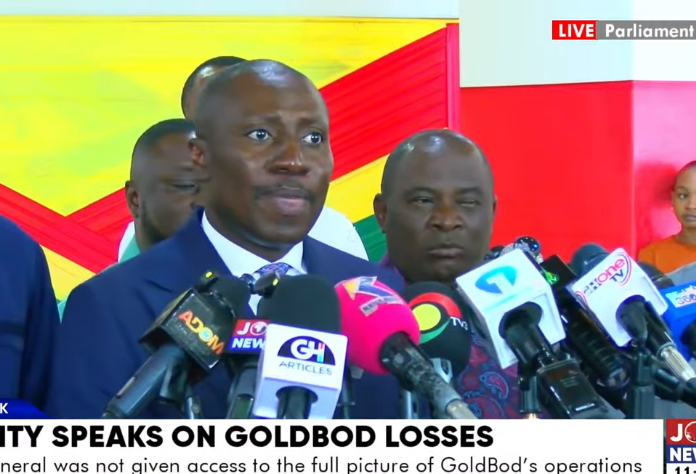
Ghana's opposition Minority has intensified scrutiny of the Ghana Gold Board (GoldBod) over what it argues is an inequitable financial structure in the country's gold trading operations. Minority Leader and Effutu Member of Parliament Alexander Afenyo-Markin has called on the institution to fully account for both revenues and losses arising from its gold purchasing and trading activities, rather than retaining transaction fees whilst leaving losses to burden the Bank of Ghana.
Speaking at a parliamentary press conference on Tuesday, 18 August, Mr Afenyo-Markin challenged GoldBod's current arrangement, arguing that the institution cannot selectively benefit from profitable aspects of its operations whilst transferring financial losses to the central bank and ultimately to Ghanaian taxpayers. "You don't get to keep the fees and disown the costs," he stated, emphasising that the Minority's position was grounded in protecting public interest rather than partisan opposition.
The IMF Report and Scope of Losses
The Minority Leader's intervention follows the release of an International Monetary Fund report highlighting significant losses under the Bank of Ghana's Domestic Gold Purchase Programme, which GoldBod implements. According to the IMF findings, the expansion of this programme in 2025 resulted in losses exceeding US$1.7 billion—equivalent to approximately 1.5% of Ghana's total GDP. This substantial deficit has raised questions about the programme's financial management and the mechanisms by which losses and revenues are allocated within the institutional framework.
Mr Afenyo-Markin emphasised that the Minority's concerns are based directly on the IMF report rather than opposition calculations, lending credibility to calls for institutional transparency. He specifically called on GoldBod to disclose the identities of off-takers (gold buyers), clarify the fee structure underpinning transactions, and explain the circumstances under which gold was sold at discounted prices.
Why It Matters for Ghana
The dispute over GoldBod's financial arrangements carries significant implications for Ghana's fiscal health and public accountability. At its core, the issue reflects broader concerns about how state-owned enterprises manage public resources and whether institutional structures adequately protect the national interest. The US$1.7 billion loss figure—roughly 1.5% of GDP—represents a substantial impact on Ghana's already-strained finances, particularly during a period when the country is managing an International Monetary Fund support programme aimed at economic stabilisation.
The Minority Leader's call for clarity on off-taker identities and discount arrangements speaks to concerns about potential opacity in gold trading operations and whether commercial decisions align with Ghana's financial interests. By insisting that GoldBod should bear responsibility for losses it incurs through its operational decisions, Mr Afenyo-Markin is arguing for institutional accountability that protects public resources. This matters for ordinary Ghanaians because losses transferred to the Bank of Ghana ultimately impact government resources available for essential services and development programmes.
Additionally, the structure of how losses and revenues are allocated between GoldBod and the Bank of Ghana raises fundamental questions about institutional governance. If one entity retains fees and profits whilst another absorbs losses, this creates perverse incentives that may not serve Ghana's economic interests.
The Broader Dispute
This parliamentary challenge represents an escalation in the ongoing dispute between the Minority and GoldBod regarding the financial performance and governance of Ghana's gold trading operations. The controversy underscores the importance of transparent institutional frameworks in managing the country's mineral wealth—a critical revenue source for Ghana's economy. As this dispute continues, pressure is mounting for comprehensive disclosure of the transactions, parties involved, and the financial logic underlying the programme's structure.
Source: MyJoyOnline


Comments (0)
Be the first to comment.