Ghana's SMS Spot-Fine System Launches November 2026: What Drivers Need to Know
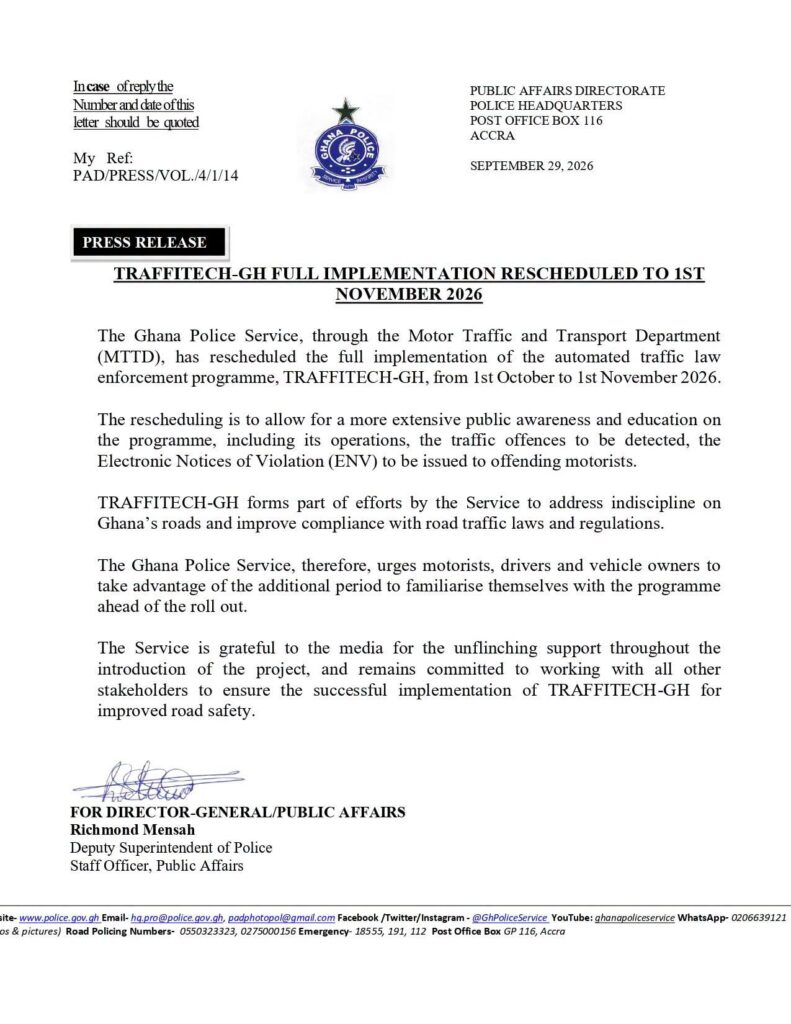
Ghana's government has delayed the rollout of its controversial Traffitech-GH SMS spot-fine system until 1st November 2026, giving motorists and stakeholders a final month to prepare for a radical shift in how traffic violations are punished. The technology-driven initiative aims to crack down on the epidemic of road deaths that claimed 2,949 lives in 2025, a sharp rise from 2,494 the previous year.
The system will deploy fixed cameras at 34 hazardous junctions, approximately 20 in-vehicle cameras, and 30 handheld laser devices to catch vehicles speeding, jumping red lights, and committing more than 45 other offences. When a violation is detected, the registered vehicle owner will receive an SMS from "GPS-MTTD" (Ghana's Motor Traffic and Transport Department) with fine details and 14 days to pay.
How the System Works and What It Costs
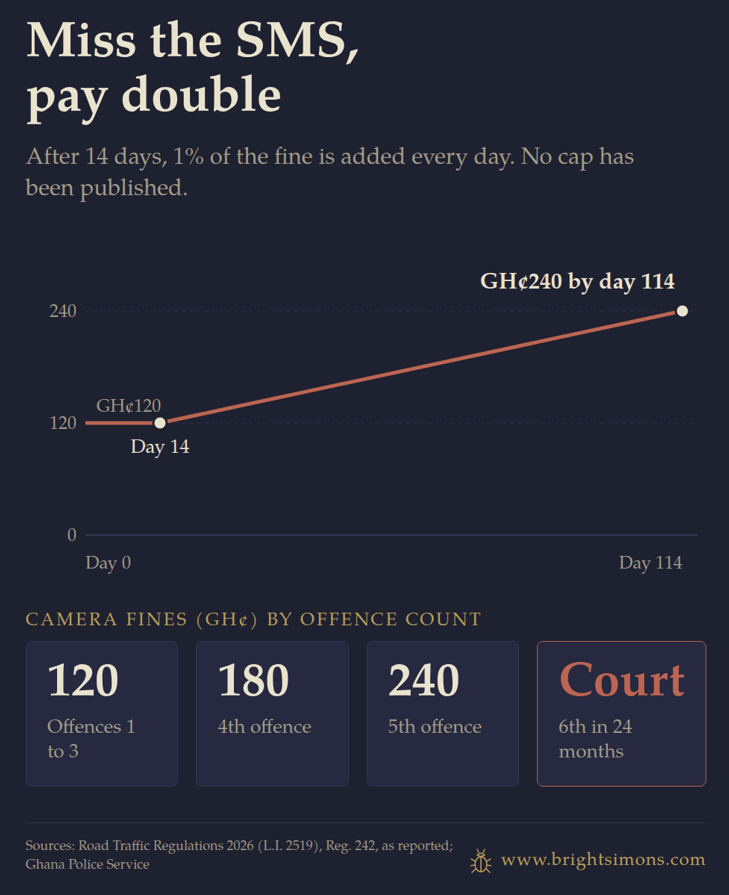
The fine structure is tiered: the first three violations within 24 months cost GH¢120 each, rising to GH¢180 for a fourth or fifth offence. A sixth violation within the same period can result in court proceedings and licence suspension for at least a year. Payment can be made through Ghana.gov, mobile money, or the USSD code *222#.
Critically, unpaid fines incur daily penalties: one per cent of the original fine is added every 24 hours after the 14-day grace period expires. This means a GH¢120 unpaid fine becomes GH¢240 after 100 days of non-payment, with no published cap on potential penalties. Motorists who fail to pay risk having their driving licence blocked through DVLA services, and officials have suggested Ghana Card restrictions may also apply. The system holds the registered vehicle owner liable regardless of who was actually driving—a provision likely to prove contentious.
A Two-Decade Journey with Uncertain Track Record
The Traffitech-GH initiative has a surprisingly long and troubled history. The concept originated around 2008, when entrepreneur Frank Osei established Nationwide Traffic Management and Enforcement Limited (NTMEL) and partnered with Swedish technology firm Sensys Gatso to develop the system. Osei had previously brokered government deals on tax stamps and fuel marking, earning credibility as a broker of major infrastructure projects.
However, implementation has repeatedly stalled. In 2016, Ghana committed to deploying the system in 2017. By 2018, President Akufo-Addo's road safety action plan directed a partnership with NTMEL and private towing companies, with GH¢335 million annually promised over three years. That effort collapsed. Another attempt came in 2021, when the Ministry of Finance valued the project at approximately US$9.9 million. The current agreement, signed on 23rd December 2022 for an 11-year concession (until December 2033), carries a reported investment cost of GH¢77.73 million (about US$7.3 million). By the end of 2025, approximately 120,000 caution notices had been sent, signalling imminent enforcement.
The Road Traffic Amendment Act, passed in December 2025, finally provided legal backing for automated enforcement, though only with a single mention of the mechanism.
Why This Matters for Ghana
Ghana's road safety crisis demands urgent intervention. With road deaths rising sharply and serious injuries reaching 16,714 in 2025, automated enforcement could deter reckless driving and shift behaviour more effectively than traditional policing alone. However, the system's success depends entirely on public trust and transparent implementation.
Key concerns remain: unclear penalty caps create potential for excessive financial burden on drivers; holding registered owners liable regardless of who drove risks punishing innocent parties; and the history of failed rollouts raises questions about whether this launch will finally stick. The one-month postponement provides an opportunity for the Ghana Police Service, MTTD, and government to conduct thorough public education and address citizen concerns about fairness and appeals procedures. Without strong sensitisation, the system risks becoming seen as a revenue-raising tool rather than a genuine safety measure—a perception that could undermine compliance and public support.
Source: The Ghana Report



Comments (0)
Be the first to comment.