
Ghana's MDPI Pushes Institutions to Invest in Staff Training as 2027 Budget Spotlights Productivity


Ghana's Management Development and Productivity Institute (MDPI) is stepping up pressure on both public and private sector organisations to treat staff training and capacity building as urgent national priorities, warning that the country's development ambitions risk falling flat without a serious push to improve workforce productivity across institutions.
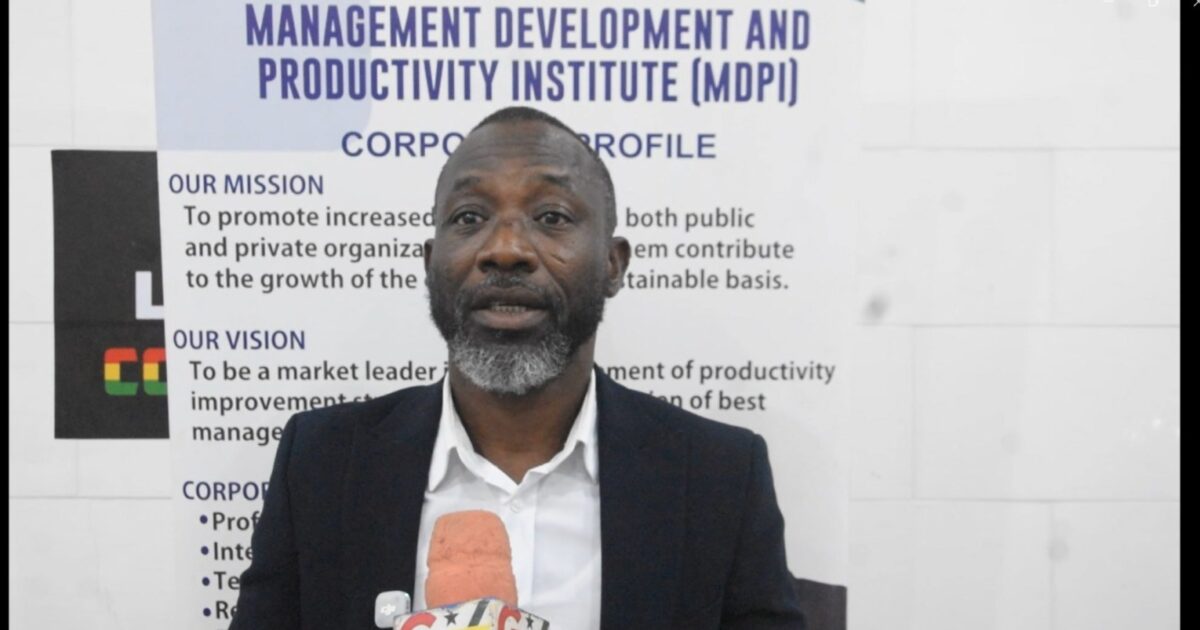
Director-General Prof. Elijah Yendaw made the call at an MDPI CEO Breakfast Meeting, where he outlined the institute's strategy to engage organisations ahead of 2027 and help them build the management and leadership capabilities needed to deliver results.
Productivity Takes Centre Stage in Ghana's 2027 Budget
Prof. Yendaw drew attention to the fact that productivity featured prominently in the budget statement recently presented by the Finance Minister, describing it as a signal that the government recognises the link between workforce capability and economic transformation.
"If you look at the budget statement that has just been presented by the Honourable Minister for Finance, you will realise that productivity is at the top of the budget," he said.
His remarks reflect a growing recognition in government circles that institutional inefficiencies — rooted in weak management practices, undertrained staff and poor leadership — remain a significant drag on Ghana's economic performance. The 2027 budget cycle appears to have created a window of opportunity for institutions to align their internal planning with a national productivity agenda, and MDPI is positioning itself as the vehicle through which that alignment can happen.
MDPI Already in Talks with Key State Institutions
The institute has not waited for organisations to come to it. Prof. Yendaw disclosed that MDPI has already held engagements with a range of influential public bodies — including the Bank of Ghana, the Ghana Revenue Authority, the Northern Development Authority, the Pharmacy Council and the Youth Employment Agency — to assess their specific training needs and design targeted capacity-building programmes.
These consultations, he explained, are part of a deliberate strategy to help institutions embed relevant training initiatives into their 2027 plans, rather than treating staff development as an afterthought. The focus is on strengthening leadership at the top, improving middle management and equipping frontline workers with practical skills that translate into better service delivery.
What This Means for Ghana's Development Goals
Ghana has long grappled with the gap between policy ambition and on-the-ground delivery. Well-designed programmes frequently struggle to achieve their intended outcomes, not because of a lack of resources alone, but because the human capital required to implement them effectively is often underdeveloped. Prof. Yendaw's argument — that productivity improvement must be treated as a shared responsibility involving government, public institutions and the private sector — speaks directly to this structural challenge.
For the private sector, the MDPI push carries equally significant implications. Businesses operating in a competitive regional environment, particularly as Ghana looks to deepen its integration within ECOWAS and capitalise on the African Continental Free Trade Area, need workforces that are skilled, adaptable and well-managed. Institutions that invest in training now are likely to gain a competitive edge as the economy evolves.
- Job creation and poverty reduction: Prof. Yendaw linked improved institutional capacity directly to Ghana's broader goals of creating decent jobs and reducing poverty — outcomes that depend on both a capable public sector and a productive private sector.
- A collaborative model: MDPI is not positioning itself as a top-down regulator but as a partner, working with organisations to understand their unique needs and tailor programmes accordingly.
- Long-term vision: The institute's work forms part of Ghana's wider ambition to become a first-class economy, a goal that requires not just infrastructure investment but sustained investment in people.
With the 2027 planning cycle now underway, institutions that delay prioritising staff training risk being left behind — both in terms of internal performance and their contribution to the national agenda.
Source: The Ghana Report




Comments (0)
Be the first to comment.