
Agalga Hails 2027 Budget as a Break from Ghana's Debt-Driven Development Model
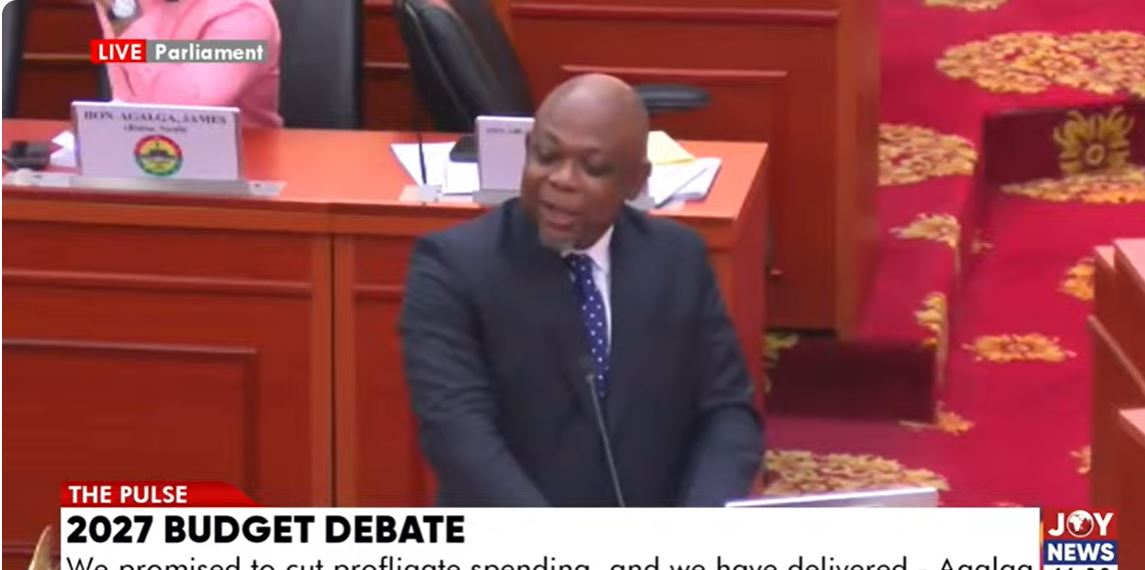

Ghana's Majority Leader, James Agalga, has thrown his weight behind the 2027 Budget Statement, describing it as a turning point in how the country finances its development — one that deliberately moves away from the borrowing-heavy approach that has defined Ghanaian fiscal policy for decades. Speaking on the floor of Parliament on Thursday, 26th November, during the formal debate on the budget, Mr Agalga argued that the document charts a more responsible economic course for the country.
A Budget That Rejects the Debt Cycle
At the heart of Mr Agalga's defence was the argument that Ghana does not need to accumulate more debt in order to grow. He criticised what he described as a long-held but damaging assumption — that development must necessarily be paid for by borrowing, leaving successive generations to bear the financial consequences.
"For too long, our people have been told that progress must come with pain, that development must be financed by more debt, and that the only way to move this country forward is to load the next generation with more loans. This budget rejects this thinking. It is a budget of restraint with purpose. It is a budget that says we can build without mortgaging tomorrow," Mr Agalga told Parliament.
The Majority Leader credited Finance Minister Dr Cassiel Ato Forson for steering the government's fiscal consolidation effort, saying the administration had made good on its pledges to cut wasteful public spending and bring borrowing under control. "We promised to cut profligate spending, and we have delivered. We promised to reduce borrowing. Thanks to the efforts of Dr Ato Forson, we have delivered," he said.
Key Economic Indicators Cited in Parliament
To back up his claims, Mr Agalga pointed to a number of economic metrics he said demonstrate measurable progress under the current administration. He noted that inflation had fallen to 5.5 per cent in October, down from 8 per cent recorded during the same month the previous year — a significant reduction that will be welcome news for Ghanaian households who have endured years of rising prices.
On public debt, Mr Agalga placed Ghana's total debt stock at GH¢759.3 billion, with a debt-to-GDP ratio of 47.5 per cent. He presented these figures as evidence that the government's restraint on borrowing is producing real results, with the debt burden declining relative to the size of the economy.
Why It Matters for Ghana
Ghana has spent much of the past several years navigating one of its most difficult economic periods, culminating in a sovereign debt restructuring programme supported by the International Monetary Fund. The country has had to renegotiate terms with both external creditors and domestic bondholders — a painful process that wiped out savings for many Ghanaians and rattled investor confidence.
Against that backdrop, the framing of the 2027 Budget as a document of fiscal discipline carries considerable weight. If the government can demonstrate that it is genuinely reducing its reliance on borrowing while keeping inflation in check, it would mark a meaningful shift in Ghana's economic trajectory and potentially strengthen the country's standing with international lenders and investors.
- Critics and opposition members are likely to scrutinise whether the budget's spending commitments are realistic without recourse to new borrowing.
- The declining inflation figure, if sustained, could ease pressure on the Bank of Ghana to keep interest rates elevated — which in turn would lower the cost of credit for businesses and consumers.
- Ghana's ability to exit its IMF programme successfully will depend in large part on whether the fiscal targets outlined in budgets like this one are actually met.
The debate on the 2027 Budget Statement continues in Parliament, with contributions expected from both sides of the House before the document is put to a vote.
Source: MyJoyOnline


Comments (0)
Be the first to comment.