
Ghana's electricity meter certification deadline: what consumers need to know by 2028
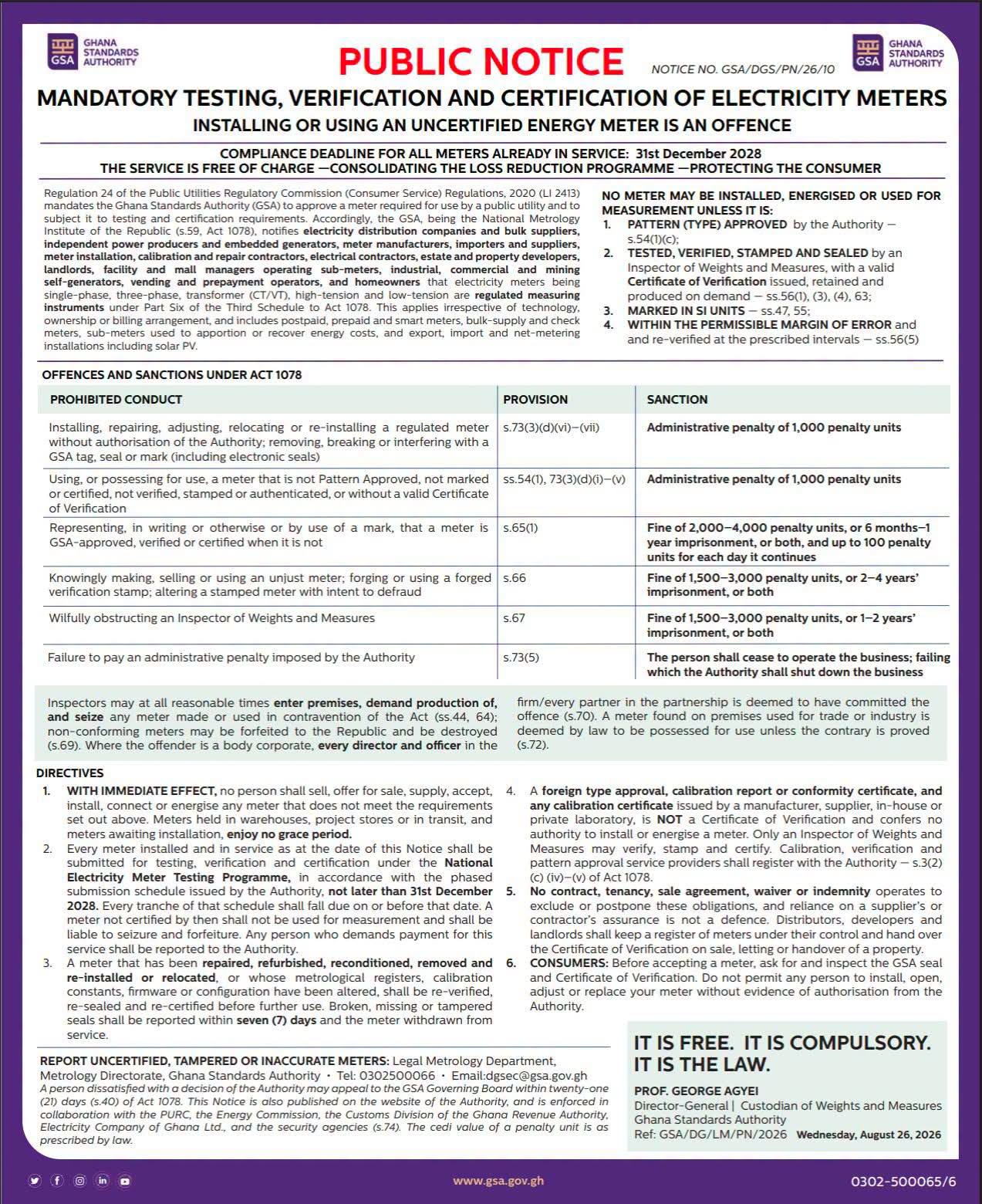
Ghana's regulatory authorities have set a firm deadline for one of the country's most ambitious consumer protection initiatives: every electricity meter in use across the nation must undergo official testing, verification and certification by December 31, 2028. The Ghana Standards Authority (GSA) announced the requirement through a public notice issued in August 2026, signalling the start of a nationwide programme designed to eliminate faulty meters and ensure Ghanaians pay only for the electricity they actually consume.
The National Electricity Meter Testing Programme represents a critical intervention in Ghana's battle against revenue losses in the power sector. For decades, inaccurate meters have been a persistent problem—whether through wear, poor maintenance, or deliberate tampering—resulting in inflated bills for consumers and reduced revenue for electricity distribution companies. The GSA's initiative tackles both issues simultaneously, protecting household budgets whilst strengthening the financial health of the power utilities.
What sets this programme apart is its accessibility: testing and certification services are being provided free of charge to all stakeholders, from individual homeowners to large industrial consumers, meter manufacturers, importers, contractors, landlords, and facility managers. This removes financial barriers that might otherwise prevent compliance and signals government commitment to making the exercise a genuine national effort rather than a burden on citizens.
Who must participate and what the rules are
The certification requirement is comprehensive in scope. Every electricity metre already installed and in operation must be submitted for testing under a phased national schedule. New metres, before installation, must be pattern-approved by the GSA, tested, verified, stamped and sealed. Each metre must also carry a valid Certificate of Verification from an Inspector of Weights and Measures and be marked with correct units, operating within approved error margins.
The GSA has been explicit about enforcement. Metres that fail to meet standards will be seized and forfeited to the state; in some cases they may be destroyed. The Authority has established a graduated penalty system for violations:
- 1,000 penalty units for installing, repairing or tampering with a metre without approval, or removing GSA seals
- 1,000 penalty units for using an uncertified metre
- 2,000–4,000 penalty units plus up to one year in prison for falsely claiming a metre is certified
- 1,500–3,000 penalty units plus two to four years in prison for knowingly using unjust metres, forging stamps, or intentional fraud
- 1,500–3,000 penalty units plus one to two years in prison for obstructing GSA inspectors
Why it matters for Ghana
This initiative addresses a longstanding pain point for Ghanaian consumers: disputed electricity bills. Many households have reported sudden spikes in charges with no obvious explanation, leading to distrust of distribution companies and disputes over payment. Accurate metres are the foundation of transparent billing and consumer confidence.
For the power sector itself, revenue protection is essential. Ghana's electricity companies have struggled with technical and commercial losses—partly due to faulty or tampered metres—that ultimately drive up costs for all users. By restoring metre accuracy, the programme aims to reduce these losses, improving the financial position of utilities and potentially stabilising tariffs over time.
The deadline of December 2028 provides a two-year window for compliance. Consumers should begin identifying their metre details now and monitor for updates on when their area will be included in the phased testing schedule. Early participation is advisable to avoid last-minute queues or potential service disruptions if metres are seized for non-compliance.
The GSA's emphasis on free certification and wide stakeholder involvement suggests the government views this as a shared responsibility across the entire electricity ecosystem. For Ghanaians, it represents a rare regulatory action explicitly designed to protect household finances whilst strengthening national infrastructure.
Source: The Ghana Report

Comments (0)
Be the first to comment.