
Ghana Customs Clamps Down on Right-Hand Steering Vehicle Imports, Demands Ministry Permits
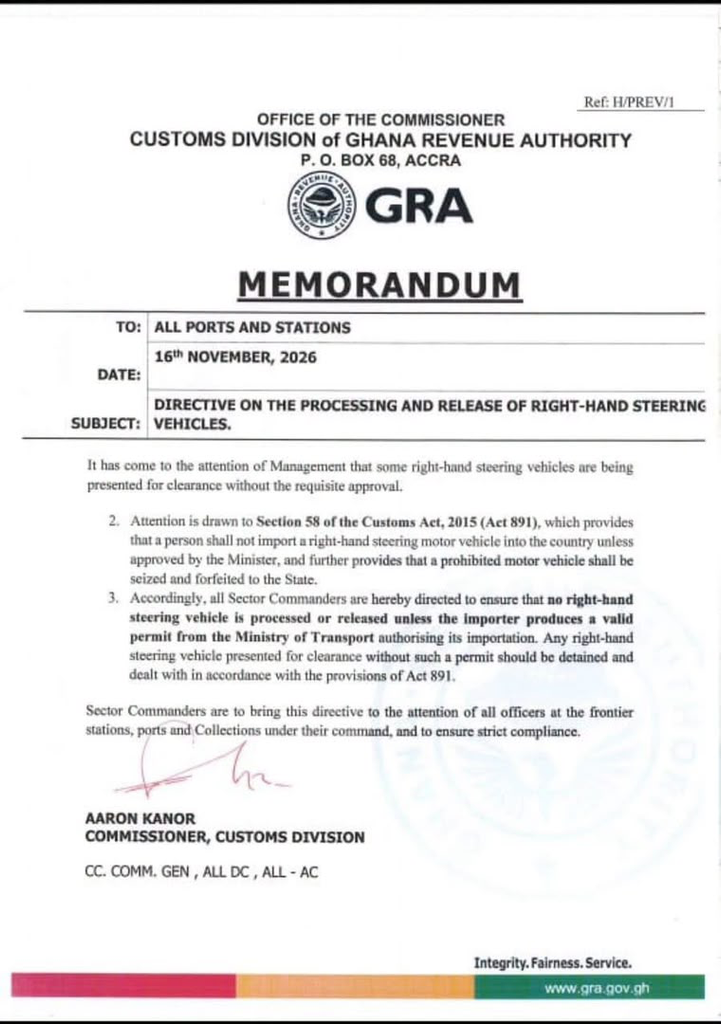

Ghana's Customs Division has issued a firm directive ordering all officers at ports, frontier stations and collection points across the country to stop processing or releasing right-hand steering vehicles that arrive without valid permits from the Ministry of Transport. The move signals a tightening of enforcement around a long-standing but inconsistently applied import regulation.
What the directive says
The directive, signed by Customs Commissioner Aaron Kanor, was triggered by reports that some importers were presenting right-hand steering vehicles for clearance without the required ministerial authorisation. Under the instruction, Sector Commanders are required to ensure that every importer of such vehicles produces a permit issued by the Ministry of Transport before any processing or release takes place.
Vehicles presented without the necessary documentation are to be detained immediately. The directive explicitly invokes Section 58 of the Customs Act, 2015 (Act 891), which prohibits the importation of right-hand steering motor vehicles unless the Minister of Transport grants specific approval. Detained vehicles are liable to be seized and forfeited to the state in line with the provisions of that Act.
Crucially, the directive does not constitute a blanket ban on all right-hand steering vehicles. It makes ministerial approval a firm precondition for clearance rather than an outright prohibition — meaning legitimate importers who obtain the proper permit may still bring in such vehicles lawfully.
Why it matters for Ghana
Ghana drives on the right-hand side of the road, which makes left-hand steering vehicles the standard for road safety. Right-hand steering vehicles — where the driver sits on the right side — are designed for countries like the United Kingdom, Japan and South Africa that drive on the left. When operated on Ghana's roads, they can pose significant safety risks because the driver's visibility for overtaking and navigating junctions is severely compromised.
Despite this, right-hand drive vehicles have continued to find their way into the country, often sourced cheaply from used-car markets abroad. Critics have long argued that lax enforcement at ports has allowed such vehicles to enter the Ghanaian market, contributing to road accidents. Ghana already has one of the more concerning road safety records in West Africa, making the regulation of vehicle standards a matter of genuine public interest.
The directive also has economic implications. Some vehicle dealers and importers have built informal supply chains around cheaper right-hand drive stock, particularly from the United Kingdom and Japan. A stricter enforcement regime could disrupt that trade, raise vehicle prices for consumers or push some operators to pursue the formal permit route they had previously bypassed.
What happens next
Sector Commanders have been tasked with communicating the directive down the chain of command to every officer at frontier stations, ports and collections under their authority. Strict compliance is expected, and any vehicle detained under the order will be dealt with according to Act 891's enforcement provisions, which include forfeiture to the state.
For importers currently holding or expecting shipments of right-hand steering vehicles, the message is clear: securing a permit from the Ministry of Transport is no longer optional — it is a legal requirement that will be actively enforced at the point of entry. Those who proceed without one risk losing their vehicles entirely.
- Customs Division orders detention of right-hand steering vehicles lacking Ministry permits.
- Section 58 of the Customs Act 2015 (Act 891) underpins the crackdown.
- Detained vehicles may be seized and forfeited to the state under the Act.
Source: MyJoyOnline




Comments (0)
Be the first to comment.