
Ga Traditional Council cracks down on illegal use of chief titles by Chamba group
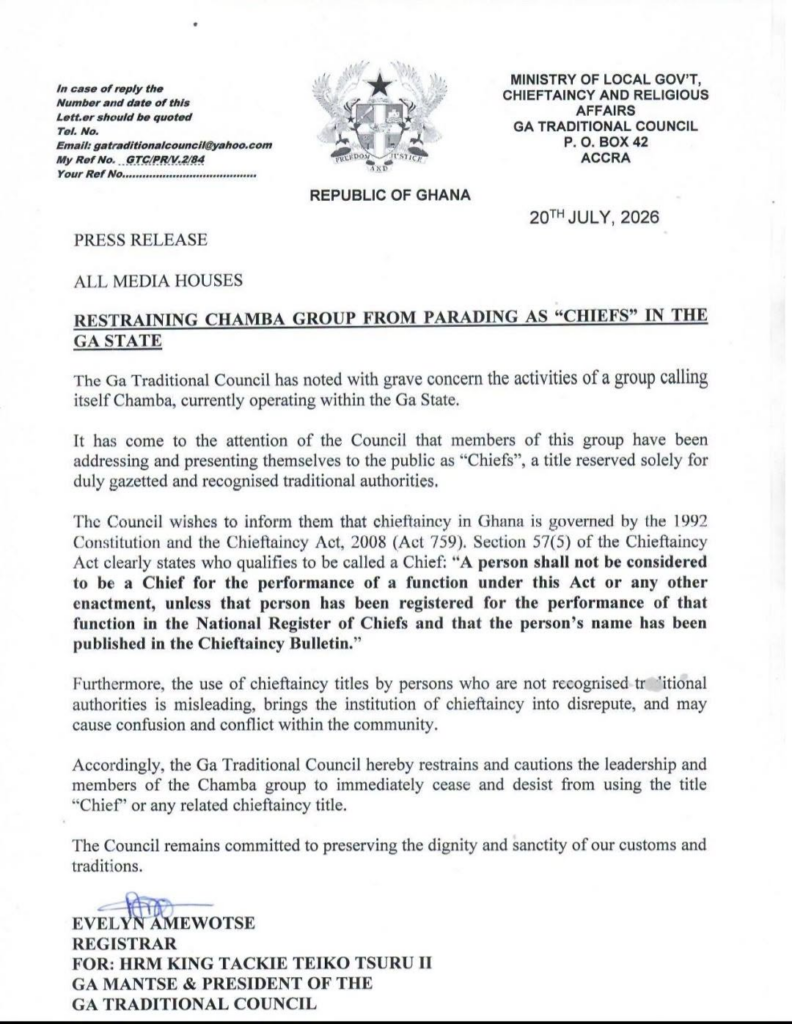

The Ga Traditional Council has taken decisive action against a group known as Chamba, issuing a formal caution against the unauthorised use of chieftaincy titles within Ga State. In a statement released by the Council's Registrar, Evelyn Amewotse, on behalf of Ga Mantse HRM King Tackie Teiko Tsuru II, the traditional authority made clear that the practice violates Ghana's established legal framework governing chieftaincy.
The core issue centres on members of the Chamba group publicly presenting and introducing themselves as "Chiefs"—a title that under Ghanaian law can only be legitimately held by individuals who have been officially recognised and formally gazetted through the proper chieftaincy procedures. According to the statement, this unauthorised appropriation of traditional titles has caught the attention of the Ga Traditional Council, which now demands immediate cessation of the practice.
Legal basis for the caution
The Ga Traditional Council grounded its directive in Ghana's constitutional and statutory provisions. The 1992 Constitution and the Chieftaincy Act, 2008 (Act 759)—specifically Section 57(5)—establish that an individual cannot legally be regarded as a chief for the execution of official duties unless their name has been officially recorded in the National Register of Chiefs and subsequently published in the Chieftaincy Bulletin. These requirements exist to ensure the integrity and transparency of Ghana's chieftaincy system, which remains central to traditional governance across the country.
The Council also cautioned that the unauthorised use of chieftaincy titles poses several risks: it can mislead the public about the legitimacy and authority of individuals, diminish the dignity of the institution itself, and create confusion within communities about who holds actual traditional authority and responsibility.
Why it matters for Ghana
This action by the Ga Traditional Council reflects ongoing tensions between informal or self-appointed leadership structures and the formal, legally-recognised chieftaincy system that Ghana has codified through its Constitution and legislation. Ghana's chieftaincy institution is not merely ceremonial—chiefs hold legal recognition and play important roles in land administration, dispute resolution, and community governance, particularly in customary matters. Allowing individuals to falsely claim chieftaincy titles without proper gazetting undermines public confidence in the system and can create practical problems in communities where legitimate chiefs are needed for official functions.
The Chamba group's activities appear to represent a broader challenge that traditional councils across Ghana periodically face: the emergence of groups or individuals claiming traditional authority without following established procedures. By acting decisively, the Ga Traditional Council is reasserting the principle that chieftaincy in Ghana is a regulated institution governed by both written law and customary practice, not something that can be self-appointed or claimed informally.
The Council's commitment
In its statement, the Ga Traditional Council reaffirmed its dedication to protecting the integrity and sanctity of Ga customs and traditions. The Council's position emphasises that proper governance of chieftaincy through legal channels and customary processes remains essential to maintaining social order and protecting the institution's credibility. The directive to the Chamba group is unequivocal: all members must immediately cease using the title "Chief" or any associated traditional titles.
Source: The Ghana Report



Comments (0)
Be the first to comment.