
The Partisan Trap: How Blind Party Loyalty Is Costing Ghana Its Future
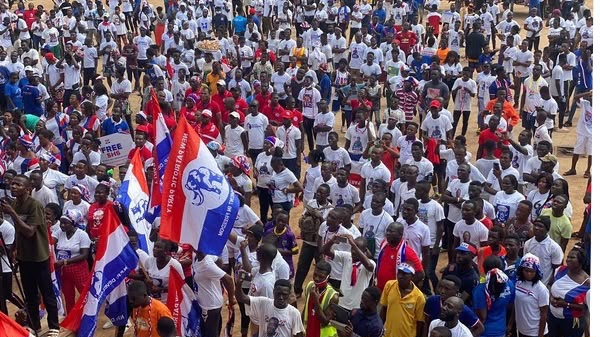

Every morning across Ghana, the same political theatre plays out — on radio, on television, in offices, in taxis and at the dinner table. The ruling government makes an announcement, the opposition holds a press conference to contradict it, and their respective supporters flood social media and airwaves to defend or attack. Meanwhile, the ordinary Ghanaian — struggling with the cost of living, unemployment, erratic utilities and crumbling public services — watches from the sidelines, largely forgotten in the noise.
This is Ghana's partisan dilemma in plain sight: a political culture so deeply divided by loyalty to the National Democratic Congress (NDC) and the New Patriotic Party (NPP) that the line between supporting a party and demanding accountability from it has almost entirely disappeared.
When loyalty becomes a blindfold
Political parties are, of course, indispensable to any functioning democracy. They offer voters competing visions, organise civic participation and enable peaceful transfers of power. Ghana has much to be proud of in this regard — its democratic transitions remain a benchmark on the African continent. But there is a critical difference between supporting a political party and surrendering one's independent judgement to it.
When a public official faces credible allegations of corruption or misconduct, the instinctive response from their party's supporters is rarely to call for investigation. More often, it is to question the credibility of investigators, attack the character of accusers, or pivot swiftly to the sins of the opposing party. The counter-accusation becomes the defence. Historical wrongdoing by the other side is invoked not to provide context but to neutralise accountability altogether.
This creates an exhausting cycle. Who borrowed more? Who built more roads? Which administration was more corrupt? These comparisons, while sometimes legitimate, are routinely weaponised to ensure that no government — past or present — is ever truly held responsible for anything. A country cannot make genuine progress when every demand for accountability is answered with a counter-accusation rather than a response.
Why it matters for Ghana
The consequences of this culture extend well beyond political debate. When citizens become more invested in the fortunes of their political side than in the wellbeing of the country, governance suffers. Public institutions — the judiciary, anti-corruption bodies, regulatory agencies — lose public trust not because they are necessarily failing, but because partisans on either side selectively accept or reject their findings depending on who is being investigated.
This dynamic, sometimes described as motivated reasoning, means that the same action is judged entirely differently depending on which party carries it out. A policy celebrated as visionary under one government is dismissed as reckless under another. An allegation treated as urgent when it involves the opposition is treated as fabricated when it involves one's own party. Over time, truth itself becomes a partisan concept.
The deeper damage is psychological and civic. When political identity becomes so central to a person's sense of belonging and community, criticism of the party starts to feel like a personal attack. Citizens begin to feel accountable to political parties, rather than the other way around. The fundamental question — is this government serving the Ghanaian people well? — is quietly replaced by a more tribal one: what does this mean for our side?
Ghana's development challenges are real and urgent. Youth unemployment remains high, public healthcare and education systems face chronic underfunding, and the economy continues to recover from significant external and domestic shocks. These are not NDC problems or NPP problems — they are Ghanaian problems, and they demand Ghanaian solutions built on honest assessment rather than partisan theatre.
A way forward
None of this means Ghanaians should abandon political affiliation. Healthy party competition is a democratic strength. But there is a meaningful distinction between being a committed party supporter and being an unconditional one. The former holds their preferred party to high standards precisely because they care about its legacy. The latter defends every action regardless of merit, and in doing so, lowers the bar for everyone.
Civil society, the media and Ghana's growing educated youth population have a particular role to play in breaking the partisan cycle — by insisting on consistent standards, demanding evidence before rushing to judgement, and refusing to let yesterday's wrongdoing excuse today's. Accountability, after all, is not a weapon to be deployed selectively against opponents. It is the foundation upon which a better Ghana must be built.
Source: The Ghana Report




Comments (0)
Be the first to comment.