Supreme Court's 'One Member, One Vote' Ruling Tackles Ghana's Vote-Buying Crisis in Party Elections
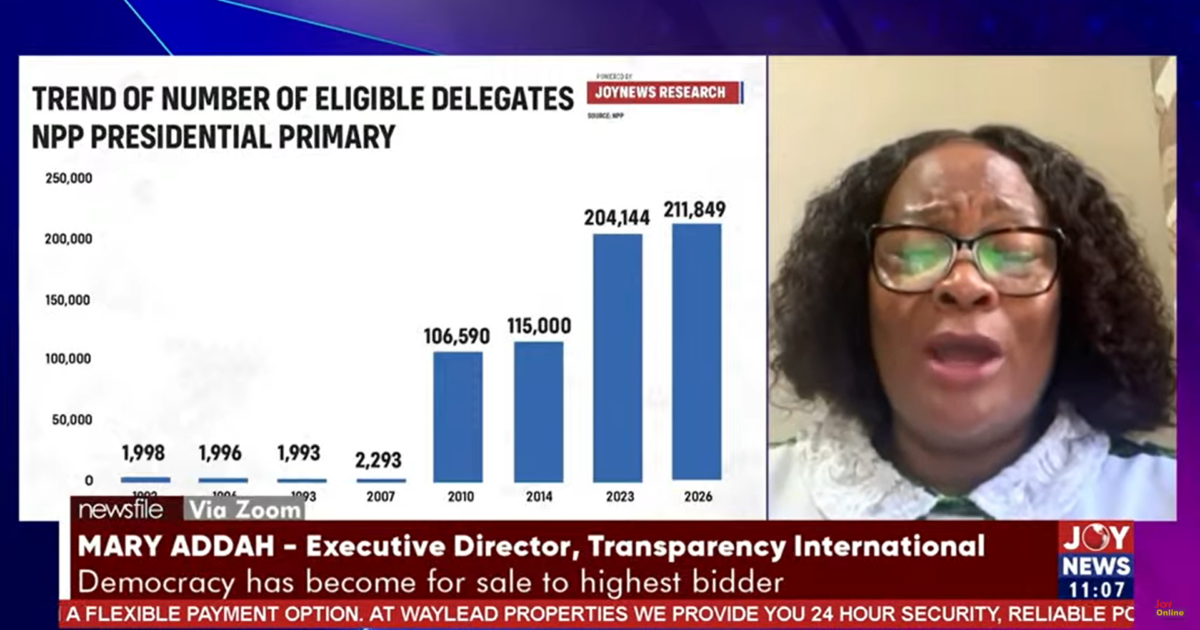
Ghana's Supreme Court has delivered a landmark ruling that fundamentally reshapes how political parties conduct internal elections, with anti-corruption experts arguing the decision directly addresses the persistent problem of vote-buying that has plagued the country's party politics. The 5–2 majority judgment, delivered on Wednesday, requires all registered members in good standing to participate in electing party leaders and candidates for parliamentary and presidential contests, effectively dismantling the delegate system that has dominated for decades.
Mary Awelana Addah, Executive Director of Transparency International Ghana, argues that the justices would have been acutely aware of vote-buying realities when reaching their conclusion. Speaking on JoyNews' Newsfile, she emphasised that the court's decision reflects a careful understanding of Ghana's political landscape, where financial inducements have become a visible feature of internal party contests.
The Vote-Buying Reality in Ghana's Party Politics
Ms Addah rejected assertions from some political actors that vote-buying during party elections is merely speculative or unsubstantiated. She pointed out that election monitoring organisations and governance watchdogs have documented numerous instances demonstrating the influence of money in political processes. However, the real challenge lies not in the visibility of these practices but in the weakness of evidence collection and enforcement mechanisms that make prosecution difficult.
"They also live in Ghana and they have seen, and when our politicians say vote-buying is an issue of conjecture, I believe they are dreaming," Addah stated, emphasising that the practice is well-known within political circles despite the legal difficulty in securing convictions.
She highlighted a critical gap: whilst organisations have captured evidence of electoral misconduct, the absence of robust documentation systems and weak investigative frameworks have prevented successful legal action. This enforcement weakness should not be misinterpreted as proof that vote-buying does not exist, she argued, but rather as a signal that stronger accountability measures are urgently needed.
Why This Matters for Ghana's Democracy
The Supreme Court's decision carries profound implications for Ghana's internal party democracy and the broader political system. By expanding voting rights from a small group of delegates to the entire party membership, the ruling aims to dilute the concentration of influence that has historically created opportunities for vote-buying and manipulation.
The delegate system, which limited voting to party-selected representatives, created a bottleneck where wealthy politicians and party elites could more easily exert influence through financial inducements. With thousands of party members now eligible to vote instead of a few hundred delegates, the cost and logistics of such operations become exponentially more difficult.
Implementation, however, will present significant challenges. Political parties must now revise their constitutions and electoral processes to comply with the ruling, whilst managing the logistical and financial burdens of conducting elections across broader membership bases. The judgment also raises questions about how parties will manage voting processes, prevent fraud, and ensure genuine participation across their memberships.
What Lies Ahead
The ruling is expected to reshape upcoming presidential, parliamentary and executive primaries. Political parties face immediate pressure to demonstrate compliance with the new system, though the transition period may reveal practical difficulties in implementation.
Addah's comments underscore a broader point: Ghana's anti-corruption advocates view this court decision not as an end to vote-buying concerns but as a structural intervention designed to make corrupt practices more difficult, visible and costly. The real test will come when parties attempt to implement the system and whether stronger enforcement mechanisms accompany the legal change.
Source: MyJoyOnline



Comments (0)
Be the first to comment.