
Presidency Orders Overaged State CEOs to Step Down as Mahama Enforces Constitutional Retirement Rules
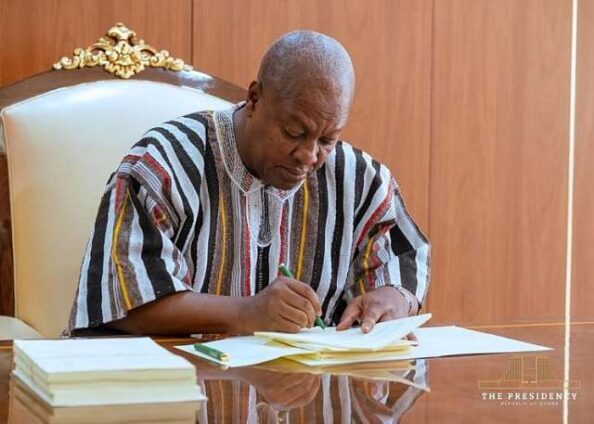

Ghana's Presidency has moved to enforce long-standing constitutional provisions on retirement age for heads of state-owned institutions, directing ministers to ensure that chief executives who have exceeded the lawful limit vacate their positions without delay. The instruction, issued by the Secretary to the President, Dr Callistus Mahama, signals a firmer approach to public sector governance under President John Mahama's administration.
What the directive says
In a letter dated 23rd November 2026, ministers were told to identify chief executives under their oversight who have either reached or surpassed the compulsory retirement age of 60 as stipulated under Article 199 of the 1992 Constitution, and to ensure those individuals submit formal handing-over notes to their respective Boards or Councils promptly.
The directive targets three specific categories of state CEOs: those who have turned 60 but are serving without a valid post-retirement contract; those whose re-engagement contracts have already expired; and those who have exhausted the maximum permissible period of re-engagement. It also requires CEOs whose lawful tenures are approaching an end to submit handing-over notes by their last official day in office.
The handing-over notes are expected to cover ongoing programmes, unresolved decisions and financial commitments, as well as matters requiring urgent attention from the relevant Board or Council. This ensures institutional continuity even as leadership transitions take place.
The constitutional background
Article 199 of Ghana's 1992 Constitution sets 60 as the compulsory retirement age for public officers. However, Article 199(4) provides a degree of flexibility — an appointing authority may re-engage a retired public officer where the operational needs of the service genuinely require it. Such re-engagements are permitted in periods of up to two years at a time, but cannot exceed five cumulative years in total. This means that a chief executive re-engaged from the age of 60 must, under all circumstances, leave office by the age of 65.
Despite these clear provisions, it is not uncommon in Ghana's public sector for state CEOs to remain in post beyond the constitutional ceiling — sometimes through expired contracts that are neither renewed nor terminated, or through administrative inertia within supervising ministries. The latest directive appears designed to close those loopholes and restore consistency across public institutions.
Why it matters for Ghana
The enforcement of retirement limits in state institutions carries significant implications for public sector reform and accountability in Ghana. When CEOs remain in office beyond their lawful tenure, it can create governance uncertainties — including questions about the validity of decisions taken, contracts signed, or appointments made during the overstay period.
Beyond legality, enforcing age limits can open the door to fresh leadership in agencies and state-owned enterprises, potentially injecting new energy and ideas into institutions that play a critical role in service delivery. Ghana's state institutions — ranging from utility companies to regulatory bodies and development authorities — are central to the government's ability to implement national policy, and their effective governance directly affects the lives of ordinary citizens.
The directive also places a clear burden of accountability on ministers. By making sector ministers responsible for compliance within their portfolios, the Presidency is reinforcing the principle that political oversight of state agencies must be active and consistent, not merely ceremonial.
- Critics of Ghana's public sector have long pointed to weak enforcement of existing rules as a key governance challenge, and this move may be seen as a step towards addressing that concern.
- It remains to be seen how swiftly ministries will act and whether the directive will be uniformly applied across all sectors, including those where certain CEOs may have strong political backing.
The Presidency has not publicly named any specific individuals affected by the directive, keeping the communication procedural rather than targeted at particular officeholders.
Source: Today GH



Comments (0)
Be the first to comment.