NDC Volta communicator slams NPP's democracy protest as 'self-serving political theatre'
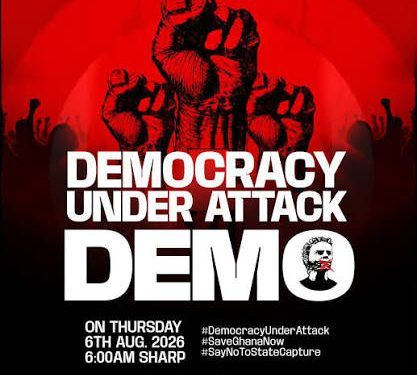
A prominent National Democratic Congress (NDC) communicator from Ghana's Volta Region has launched a scathing attack on the New Patriotic Party's recent 'Democracy Under Attack' demonstration, characterising the protest as a calculated political manoeuvre rather than a genuine civic concern.
The NDC official, speaking through his Facebook platform on Thursday, August 6, 2026, argued that the NPP's demonstration represents a deliberate attempt to reshape the political narrative, escape responsibility for its governance record, and manufacture artificial public backing that lacks authentic foundation.
The criticism reflects the deepening partisan tensions surrounding how Ghana's two major political parties frame recent political events and institutional challenges. The exchange underscores the sharp divide in how the governing NDC and opposition NPP interpret similar circumstances and communicate their respective positions to voters.
The backdrop: Ghana's political temperature
Ghana's political landscape has been characterised by heightened scrutiny of democratic institutions in recent months. Both major parties have mobilised their communications machinery to contest narratives about governance, accountability, and the state of democratic practice. The NDC's characterisation of the NPP protest as 'self-serving' suggests the party views the demonstration as divorced from legitimate institutional concerns and instead motivated by partisan advantage ahead of electoral competition.
The Volta Region, a traditional NDC stronghold, remains a critical battleground in Ghana's political competition. Communications from regional party operatives often serve as bellwethers for how each party intends to frame national issues during electoral cycles. This particular intervention suggests the NDC is moving quickly to counter the NPP's framing of democracy and accountability concerns.
Why it matters for Ghana
The exchange between these political communicators highlights a broader challenge facing Ghana's democratic system: the difficulty of establishing shared truth about institutional performance and political conduct. When major parties fundamentally disagree on whether concerns about democratic integrity are genuine or manufactured, the foundation for constructive political dialogue erodes.
For ordinary Ghanaians, these competing narratives create confusion about where legitimate institutional problems exist and how seriously to treat claims from either side. Citizens attempting to hold leaders accountable struggle when political parties exploit genuine concerns for partisan positioning, or conversely, when legitimate institutional anxieties are dismissed as mere theatre.
The timing and intensity of such exchanges also matter: as Ghana approaches electoral periods, communications from political parties become more aggressive and less nuanced. What might be addressed through institutional dialogue often becomes fodder for public campaigns designed to mobilise supporters rather than resolve underlying problems.
The NDC's characterisation of the NPP demonstration as an attempt to 'alter political history' and 'evade accountability' suggests the party believes the opposition is attempting to distract from its record whilst in government. This counter-narrative will likely shape how NDC supporters interpret the NPP's actions, whilst the NPP will continue advancing its own institutional concerns. The challenge for Ghana remains ensuring that legitimate democratic concerns—from whichever quarter they emerge—are addressed on their merits rather than dismissed based purely on their political source.
Source: 3News


Comments (0)
Be the first to comment.