Mahama Pardons 863 Prisoners to Mark Ghana's 70th Independence Milestone
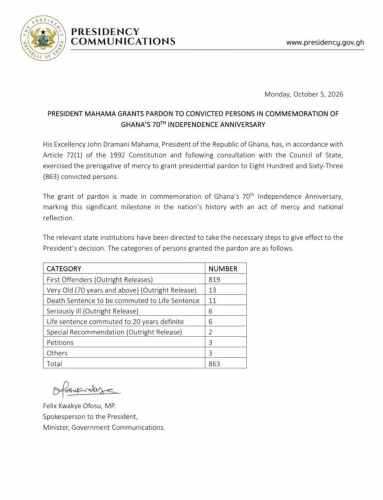
President John Dramani Mahama has extended presidential pardons to 863 convicted individuals in a sweeping act of mercy timed to coincide with Ghana's 70th Independence Anniversary celebrations. The decision, announced by the Presidency on Monday, October 5, 2026, represents a significant use of the President's constitutional prerogative and signals a moment of national reflection as the country marks seven decades of independence since 1957.
The pardon was granted in accordance with Article 72(1) of Ghana's 1992 Constitution, following formal consultation with the Council of State—a requirement that ensures such decisions receive appropriate scrutiny before implementation. The Presidency characterised the action as an act of mercy aligned with the significance of the independence milestone.
Who Benefits from the Pardon
The 863 beneficiaries represent a diverse cross-section of Ghana's prison population. The largest cohort consists of 819 first-time offenders who have been granted outright release, reflecting a policy focus on rehabilitation and second chances for those without repeated convictions.
Thirteen individuals aged 70 years and above have also received unconditional release, acknowledging both their age and humanitarian considerations. Six seriously ill prisoners will similarly be freed, prioritising medical grounds for release.
The pardon extends to more serious cases as well. Eleven persons serving death sentences will have their sentences commuted to life imprisonment, while six others with life sentences will have them reduced to 20 years definite. Two individuals recommended through special channels and three persons whose cases were processed through petitions have also been granted outright release, alongside three others falling under miscellaneous categories.
The Constitutional Framework and Implementation
Presidential pardons in Ghana operate under established constitutional mechanisms designed to balance executive mercy with democratic oversight. The requirement to consult the Council of State ensures that such significant decisions are not made unilaterally, adding a layer of institutional review to the process.
The Presidency has directed all relevant state institutions—including the Ghana Prison Service, the Attorney General's Office, and related agencies—to implement the President's decision without delay. This administrative directive will trigger the necessary paperwork, verification processes, and logistical arrangements to effect the releases and sentence commutations.
Why This Matters for Ghana
Presidential pardons carry symbolic weight in any nation, but particularly in Ghana where they intersect with constitutional democracy, human rights, and prison reform conversations. This action comes at a moment when Ghana's criminal justice system faces ongoing discussions about overcrowding, rehabilitation versus punishment, and the treatment of elderly and vulnerable inmates.
The timing during the 70th independence anniversary suggests the government is framing the pardon as a national gesture of reconciliation and mercy—values often associated with independence and renewal. For families of the 863 individuals affected, the decision represents a direct change in circumstances and potential reunification.
The pardon also reflects broader global trends in criminal justice reform, where jurisdictions increasingly recognise that blanket incarceration may not serve public safety or rehabilitation goals equally. The focus on first-time offenders and vulnerable populations signals a differentiated approach to mercy, rather than universal clemency.
For Ghana's international standing, such acts of mercy can demonstrate a functioning constitutional system where the executive exercises power within legal and institutional bounds. The consultation with the Council of State underscores that Ghana's governance structures operate with checks and balances.
As implementation proceeds over coming weeks, attention will likely focus on how smoothly the releases occur and what support structures exist for reintegration into society—a critical factor in determining whether the pardon achieves its intended humanitarian goals.
Source: Ameyaw Debrah
Comments (0)
Be the first to comment.