
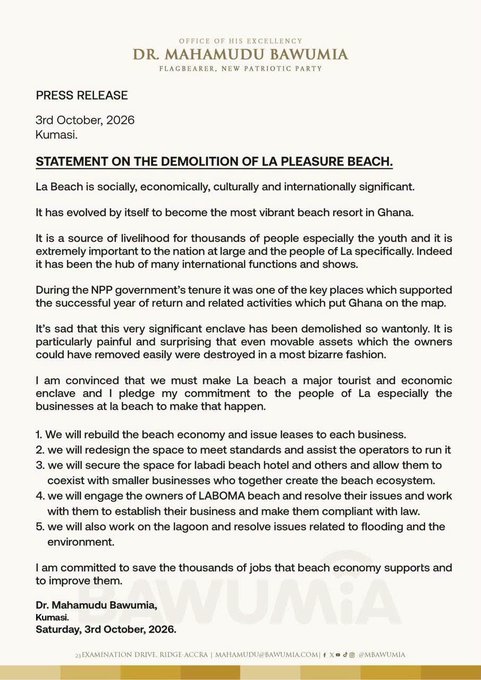
La Community vows court battle over beach resort demolition as ownership dispute escalates


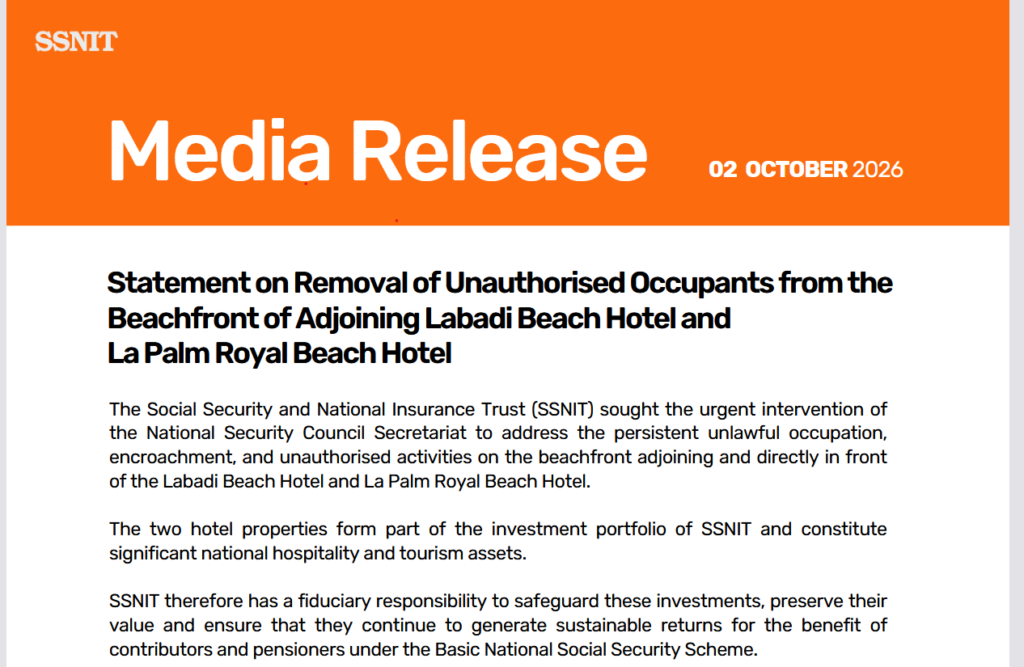
A bitter dispute over land ownership at La Beach in Accra has intensified after the demolition of structures including the La Pleasure Beach Resort and Polo Beach Club, with the La Community now threatening court action against any further development without their consent.
The demolition exercise, supervised by personnel from the Ghana Armed Forces' 48 Engineer Regiment with Ghana Police Service support, saw traders and business operators ordered to vacate the premises. The operation has reignited tensions over who legitimately owns the beachfront property and cast uncertainty over the future of enterprises operating in the area.
Community takes legal stance
Speaking at a press conference, the community's lawyer Nsiah Akuetteh announced that legal proceedings have already begun against what he characterised as unauthorised occupation of the land. He made clear that the La Community does not recognise the resort's right to operate on the property and views the demolition as a violation of their ownership rights.
Mr Akuetteh issued a stark warning to potential investors: any developer attempting to proceed with redevelopment plans without first resolving the ownership dispute faces the prospect of being sued. He emphasised that possession of financial resources or security personnel cannot substitute for legitimate title to land—a principle central to Ghana's property law.
The community's lawyer indicated openness to development projects, but only on terms that respect their land claims and involve genuine consultation with residents. He urged La Pleasure Beach's management to engage directly with the community to address the grievances of displaced traders and other affected persons, arguing that dialogue remains the most constructive path forward.
What this means for coastal development in Ghana
The La Beach dispute highlights a recurring challenge in Ghana's management of valuable beachfront property. Coastal communities often claim ancestral rights to land, whilst government agencies, private investors and private operators assert competing claims based on leases, permits or military jurisdiction. These conflicts frequently leave traders and small business operators caught between warring interests, their livelihoods hanging in the balance.
The involvement of the Ghana Armed Forces in the demolition suggests government backing for whoever commissioned the operation—raising questions about how competing claims to coastal land are being adjudicated. For Accra's tourism sector, the standoff presents a cautionary tale: major hospitality investments can face years of legal paralysis if community ownership claims are not resolved upfront.
The La Community's insistence on consultation-before-development is a reasonable position under Ghanaian law, which recognises customary land rights. However, the legal pathway to resolving such disputes remains complex, requiring clarity on whether the community holds registered title, can prove customary ownership, or occupies the land under other legal arrangements.
Next steps and investor uncertainty
The community has signalled it will scrutinise any investment proposals carefully before permitting development to resume. This creates a period of limbo for La Pleasure Beach, its staff and the wider business ecosystem at La Beach. Without resolution of the ownership question, lenders and operators face heightened risk.
For Ghana's investment climate, the case underscores the importance of conducting thorough due diligence on land title before committing capital to coastal projects. Developers working along Ghana's shoreline must engage customary authorities and local communities early, even where they believe they hold legal title. The alternative—as La Pleasure Beach has discovered—is costly litigation and operational shutdown.
Source: MyJoyOnline


Comments (0)
Be the first to comment.