
Is Accra Swapping Trees for Stones? The Hidden Cost of the Capital's Beautification Drive
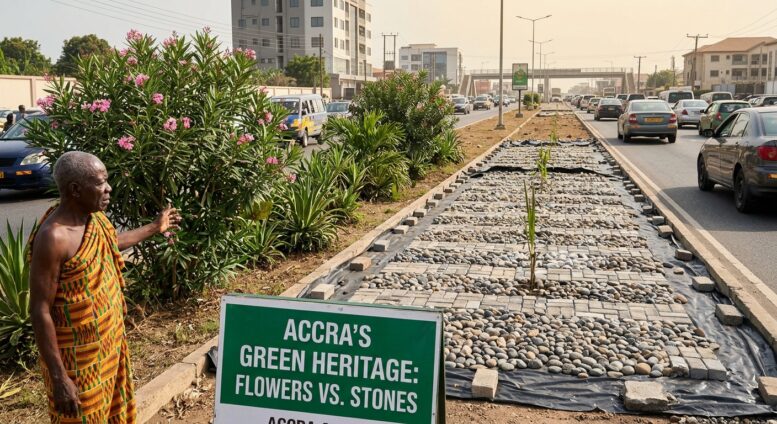

A quiet but troubling transformation is under way along some of Accra's busiest road corridors. Mature trees, hardy flowering shrubs and established ornamental vegetation — many of which have thrived for years despite vehicle fumes, dust and harsh weather — are being uprooted and replaced with decorative stones, plastic ground covers and other hard-landscaping materials. The result may look tidy and modern at first glance, but landscape professionals and environmentalists are sounding the alarm: Accra could be trading long-term ecological health for short-lived aesthetic appeal.
What is happening on the ground?
Some of the most visible changes are occurring along high-profile corridors in the capital. The stretch running from the 37 Military Hospital through the Jubilee House area towards the Ako Adjei Interchange — once softened by rows of pink-flowering oleanders — has seen sections of that established planting removed and replaced with stone arrangements. Around the Airport enclave, including areas near the Airport Police Station, the Association International School and the Airport traffic intersection, existing vegetation and topsoil have in some instances been stripped away, plastic sheeting laid down and decorative stones carefully arranged on top.
Mature trees have reportedly been felled in certain locations, while established trees at Togo Roundabout have undergone severe pruning. The investments being made in road-corridor improvements — including the stretch from the National Theatre towards the Pantang Hospital Intersection — are welcomed by many Accra residents. The concern, however, is not with beautification itself, but with what is being lost in the process, and whether the trade-off makes any environmental sense.
Why it matters for Ghana
Ghana's capital is already grappling with worsening air quality, rising urban temperatures and flooding — challenges that well-managed urban greenery directly helps to address. Trees and shrubs are not decorative luxuries; they are functioning pieces of environmental infrastructure. Vegetation intercepts airborne dust and particulate matter, provides shade that reduces surface and air temperatures through evapotranspiration, supports urban biodiversity and contributes to the mental well-being of city dwellers. In a city as congested and heavily trafficked as Accra, roadside vegetation forms part of a broader, if imperfect, defence against pollution and heat stress.
The oleander (Nerium oleander), a plant widely used in Accra's road medians, is particularly well suited to tough urban conditions — tolerant of heat, drought and vehicle emissions. Removing plants that have already successfully adapted to such a hostile environment, without evidence that the replacements deliver greater environmental benefit, is difficult to justify on sustainability grounds.
Decorative stones, by contrast, do not cool the air, absorb pollutants or support wildlife. They cannot perform any of the ecological functions that living vegetation provides. Beyond that, Accra's dusty, sooty environment is likely to stain and discolour decorative white stones over time, raising questions about maintenance costs and longevity. Plastic ground covers beneath the stones also raise concerns about soil health and rainwater infiltration — both critical issues in a city that floods regularly during the rainy season.
A call for smarter urban planning
None of this is an argument against improving Accra's public spaces. The capital has many bare, neglected road medians and roundabouts that would genuinely benefit from thoughtful landscaping investment. The more logical approach would be to direct resources towards greening those undeveloped spaces, rather than dismantling vegetation that has already established itself and is delivering environmental value.
Urban landscaping done well is a long-term investment — in cleaner air, cooler streets, reduced flooding risk and a more liveable city. Done poorly, or with an eye only on immediate visual impact, it can quietly erode the very environmental assets a growing city needs most.
- Professional selection matters: Landscape practitioners emphasise that plant species must be chosen for pollution tolerance, soil conditions and long-term resilience, not just appearance.
- Stones complement, not replace: Hard-landscaping materials have legitimate uses in urban design but should work alongside vegetation, not substitute for it.
- Long-term cost questions remain: Maintaining stone-and-plastic installations in Accra's dusty, high-traffic environment may prove more expensive over time than sustaining established greenery.
As Accra continues to grow and modernise, the choices made now about its urban environment will shape the city for decades. Getting the balance right between aesthetic improvement and ecological integrity is not optional — it is essential.
Source: The Ghana Report

Comments (0)
Be the first to comment.