
IMF Warns Ghana Still Vulnerable to Gold, Cocoa and Oil Price Swings as Domestic Risks Linger

Ghana's economy remains significantly exposed to swings in the prices of gold, cocoa, and oil, the International Monetary Fund (IMF) has cautioned, while also pointing to a range of domestic risks that could undermine the country's hard-won economic recovery. The warning came as an IMF Mission completed its first review of Ghana's Policy Coordination Instrument (PCI), a framework designed to guide the country's economic stabilisation efforts.
What the IMF found
The Fund's Mission noted that Ghana's performance under the PCI has been broadly satisfactory, with most quantitative targets met during this review period. However, it was careful to highlight that significant vulnerabilities remain. Chief among these are the country's dependence on commodity exports — particularly gold, cocoa, and oil — whose prices are subject to sharp and unpredictable global fluctuations. Any sustained downturn in these markets could quickly erode government revenues and foreign exchange earnings.
On the domestic front, the IMF identified several pressing concerns. These include substantial debt rollover requirements, meaning the government must regularly refinance large amounts of maturing debt, which puts pressure on public finances. Fiscal stress in the energy sector, the cocoa industry, and the gold sector were also flagged, alongside lingering weaknesses in parts of the financial system.
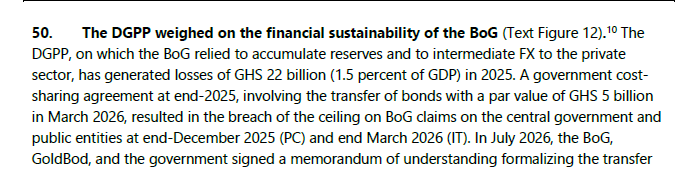
In response to a recent decline in foreign exchange reserves, the authorities — the Ministry of Finance and the Bank of Ghana — have already moved to implement corrective measures. These include shifting foreign exchange intermediation away from the Bank of Ghana to GoldBod, as well as enforcing higher gold sale requirements on large-scale mining companies operating in the country. The IMF indicated that these steps were necessary and that sustained implementation, combined with greater flexibility in the exchange rate, would be essential to rebuilding reserves to target levels.
Why it matters for Ghana
Ghana is at a critical juncture in its economic recovery following the debt crisis that forced the country to seek an IMF bailout in 2023. The PCI serves as an important signal of economic discipline to international creditors and investors, and the fact that it is broadly on track is a positive development. However, the IMF's warnings are a reminder that recovery is far from guaranteed.
The Fund stressed that prudent monetary policy, stronger reserve buffers, greater exchange rate flexibility, and the building up of a sinking fund to manage maturing debt are all crucial to maintaining stability. For ordinary Ghanaians, these policy choices have real implications — influencing the cost of imports, the value of the cedi, and ultimately the prices of everyday goods.
Governance reforms were also highlighted as a priority area. The IMF called for the adoption of the Conduct of Public Officers Bill, publication of a new National Ethics and Anti-Corruption Action Plan, and better oversight of state-owned enterprises. It argued these steps would help build public confidence and attract private investment — both of which are vital for sustainable growth.
Structural reforms progressing
The Mission acknowledged meaningful progress on structural reforms. Authorities published the Fiscal Strategy Document and secured parliamentary approval of a new Cocoa Board Act aimed at strengthening governance and financial discipline within the cocoa sector. Quarterly electricity tariff adjustments are also continuing, and a comprehensive review of customs and excise legislation was completed ahead of schedule.
Work is also advancing on reforming the Bank of Ghana's liquidity management framework, rolling out the Integrated Tax Administration System, and operationalising the Fiscal Council. The IMF noted, however, that completing all remaining reforms on time remains important — including the delayed publication of an audit of the Electricity Company of Ghana's collection accounts, which has yet to be released.
The IMF concluded by reaffirming its commitment to Ghana's recovery, expressing confidence that the country can achieve stronger, more inclusive, and job-rich growth if reforms are seen through with consistency and determination.
Source: MyJoyOnline

Comments (0)
Be the first to comment.