Bank of Ghana's gold scheme lost GH¢22bn in 2025, IMF reveals in damning assessment
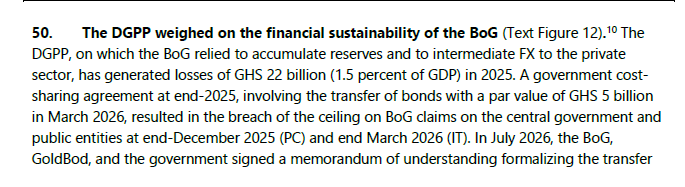
Ghana's ambitious domestic gold-buying scheme has suffered staggering losses of GH¢22 billion in 2025—equivalent to 1.5% of gross domestic product—according to a bombshell International Monetary Fund report released alongside the final review of the country's $3 billion Extended Credit Facility. The figure represents a dramatic escalation from earlier estimates and has intensified a growing controversy over who should bear the financial burden of the nation's cornerstone gold strategy.
The Domestic Gold Purchase Programme (DGPP), jointly operated by the Bank of Ghana and the state-owned Ghana Gold Board, was designed to bolster foreign exchange reserves and support the private sector. However, the IMF's latest findings reveal the scale of losses far exceeded initial disclosures. The December report had flagged a $214 million loss for the nine-month period ending September 2025, but as the Bank of Ghana closed its books for the full year, the true cost became apparent. The gross loss on doré gold trading with GoldBod ballooned to approximately GH¢22 billion—roughly $2 billion at current exchange rates—before partial offsets from government intervention and bullion sales reduced the net impact reflected in the central bank's audited accounts.
The cascading impact on Ghana's finances
The damage extends well beyond the direct trading losses. The IMF report indicates that combined with higher open-market operation costs and substantial exchange rate valuation losses from a strengthening cedi, the gold losses have pushed the Bank of Ghana's equity position deeper into negative territory, now standing at minus 6.7% of GDP at year-end 2025.
These mounting losses created complications for Ghana's IMF programme itself. A government cost-sharing agreement finalised at the end of 2025, involving the transfer of bonds valued at GH¢5 billion in March 2026, technically breached a critical ceiling on central bank claims on government—a formal performance criterion under the loan arrangement. The breach occurred both at end-December 2025 and again at end-March 2026, though the IMF ultimately approved a waiver, describing it as a minor deviation that did not signal weakening policy commitment.
Why it matters for Ghana
Ghana's gold sector has become increasingly vital to the nation's economic performance, with artisanal and small-scale gold exports reaching $10.9 billion in 2025, representing 9.5% of GDP. However, the DGPP's losses underscore the risks of state-led involvement in commodity trading, particularly when conducted through quasi-fiscal central bank operations.
In response to the IMF's findings, Ghanaian authorities have implemented significant structural reforms. The gold purchasing programme has been transferred from the Bank of Ghana to GoldBod, a newly established state entity created by parliamentary act in April 2025. Since 1 July 2026, the government now bears 100% of the programme's costs through the national budget, removing the central bank's direct exposure to future losses. The Bank of Ghana's role has been reduced to that of fiscal agent.
However, the IMF cautioned that state involvement in gold buying remains a substantial fiscal liability. The programme generated losses equivalent to 15.3% of gross gold purchases under the old structure—with roughly half stemming from the practice of buying gold at the more expensive forex-bureau exchange rate. Though authorities have reduced this to 11.7% in the first quarter of 2026, the restructured memorandum of understanding mandates a further reduction to 5%, requiring narrower forex spreads, supply-chain streamlining, and enhanced competition among service providers.
An external auditing firm is currently conducting a special audit of the entire programme from inception, with results expected in the third quarter of 2026. Additionally, the IMF has emphasised the urgency of a credible recapitalisation plan for the Bank of Ghana, whose balance sheet has been severely weakened by past monetary financing, the 2022 domestic debt restructuring, and these quasi-fiscal gold activities. Authorities have committed to full recapitalisation by 2032, though the Fund stressed this will require sustained fiscal effort and a formal agreement with the finance ministry.
Source: MyJoyOnline

Comments (0)
Be the first to comment.