
Ghana's Economy Set for Strong 2026 But Faces Slowdown in 2027, Fitch Solutions Warns

Ghana's economy is on course for a robust 2026, with global ratings and research firm Fitch Solutions maintaining its GDP growth forecast at close to 6.0% for the year — but a more challenging 2027 looms on the horizon, driven by rising inflation and tighter monetary conditions.
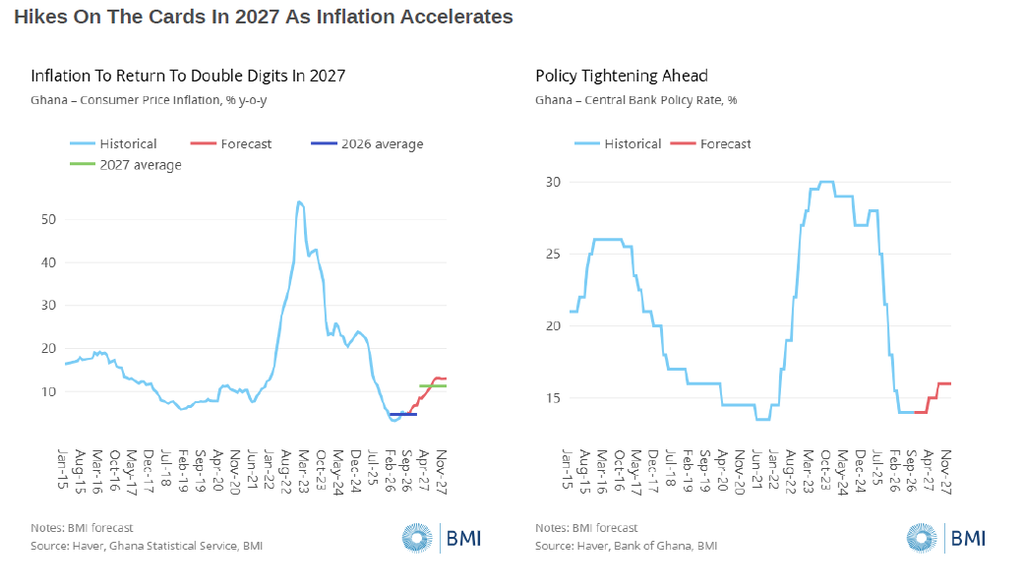
The UK-based firm says Ghana has largely managed to shield itself from turbulent global developments over the past year, buoyed by high gold prices on international markets, falling domestic inflation, and the significant easing undertaken by the Bank of Ghana (BoG). The central bank cut its benchmark policy rate by a cumulative 1,400 basis points — a dramatic monetary loosening designed to revive credit and stimulate economic activity following Ghana's post-debt crisis recovery.
Gold and Oil Provide a Cushion
A key pillar of Ghana's resilience has been its commodity position. Fitch Solutions notes that while elevated global oil prices have pushed up the country's energy import costs, Ghana remains broadly neutral in oil trade — thanks primarily to production from the offshore Jubilee and TEN fields. The oil trade deficit stood at just 0.3% of GDP in the second quarter of 2026, a figure that has limited damage to the current account.
More significantly, gold continues to be a major economic anchor. With Fitch's commodities analysts forecasting gold prices to hold at around US$4,200 per ounce, Ghana's current account surplus is expected to remain substantial at 5.3% of GDP in 2027. This healthy surplus supports the country's foreign reserves and helps contain depreciation pressure on the cedi — a concern that has historically rattled Ghanaian households and businesses alike.
Why It Matters for Ghana
For ordinary Ghanaians who lived through the economic hardships of 2022 and 2023 — currency collapse, soaring inflation, fuel shortages and an IMF bailout — the prospect of sustained growth is welcome relief. A near-6% expansion in 2026 would represent a meaningful consolidation of the recovery that began under the IMF-supported programme.
However, the warning about 2027 deserves serious attention. Fitch Solutions projects inflation rising sharply from an annual average of 4.7% in 2026 to 11.3% in 2027. This spike is attributed to several compounding factors: unfavourable base effects as the low-inflation period fades, rapid growth in money supply, and higher global food prices linked to the El Niño weather phenomenon — which tends to disrupt agricultural output across West Africa.
As inflation rises, the Bank of Ghana is expected to reverse course and begin tightening monetary policy again — raising interest rates to bring price growth under control. While necessary, this will make borrowing more expensive for businesses and consumers, slowing credit growth and dampening domestic demand. The combination of eroded purchasing power and costlier loans is a familiar squeeze for Ghanaian households.
- Sub-Saharan Africa context: Fitch Solutions warns that across most Sub-Saharan African economies, a persistent inflationary environment in 2027 will weigh on private consumption and business activity more broadly — meaning Ghana's challenge is part of a regional trend rather than an isolated concern.
- Oil exporters benefit: Countries that export significant volumes of oil stand to gain from elevated energy prices, which will boost export earnings and government revenues — giving them a temporary buffer that non-oil economies will not enjoy to the same degree.
For Ghana's policymakers, the Fitch outlook underscores the importance of locking in fiscal discipline and diversifying the economy beyond commodities while conditions remain favourable. The window of strong growth in 2026 offers an opportunity to build buffers — in reserves, in social spending, and in structural reforms — that could soften the anticipated slowdown heading into 2027.
Source: The Ghana Report

Comments (0)
Be the first to comment.