
Digital fraud in Ghana surges 98% as criminals exploit mobile money and online payment boom


Ghana's digital financial ecosystem faces a critical security challenge, with fraud incidents in online channels nearly doubling between 2022 and 2025, according to alarming new data from the Bank of Ghana. The 98% spike reveals a worrying trend: as more Ghanaians abandon cash and embrace mobile money, payment apps, and digital banking, criminals are following them into these channels with increasingly sophisticated tactics.
The scale of the problem is stark. Total fraud cases across Ghana's entire financial system jumped from 16,733 incidents in 2024 to 24,778 in 2025—a 48% year-on-year increase driven overwhelmingly by digital transactions. Significantly, traditional banking fraud has actually declined, underscoring a fundamental shift in how financial crime operates in Ghana.
The digital crime wave: Why traditional measures are failing
Matilda Asante-Asiedu, Second Deputy Governor of the Bank of Ghana, described the phenomenon bluntly: financial criminals are "following customers into digital channels" as electronic payments expand. The rise is not merely a statistical shift but represents a fundamental restructuring of Ghana's financial crime landscape.
What makes this trend particularly concerning is the interconnected nature of Ghana's financial infrastructure. When a fraudster targets a payment service provider (PSP), the consequences ripple across the entire ecosystem. As Asante-Asiedu explained, a PSP's account sits within a bank, meaning fraud incidents do not remain isolated—they affect multiple institutions and undermine confidence in the broader system.
The sophistication of modern fraudsters compounds the problem. Unlike traditional bank robbers or forgers, digital criminals employ evolving techniques that exploit vulnerabilities in apps, SMS banking, and online platforms. They target both individuals making everyday purchases and businesses processing bulk transactions, adapting their methods faster than regulators can respond.
Why this matters for Ghana
Ghana has made remarkable progress in financial inclusion over the past decade. Mobile money services like MTN Mobile Money, AirtelTip-Off, and Vodafone Cash have brought banking to millions of unbanked Ghanaians. Digital payment platforms enable traders, transporters, and professionals to conduct business without carrying cash. These innovations have reduced poverty and improved economic efficiency—but they have also created new vulnerabilities.
The 98% surge in digital fraud threatens this progress. If Ghanaians lose confidence in digital payments, they may revert to cash, reversing years of financial inclusion gains. Small businesses and informal traders, who rely heavily on mobile money for daily operations, face particular risk. Young people entering the digital economy for the first time may become victims before establishing secure habits.
There are also macroeconomic implications. Large-scale fraud increases operational costs for banks and fintechs, which typically pass these costs to consumers through higher fees. It diverts institutional resources from innovation to security, potentially slowing Ghana's fintech development relative to regional competitors like Kenya.
The path forward: Coordination and deterrence
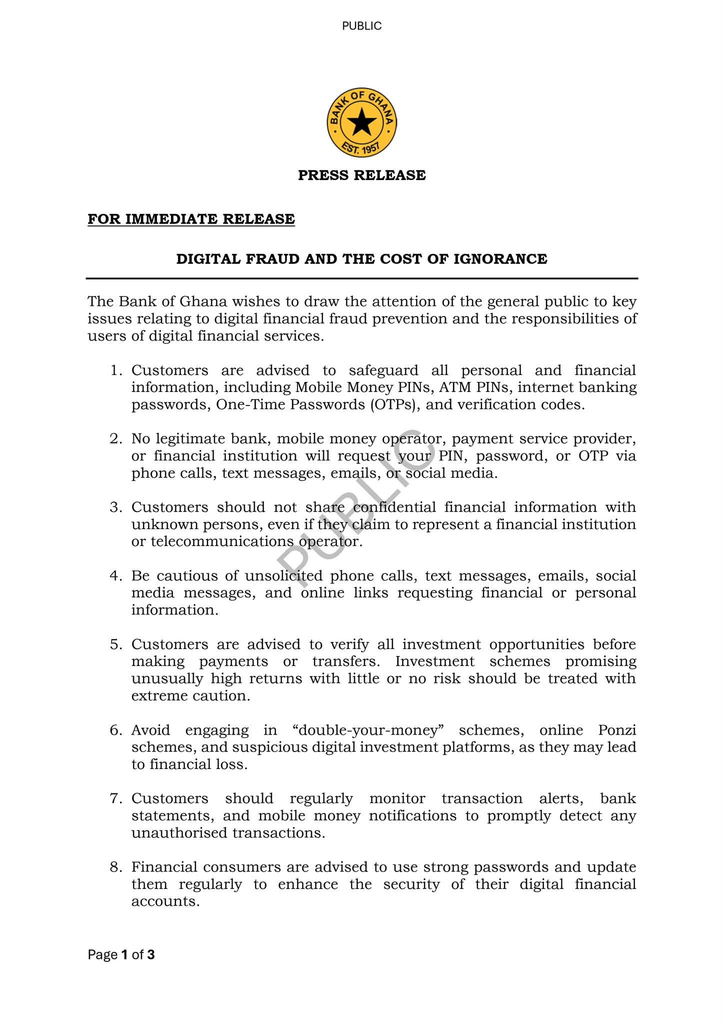
The Bank of Ghana is calling for a comprehensive response involving regulators, financial institutions, and law enforcement. At a recent COCLAB (Committee for Cooperation Between Law Enforcement Agencies and the Banking Community) workshop in the Eastern Region, Asante-Asiedu outlined the needed strategy: strengthened intelligence sharing, more rigorous investigations, swift prosecutions, and targeted public awareness campaigns.
She emphasised that success should be measured not by statistics alone, but by tangible outcomes—fewer fraud victims and stronger customer protection. Critically, the approach must also create genuine deterrence. As Asante-Asiedu put it, fraudsters must come to fear the consequences: "When the fraudster begins to think through their next move, they'll also think, gosh, what if these people arrest me?"
For ordinary Ghanaians, this means learning to recognise common fraud tactics: phishing messages, fake payment confirmations, and social engineering schemes. For businesses, it means implementing multi-factor authentication and educating staff. For regulators and law enforcement, it means modernising investigative tools and closing legal loopholes that fraudsters currently exploit.
Ghana's digital financial revolution has lifted millions out of poverty and opened economic opportunities. Protecting that progress requires urgent, coordinated action to turn back the tide of digital fraud.
Source: Today GH




Comments (0)
Be the first to comment.