Beyond the hype: How Ghanaian small businesses can actually use AI to grow
Artificial intelligence has a serious image problem in Ghana. Most small business owners hear the term and picture expensive Silicon Valley technology designed for giant corporations with sprawling tech teams. The reality, however, is almost the opposite: AI is becoming most powerful precisely for the entrepreneurs and traders who have been locked out of advanced business tools by cost and complexity.
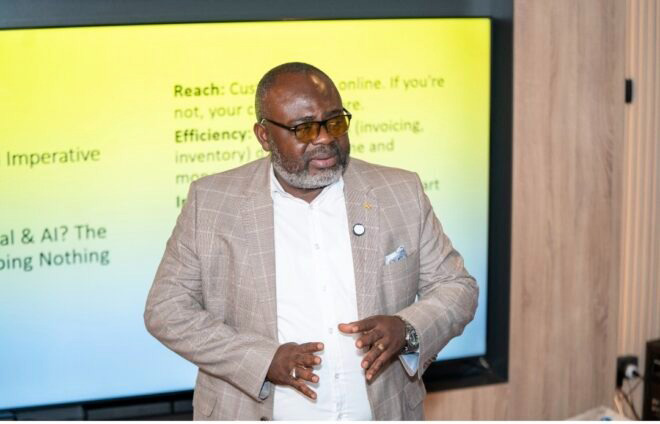
This insight emerged clearly at a recent Master Class organised by the WERIse Network, where Ghanaian women entrepreneurs and business owners engaged with practical AI applications for their own operations. Their response was striking—not scepticism or confusion, but urgency. Once AI was explained not as futuristic innovation but as a solution to the concrete daily struggles they face—staff shortages, slow customer response times, limited financial resources, inability to compete with larger rivals—the entrepreneurial appetite became obvious.
The economic stakes are substantial. Ghana's micro, small, and medium enterprises (MSMEs) represent over 90 per cent of all businesses and generate more than 70 per cent of employment nationwide. These firms are the backbone of the economy. Yet they operate under a fundamental constraint that management experts have studied for decades: owner-managers are stretched thin. They lack the time, staff, and capital that larger competitors take for granted. This is where AI can make a genuine difference—by automating routine tasks and providing insights that would otherwise require hiring additional specialists.
Why adoption remains low—and how it's changing
A survey of businesses backed by Ghana's National Entrepreneurship and Innovation Programme found that fewer than 5 per cent were actively using AI. The barriers, however, are not primarily cost. The deeper obstacles are low digital skills among employees, reluctance to abandon familiar ways of working, and unreliable infrastructure in many parts of the country. These are organisational and managerial challenges, not purely technical ones.
Several developments are shifting this picture. Large language models—AI systems trained on vast amounts of text data—have become accessible tools that smaller firms can deploy quickly and affordably. Ghana's National AI Strategy, launched in April 2026, explicitly acknowledges this opportunity, naming small traders and artisans as intended beneficiaries and pledging support for AI-powered credit scoring, fraud detection, and market access tools. Importantly, Ghanaian entrepreneurs and tech startups are building solutions designed for local contexts. Papermap.ai, for example, is an analytics platform that accepts questions in Pidgin, Twi, and French—removing the language barrier that often prevents local business owners from using data properly.
Research on Ghanaian SMEs using AI-based accounting systems shows a clear chain of cause and effect: when the tools are of good quality and easy to use, businesses adopt them more readily; when they adopt them, performance improves measurably. This academic evidence validates what entrepreneurs at the WERIse Master Class already sensed: the technology works.
Practical entry points for Ghanaian businesses
Not all AI applications require technical expertise or large budgets. Research from UNCTAD, the United Nations trade body, identifies a logical sequence: start with ready-made tools, progress to partnerships for specialised needs, and only invest in building custom systems once the business has matured. For most Ghanaian MSMEs, the early stages offer immediate returns.
- Chatbots for customer response. WhatsApp Business chatbots represent the simplest entry point. For traders and service businesses that lose sales because they cannot respond to enquiries quickly during busy periods, this is a direct revenue tool. Several Master Class participants immediately recognised applications in their own customer-facing work.
- Data analytics without coding. Platforms like Papermap.ai allow business owners to ask questions about their data—stock levels, sales patterns, customer behaviour—in their own language and receive answers without needing to understand programming.
- Financial management and credit scoring. Ghana's strategy emphasises AI tools for business lending and fraud prevention, areas where MSMEs have traditionally faced barriers to credit access.
What this means for Ghana's economy
The adoption of practical AI by Ghana's 2+ million MSMEs could reshape the competitive landscape. Businesses that currently compete on traditional terms—personal networks, physical location, manual processes—would gain access to capabilities that large firms have long monopolised: fast customer response, insight-driven decisions, and financial discipline. This is not disruption for its own sake; it is competitive equalisation.
The barriers remain real. Infrastructure gaps, skills deficits, and organisational inertia will not disappear overnight. But the recent enthusiasm from Ghanaian entrepreneurs, combined with a supportive national strategy and locally built solutions, suggests that the window is opening. The conversation is shifting from "Can small businesses use AI?" to "How quickly can they adopt it?" That shift, in itself, is progress.
Source: The Ghana Report




Comments (0)
Be the first to comment.