
Asiedu Nketiah Raises Alarm Over 'Electoral Neocolonialism' Threatening Africa's Democratic Sovereignty


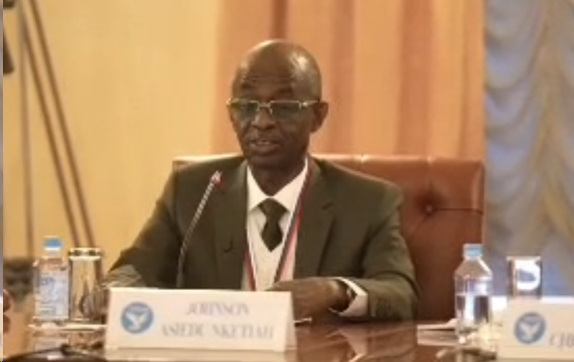
Johnson Asiedu Nketiah, the former General Secretary of Ghana's National Democratic Congress (NDC), has sounded a strong alarm over what he describes as 'Electoral Neocolonialism' — a growing trend in which foreign actors and institutions exert undue influence over the electoral processes of African nations, undermining the sovereignty of their democratic systems.
Anchoring his address around one of Ghana's most recognisable electoral tools — the pink sheet — Asiedu Nketiah used the document as a symbol of homegrown accountability. The pink sheet is the official polling station results form that is signed by party agents representing various political parties immediately after the close of voting at each polling station. It has long been regarded as a cornerstone of Ghana's election transparency architecture, giving ordinary political representatives the power to verify and dispute results at the most basic level.
The Pink Sheet as a Symbol of African Electoral Integrity
By centring his argument on the pink sheet, Asiedu Nketiah made a pointed case that African countries already possess robust, locally-designed mechanisms for ensuring free and fair elections. His argument suggests that the problem is not a lack of capacity on the continent, but rather the growing tendency for external bodies — whether foreign governments, international organisations, or Western-backed electoral monitoring groups — to impose frameworks, standards, and narratives that override local systems and local judgement.
The pink sheet itself has featured prominently in Ghana's own electoral disputes, most notably during the 2012 presidential election petition, when the then-opposition New Patriotic Party challenged the results of the election at the Supreme Court, citing irregularities on thousands of pink sheets. The case, which lasted several months, ultimately resulted in the court upholding the election of John Mahama. The episode nonetheless demonstrated just how central the document is to Ghana's electoral dispute resolution process.
Why It Matters for Ghana and the Rest of Africa
Asiedu Nketiah's warning arrives at a moment of heightened sensitivity around elections across the African continent. Several countries have experienced disputed elections in recent years, with foreign powers and multilateral institutions often playing prominent — and sometimes controversial — roles in declaring results legitimate or illegitimate.
For Ghana, which has long prided itself on being one of West Africa's most stable democracies and a model for peaceful power transfers, the debate around electoral sovereignty is particularly significant. Ghana has successfully conducted multiple competitive elections, with power changing hands between the NDC and the NPP on several occasions. This track record gives Ghanaian political figures like Asiedu Nketiah a credible platform from which to speak on best practices in African elections.
The concern being raised is broader than any single election. Critics of external electoral influence argue that when international bodies pre-emptively signal which outcomes they consider acceptable, or when foreign funding shapes the operations of electoral commissions and civil society monitors, the genuine will of African voters can become secondary to geopolitical interests.
- African-designed accountability tools, like Ghana's pink sheet system, demonstrate that the continent has the capacity to manage credible elections independently.
- External pressure on electoral outcomes, even when framed as democracy promotion, can inadvertently delegitimise results and fuel political instability.
- Strengthening intra-African peer review and monitoring mechanisms may offer a more culturally appropriate and politically neutral alternative to heavy Western oversight.
What Comes Next
Asiedu Nketiah's remarks are likely to resonate beyond Ghana's borders, particularly within ECOWAS circles where debates about democratic backsliding and the role of international institutions in West African politics have become increasingly urgent. With a number of Sahelian countries having recently expelled Western observers and pushed back against external electoral oversight, his comments enter a live and contested conversation.
Whether his call is taken up as a formal policy position within the NDC or the broader Ghanaian political establishment remains to be seen. What is clear, however, is that the conversation about who truly controls the ballot in Africa — and whose standards define a credible election — is far from settled.
Source: 3News



Comments (0)
Be the first to comment.