
Another Boat Sinks Off Senegal With 100 Migrants On Board, Dozens Still Missing

Search and rescue teams in Senegal are continuing operations after a wooden pirogue carrying approximately 100 migrants capsized in the early hours of Wednesday, adding to a mounting toll of tragedies along West Africa's Atlantic migration corridor. At least four bodies have been recovered, while dozens of people remain unaccounted for as authorities press on with the search.
The stricken vessel washed ashore near the village of Yenne, located south of the capital Dakar, with personal belongings, identity documents, mobile phones and even a school enrolment document found scattered across the wreckage. A village representative, Oumar Sow, told AFP that distressed cries from those on board could be heard from the beach as far back as the early hours of Wednesday morning, with the capsize believed to have occurred around 02:00 local time.
A survivor interviewed by police confirmed there were roughly 100 people on the boat, including five women.
A Second Disaster in Under a Fortnight
The timing of the latest sinking is particularly alarming. It comes less than two weeks after a separate shipwreck off the north-western town of Thieppe claimed at least 39 lives — one of Senegal's deadliest single migration incidents in recent memory. The back-to-back disasters have prompted Senegalese President Bassirou Diomaye Faye to raise the alarm publicly at a cabinet meeting on Wednesday, expressing serious concern about a renewed surge in irregular departures from the country's coastline.
President Faye has directed the interior ministry to compile a comprehensive report examining the root causes behind the dangerous voyages and to propose concrete measures to address the problem. He had previously appealed to Senegalese citizens to refrain from risking their lives on perilous sea crossings following last month's tragedy.
Why It Matters for Ghana and West Africa
While this disaster unfolded in Senegalese waters, the crisis is deeply regional in nature and resonates strongly across West Africa — including Ghana. The United Nations migration agency, IOM, recorded at least 454 deaths and disappearances off the West African coast this year alone, and warned that the true figure is likely far higher, since many boats vanish without leaving survivors or any trace.
Migrants making these journeys — many of them young men — are driven by limited employment prospects, family financial pressures and well-established migration networks across the sub-region. Ghana, like Senegal and other ECOWAS nations, faces similar underlying push factors: youth unemployment and limited economic mobility continue to make the idea of reaching Europe appealing despite the well-documented risks.
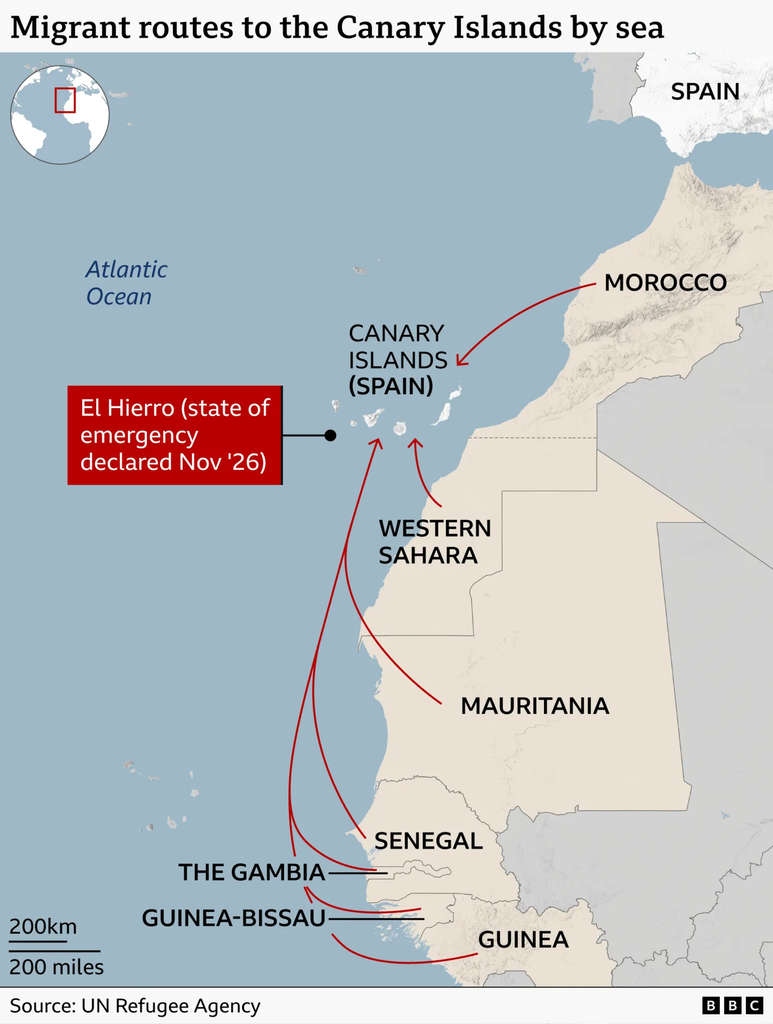
As North African migration routes have become increasingly difficult due to tighter border controls and growing cooperation between European and North African governments, the Atlantic route targeting Spain's Canary Islands has become the preferred option for many West Africans. The IOM notes that Senegalese nationals currently make up the largest group of migrants arriving in the Canary Islands this year. In early November, the island of El Hierro declared a state of emergency after more than 3,300 people arrived on roughly 30 boats in a matter of days — a number approaching a third of the island's entire population.
The Broader Migration Crisis
The pirogues used on these crossings are traditional wooden fishing boats that are frequently overloaded and entirely ill-suited to the rough conditions of the open Atlantic. Many thousands of West Africans have died or disappeared attempting these crossings in recent years, fleeing a combination of conflict, authoritarian governance and economic hardship.
ECOWAS member states, including Ghana, face growing pressure to coordinate regional responses to irregular migration — not only to prevent further loss of life but also to address the structural economic conditions that push young people to take such desperate risks in the first place. For now, families across West Africa are once again left waiting and hoping for news of loved ones missing at sea.
Source: MyJoyOnline



Comments (0)
Be the first to comment.