
Justice and Tradition: Chief Justice Charts Shared Vision Between Supreme Court and Chieftaincy


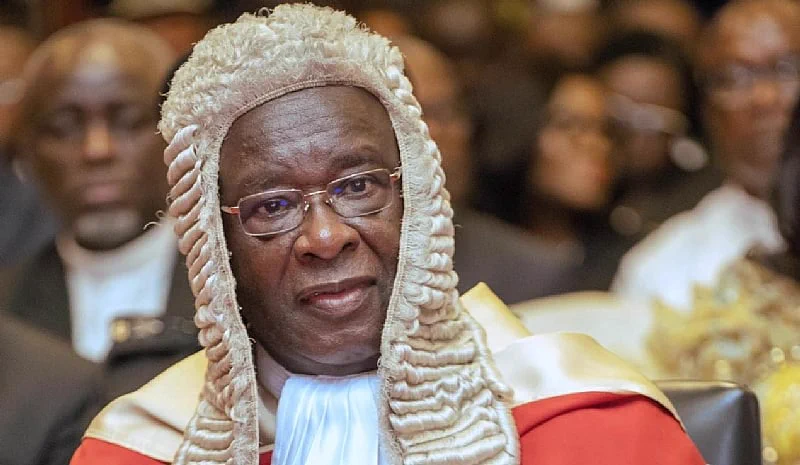
Ghana's Chief Justice Paul Baffoe-Bonnie has highlighted the fundamental alignment between the nation's Supreme Court and the institution of chieftaincy, arguing that despite their distinct origins and methods, both serve an identical purpose: the preservation of justice, the securing of peace, and the protection of human dignity.
Speaking at a commemorative lecture in Kumasi under the patronage of the Asantehene, Otumfuo Osei Tutu II, Justice Baffoe-Bonnie drew parallels between traditional and modern approaches to adjudication as Ghana's Supreme Court marked 150 years of operation. The lecture explored "The Supreme Court and the Institution of Chieftaincy: The Past, Present and Future," examining how these two pillars of Ghana's governance have evolved while maintaining their core commitment to justice.
Two Paths, One Destination
The Chief Justice underscored a critical distinction: the Supreme Court derives its authority from the Constitution and speaks through judicial processes, whilst chieftaincy draws legitimacy from custom and historical tradition. Yet, he argued, they converge at a shared philosophical point. "The Supreme Court speaks through the Constitution while chieftaincy speaks through custom. One draws its authority from the Republic and the other from the deep wells of history, yet both meet at the same point of purpose," Justice Baffoe-Bonnie said.
To illustrate this convergence, he invoked the image of justice as historically practiced under trees, where disputes were resolved through patient deliberation aimed at restoring community harmony rather than simply determining winners and losers. This ancient approach, he suggested, mirrors the underlying intent of modern judicial processes despite their formal differences. The methods have transformed, but the underlying human aspiration for fair resolution remains constant.
Building Institutions That Outlast Generations
Reflecting on the Supreme Court's 150-year journey, Justice Baffoe-Bonnie emphasised that the institution's founders recognised a fundamental truth: justice requires structures capable of transcending individual lifespans. "They simply believed that justice deserved an institution that could outlast any single generation," he noted, describing how successive generations have nurtured the Court through learning, courage and resilience until it has become "a tree whose shade now stretches across our entire Republic."
The Chief Justice stressed that each generation bears responsibility for the institutions it inherits. Every era either strengthens or weakens these foundations through its stewardship. The current generation, he argued, must preserve what is valuable, reform what requires change, and deliver a stronger institution to those who follow.
He pointed to chieftaincy as a model of this principle, having demonstrated the capacity to preserve tradition whilst adapting to changing circumstances. "Its strength has never rested in age alone, but in its ability to carry yesterday into tomorrow without letting yesterday intrude into tomorrow," he explained.
Why It Matters for Ghana
This address carries significance for Ghana's broader governance landscape. As the nation navigates modernisation and social change, Justice Baffoe-Bonnie's remarks suggest a vision of institutional complementarity rather than competition. Ghana's dual system—combining formal constitutional law with customary authority—can function more effectively when both are recognised as legitimate expressions of justice rather than rival forces.
The lecture also frames institutional renewal as an ongoing responsibility. Ghana's Supreme Court, having completed 150 years, is not resting on historical achievement but is being called to pursue greater contribution. Similarly, traditional authorities are encouraged to view themselves as dynamic institutions capable of relevance across generations.
Justice Baffoe-Bonnie concluded with a powerful statement about the future: "The greatest chapter of the Supreme Court's history must never be the one already written, but always the next one." This sentiment reflects a conviction that Ghana's institutions—both judicial and traditional—remain essential to national development and must continually evolve whilst staying true to their core principles. As Ghana faces complex social and economic challenges, the strength of these complementary systems may prove increasingly valuable.
Source: MyJoyOnline




Comments (0)
Be the first to comment.