
Inside Ghana's 2026 School Placement Crisis: 76,000 Students Left Hanging as System Struggles
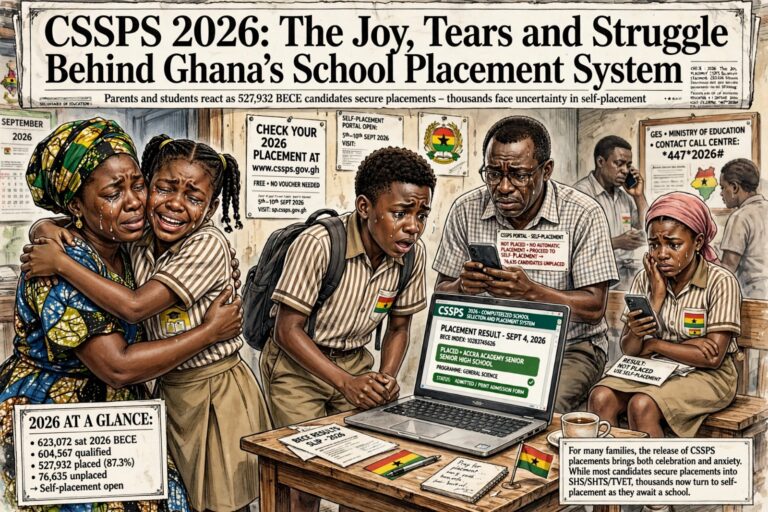

Ghana's education system faced another challenging year in September 2026 when the Computerised School Selection and Placement System (CSSPS) delivered results that left tens of thousands of families frustrated and searching for answers. While the system successfully placed 527,932 candidates into secondary institutions—representing 87.3 per cent of those who qualified after the Basic Education Certificate Examination—the real story lies in the 76,635 qualified students who were left without automatic placement, raising uncomfortable questions about equity and access in Ghana's secondary education sector.
The placement drama has become as predictable as the annual BECE examination itself. Each September, Ghanaian families log into the CSSPS portal hoping to see their child's name matched with a preferred school. For some, celebration follows. For many others, the notification brings confusion, disappointment and a desperate scramble to understand why strong academic performance did not guarantee entry to their chosen institution.
The Real Problem: Preference Mismatch, Not Space Shortage
The Ministry of Education's analysis reveals a counterintuitive truth that undermines much of the public frustration. The challenge is not necessarily a lack of secondary school places across the country. Rather, it is a fundamental mismatch between where vacancies exist and where students want to attend. Of 604,567 qualified candidates, 313,283 selected Category A schools—the most prestigious and highly sought institutions—as their first choice, competing for only 76,417 available spaces. This creates an impossible mathematics: demand vastly outpaces supply at preferred schools, whilst other institutions remain undersubscribed.
This structural problem means that two students with comparable grades can receive entirely different placement outcomes depending solely on their school and programme selections. A student with 8.5 aggregate who selects a Category A school may go unplaced, whilst another with an identical score choosing a less popular institution receives automatic placement. The system is technically fair but emotionally brutal for families who perceive the outcome as arbitrary.
Why This Matters for Ghana: Widening Inequality and Digital Divides
The placement crisis exposes deeper fractures in Ghana's approach to secondary education access. For unplaced candidates, the self-placement process offers a lifeline—but it is one only accessible to families with reliable internet access, digital literacy and the ability to make quick decisions under pressure. In a country where digital connectivity and technical skills remain unevenly distributed between urban and rural areas, this requirement disadvantages already marginalised families. The online-only nature of CSSPS, whilst efficient for government administration, creates barriers for millions of Ghanaians.
Beyond digital access, the placement outcome often determines significant financial consequences for families. A student placed far from home incurs transport costs. A boarding placement requires money for uniforms, supplies and accommodation. Families without resources face impossible choices: spend money they do not have or turn down placement. The Ministry's recent online admission improvements are welcome but address only part of the problem. The core issue remains: placement allocation itself reflects and reinforces existing inequalities based on geography, information access and family resources.
Long queues at the National Placement Resolution Centre at GNAT Hall in Accra have become symbolic of system strain. Parents and candidates spend hours seeking resolution for individual cases, reflecting frustration that extends beyond mere disappointment about school choice. For many, it represents powerlessness in the face of a system they do not fully understand and cannot influence.
Moving Forward: Questions Without Easy Answers
The CSSPS has operated for 21 years, and its core architecture remains largely unchanged. Whilst computerisation eliminated manual corruption and ethnic bias that characterised earlier systems, it has created new problems: algorithmic fairness, digital equity and the illusion that objective metrics can resolve fundamentally subjective human preferences. Every year, thousands of families discover that high grades and careful planning still cannot guarantee the outcome they want.
Sustainable solutions require difficult choices. Should Ghana expand secondary capacity in undersubscribed regions? Should it actively manage demand by limiting Category A school applications? Should it invest heavily in making underutilised institutions more attractive? These questions involve politics, money and competing visions for what secondary education should deliver. Until policymakers engage seriously with these broader questions, CSSPS will continue to deliver technically correct outcomes that feel profoundly unfair to hundreds of thousands of Ghanaian families each year.
Source: The Ghana Report




Comments (0)
Be the first to comment.