
GRA Clamps Down on Illegal Right-Hand-Drive Car Imports at Ghana's Ports


The Customs Division of the Ghana Revenue Authority (GRA) has issued a firm directive ordering all ports and customs stations across the country to immediately detain right-hand-drive vehicles that arrive for clearance without the proper authorisation from the Ministry of Transport. The move signals a renewed push to enforce a law that has long been on the books but inconsistently applied.
What the directive says
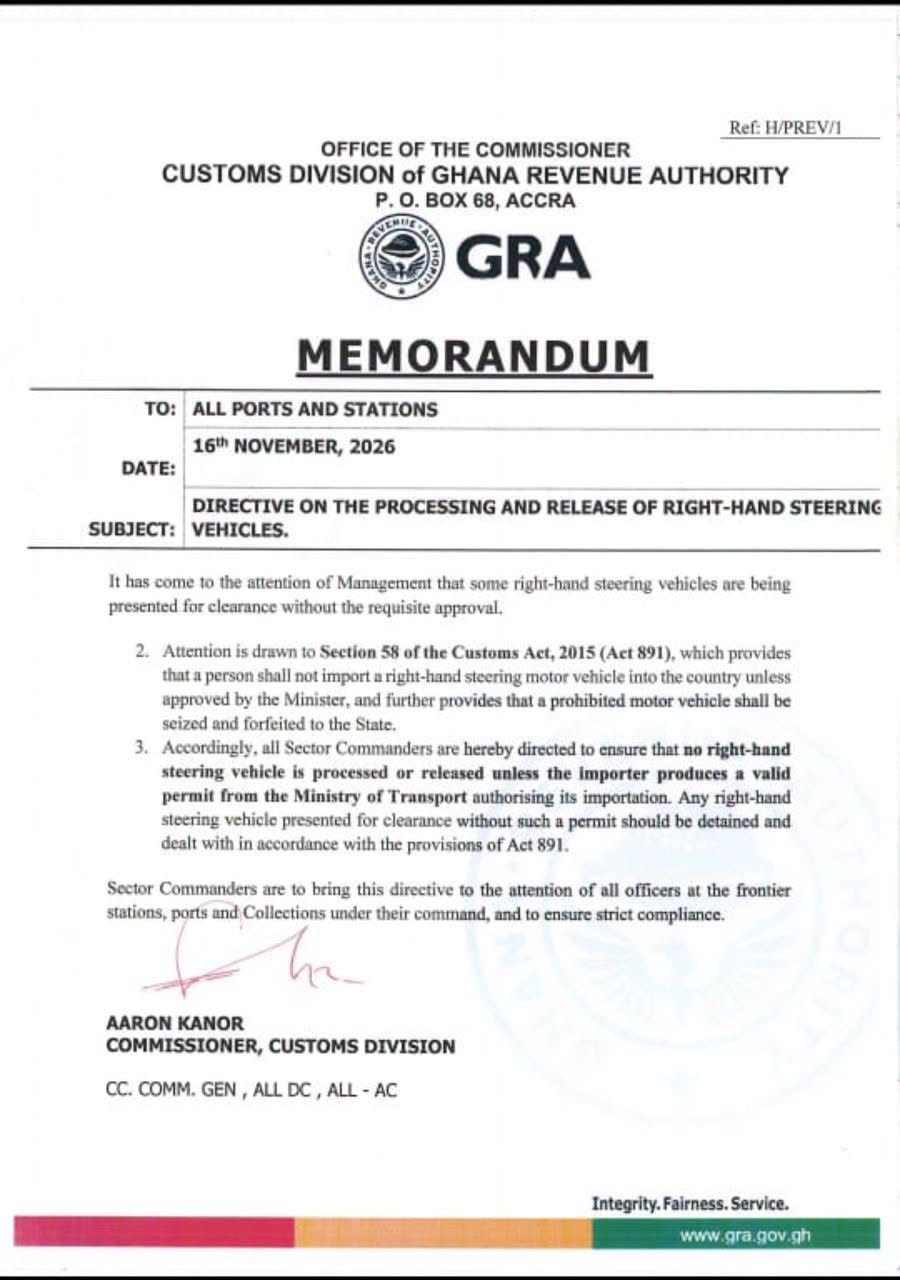
A memorandum dated 16th November 2026 and addressed to all Sector Commanders makes clear that no right-hand-drive vehicle is to be processed or released unless the importer presents a valid import permit issued by the Minister responsible for Transport. Customs officers at every frontier station, port and inland collection point have been instructed to enforce the rule without exception.
The legal basis for the crackdown is Section 58 of the Customs Act, 2015 (Act 891), which explicitly prohibits the importation of right-hand-drive motor vehicles into Ghana without ministerial approval. The same law empowers the state to seize and forfeit any vehicle brought in without the required permit. Any vehicle detained under the directive will be dealt with strictly in accordance with the provisions of Act 891, which could ultimately mean the state taking permanent ownership of the impounded cars.
The GRA said the directive was prompted by concerns that a number of right-hand-drive vehicles were being presented at ports of entry without the necessary approvals — suggesting the practice had become common enough to warrant a formal, nationwide enforcement response.
Why it matters for Ghana
Ghana drives on the right-hand side of the road, meaning right-hand-drive vehicles — where the steering wheel is on the right side of the car — are considered a road safety risk in normal traffic conditions. The restriction on their importation is therefore not merely bureaucratic; it is rooted in concerns about driver visibility and accident prevention on Ghanaian roads.
Despite the legal prohibition, right-hand-drive vehicles have continued to find their way into the country, often sourced cheaply from markets such as Japan and the United Kingdom where they are the standard configuration. For some importers, the lower purchase price of such vehicles makes them attractive, with the hope of either converting the steering or finding a way through customs.
The enforcement gap has also raised concerns about revenue losses for the state, since vehicles detained or forfeited represent imports that bypassed the full legal process. A stricter regime at the ports could reduce that leakage while also sending a clear message to the vehicle import trade.
What importers and dealers need to know
Anyone currently in the process of shipping a right-hand-drive vehicle to Ghana — or planning to do so — should be aware that the GRA is now actively enforcing the permit requirement. The consequences of arriving at port without a valid Ministry of Transport authorisation are serious: the vehicle will be held, and the importer risks permanent forfeiture to the state.
- Importers must obtain a permit from the Ministry of Transport before shipping a right-hand-drive vehicle to Ghana.
- Customs officers at all ports and border stations have been directed to detain non-compliant vehicles on the spot.
- Vehicles detained in violation of Act 891 are liable to seizure and forfeiture to the Ghanaian state.
Industry players and clearing agents are advised to familiarise themselves with the requirements under Section 58 of the Customs Act and to counsel their clients accordingly. With Sector Commanders now under direct instruction to ensure compliance across all stations under their jurisdiction, the window for leniency at the ports appears to have closed.
Source: Today GH



Comments (0)
Be the first to comment.