Ghana's youth crisis demands rethink of education and skills for the AI era, experts warn
Ghana is marking National Youth Week as the country grapples with a stark reality: nearly two million young people—representing about 19.5% of the youth population—are neither employed, in education, nor receiving training. Youth unemployment stands at 21.9% across the first three quarters of 2025, nearly double the national average of 12.8%, with Greater Accra recording youth joblessness of 31.9% and Ashanti 27.2%. These figures demand more than familiar calls for job creation; they signal the need for a fundamental reimagining of how Ghana educates and prepares its young people for an economy rapidly transformed by technology.
The technology that's reshaping work
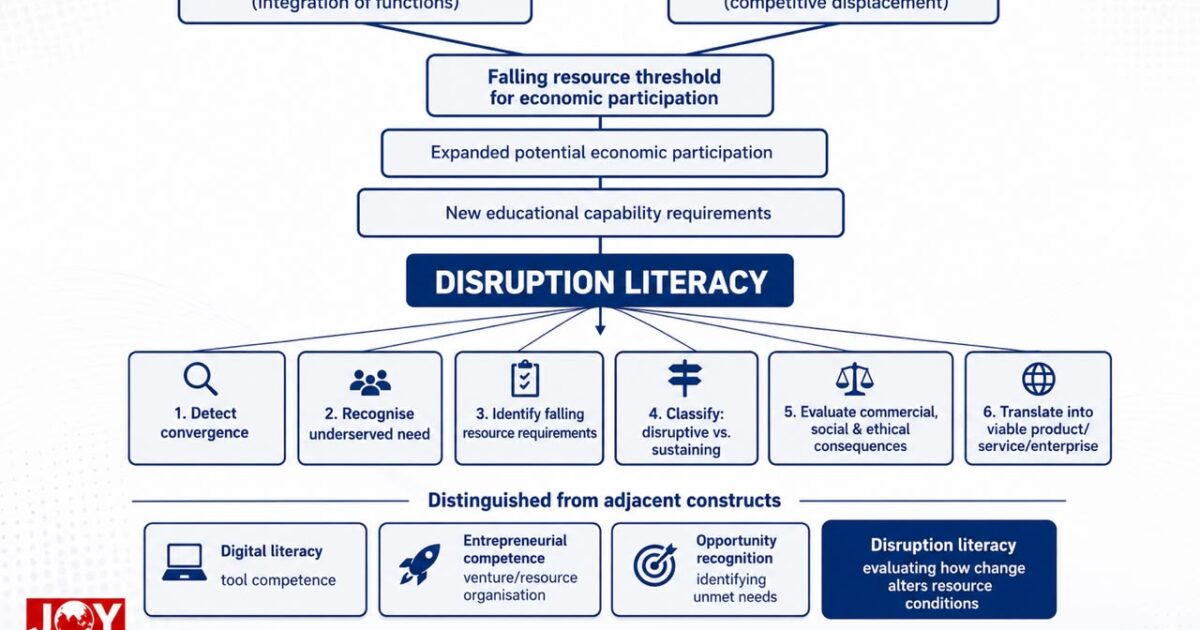
Technological convergence—the blurring of boundaries between separate technologies and their functions—is fundamentally changing who can participate in economic activity and what resources they need. A smartphone today functions simultaneously as a camera, editing suite, recording studio, design workstation, distribution platform and payment gateway. Artificial intelligence is accelerating this convergence further.
Young Ghanaians now have access to tools that previously required institutional gatekeepers. An aspiring author can write, design and distribute a book digitally without a traditional publisher. A filmmaker can produce a documentary on a smartphone without studio infrastructure. A musician can record and share music without a record label. A designer can reach clients globally without a physical agency. An entrepreneur can launch an online shop and accept digital payments without renting a storefront.
This represents a genuine shift in the economics of participation. Historically, entering industries like publishing, film, music or retail demanded substantial capital investment and access to established networks. Those barriers have collapsed for many sectors. What has not disappeared, however, is the challenge of succeeding once entry is possible. Publishing a book online is now easy; finding readers is not. Creating excellent content is possible; achieving visibility amid algorithmic sorting by social-media platforms and search engines is harder.
Why this matters for Ghana
The implications for Ghana's education system and youth employment are significant. If traditional employment pathways cannot absorb nearly two million young people, alternative models of economic participation become essential. Technology enables self-directed entrepreneurship, creator economies, and remote work in ways that were impossible a decade ago. Yet Ghana's education system was largely designed for a previous era—one focused on producing employees for formal institutions rather than enabling young people to create value independently or navigate digital platforms strategically.
The policy question is not whether technology is disruptive, but what it changes about participation, resource requirements and value creation. Ghana has already demonstrated its capacity to leapfrog conventional infrastructure: mobile money extended financial services through phones that Ghanaians already owned, allowing digital payments without traditional banking infrastructure. Sub-Saharan Africa now holds more than one billion registered mobile-money accounts.
A similar logic should guide education policy. Rather than waiting for formal employment opportunities that may never arrive at the required scale, Ghana's education system should equip youth with the digital literacy, creative skills and entrepreneurial mindsets needed to harness convergent technologies. This means rethinking curricula to emphasise problem-solving, digital tool mastery and the ability to build audiences and markets online—skills that were not traditionally taught in Ghanaian schools.
The path forward
The challenge is neither inevitable nor insurmountable. Ghana's young people possess the demographic advantage of being digital natives. They have access to technologies that democratise creation and distribution. What they often lack is structured guidance on how to translate those tools into sustainable income. Policymakers, educators and industry leaders must collaborate to bridge that gap—not through job-creation schemes alone, but through education that recognises how economic value itself is being created in the 21st century.
Source: MyJoyOnline



Comments (0)
Be the first to comment.