
Ghana's T-bills auction falls 22% short of target, but borrowing costs ease further


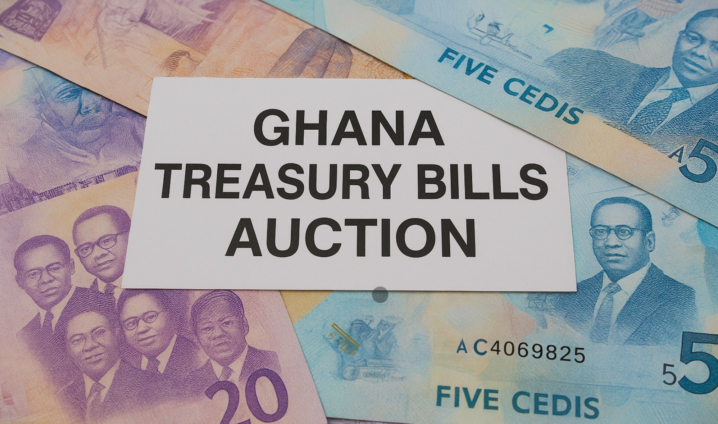
Ghana's latest treasury bills auction has come up significantly short of government's borrowing target, with bids accepted falling roughly 22% below the GH¢5.57 billion the government had set out to raise. According to Bank of Ghana auction results, total bids tendered reached GH¢4.33 billion, of which the government accepted GH¢3.44 billion — leaving a notable shortfall that will likely prompt attention from investors and fiscal analysts tracking the country's debt management strategy.
Breaking down the numbers
The 91-day bill dominated activity, attracting bids of approximately GH¢2.74 billion, with GH¢2.51 billion of that accepted — making it by far the most popular instrument and accounting for around 63% of total bids. The shorter tenor continues to appeal to investors who prefer to keep their exposure limited given ongoing uncertainty in the broader economic environment.
The 182-day bill drew bids of about GH¢721.62 million, with GH¢596.62 million accepted. Meanwhile, the 364-day bill attracted GH¢873.41 million in bids, though only GH¢344.81 million was taken up by government — suggesting the authorities were selective about how much longer-term debt they were willing to absorb at prevailing rates.
Despite the undersubscription, all three instruments recorded falling yields. The 91-day bill eased by one basis point to 4.55%, the 182-day bill dropped four basis points to 6.16% from 6.20% the previous week, and the 364-day bill declined two basis points to 9.46%. The consistent movement lower across the yield curve signals a continued softening in the cost of short-term government borrowing.
What this means for Ghana's finances
Treasury bills are a key tool through which the government manages its short-term financing needs — paying for day-to-day expenditure and rolling over maturing obligations. A shortfall of this magnitude means the government raised less than it needed from domestic investors, which could place pressure on liquidity management at the Ministry of Finance.
That said, the silver lining is the direction of interest rates. Falling yields on T-bills reflect improved investor confidence in Ghana's macroeconomic trajectory — a trend that has been building as the country advances through its IMF-supported recovery programme following the 2022 debt crisis. Lower borrowing costs reduce the burden on the public purse over time and are a broadly positive sign for fiscal sustainability.
The preference for shorter-dated instruments like the 91-day bill also tells a story: many investors remain cautious about committing capital over longer periods, even as confidence gradually returns. This risk-averse posture is common in post-crisis environments and is likely to persist until the macroeconomic outlook becomes more decisively stable.
The broader context
Ghana has been working to rebuild trust with domestic and international investors following the restructuring of its debt, which affected bondholders and contributed to significant economic disruption. The T-bills market — which was largely excluded from the domestic debt exchange — has remained functional throughout this period, serving as a relatively safe short-term savings vehicle for banks, pension funds and institutional investors.
The decline in yields, if sustained, could gradually encourage more investment into longer-dated instruments, deepening the domestic capital market and reducing the government's reliance on external borrowing. For now, however, analysts and market watchers will be keeping a close eye on whether future auctions can close the gap between target and actual uptake — a key indicator of how much appetite exists for Ghanaian government securities at home.
Source: MyJoyOnline



Comments (0)
Be the first to comment.