
Ghana's Music Industry in Crisis: How CRBT Platforms Exploit Artists While Telecom Giants Profit
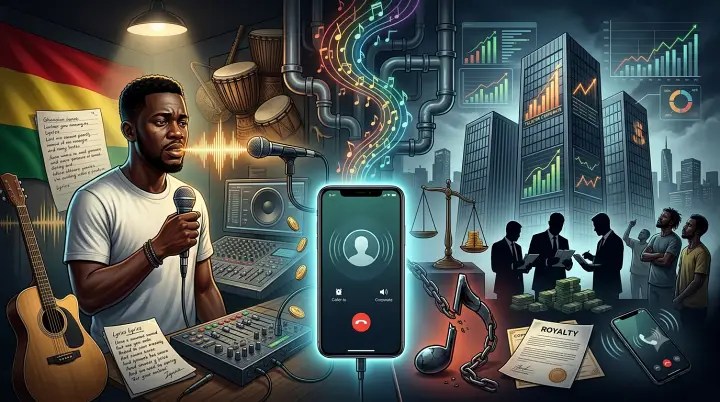
Ghana's thriving music industry faces a stark reality: the artists fuelling the country's Caller Ring Back Tone (CRBT) economy are among the poorest beneficiaries of the business their talent sustains. For nearly two decades, telecom operators have generated substantial revenues from CRBT services—a platform entirely dependent on Ghanaian music—while creators struggle with basic welfare needs.
The disparity has ignited serious questions about fairness, accountability and respect for intellectual property in an industry where success stories rarely reach those who write, produce and perform the songs.
How the Money Actually Flows
The CRBT model appears straightforward: customers pay an activation fee to set a favourite song as their caller tune, then maintain a monthly subscription to keep the service active. Yet the financial breakdown reveals a troubling imbalance.
Telecom operators reportedly retain approximately 70 percent of activation fee revenue. Aggregators receive roughly 30 percent, but after deducting their own operational costs, musicians and record labels are left with estimates between 11 and 15 percent of the original payment.
For context, this means a customer paying GHS 5 for activation might see the telecoms pocket GHS 3.50, aggregators take GHS 1.50, leaving creators with between GHS 0.55 and GHS 0.75. Yet without these creators—the songwriters, producers and artists—no caller tune exists to sell.
The argument that infrastructure and technology investments justify such margins becomes increasingly difficult to defend, particularly when recurring monthly subscriptions already finance platform maintenance and server costs. Infrastructure deserves compensation, but not at the expense of disproportionate enrichment.
The Mechanical Royalties Standoff
Beyond the activation fee dispute lies an even more contentious issue: mechanical royalties for musical compositions themselves.
International copyright law recognises two distinct rights: the sound recording copyright (protecting performers and record labels) and the underlying musical composition copyright (protecting songwriters, composers and publishers). Globally, CRBT platforms honour both obligations.
Ghana's experience tells a different story. Composers and publishing rights holders have waited over a decade for full recognition of these rights. GHAMRO, Ghana's music rights organisation, has pursued the matter through the courts and secured a High Court decision affirming the obligation to pay appropriate royalties. Yet court victories mean little without compliance.
The uncomfortable truth: if telecom operators reportedly honour comparable royalty obligations in other African countries, Ghanaian creators have legitimate grounds to question why they should accept less protection and compensation within their own borders.
Why It Matters for Ghana
This is not merely a commercial disagreement between corporations and artists. It strikes at the heart of whether Ghana can build a sustainable creative economy where musicians remain viable professionals rather than struggling hobbyists.
Ghana's music industry has become a significant economic and cultural asset, generating international recognition and revenue streams. Yet that success rings hollow for creators whose basic welfare remains precarious. Industry leaders cannot celebrate CRBT as a major revenue opportunity while ignoring that the people creating the music receive minimal benefit.
MUSIGA, the Ghana Music Union, was established specifically to protect musicians' interests and improve their welfare. Similarly, GHAMRO's legal battles have highlighted the necessity of enforcing intellectual property rights. Both organisations now face pressure to move beyond courtroom victories toward transparent, equitable commercial agreements that ensure creators receive fair compensation for their work.
Without reform, Ghana risks losing creative talent to markets offering better protection and reward. The alternative—a sustainable music industry where artists earn dignified livings from their work—requires telecom operators to accept more modest margins and industry bodies to demand accountability.
The message is clear: respect for creators should not depend on geography, and the law should not become flexible based on profit margins.
Source: Ameyaw Debrah




Comments (0)
Be the first to comment.