
Ghana's Courts Grind to a Halt as Judicial Staff Strike Over Unpaid Salary Arrears
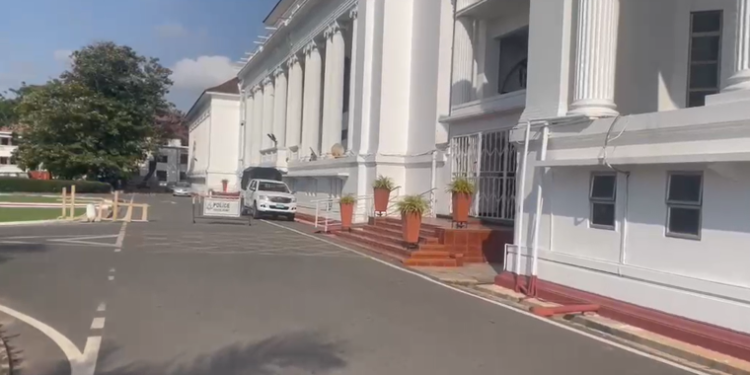

Ghana's judicial system has been thrown into disarray as the Judicial Service Staff Association of Ghana (JUSAG) commenced an industrial strike that has effectively shut down court operations in several parts of the country. The action, which has locked the gates of some of the nation's most prominent courts, underscores a deepening dispute between judicial workers and the government over unpaid salary arrears.
Courts locked, red cloth signals workers' grievances
The impact of the strike was immediately visible across Ghana's court landscape. The Supreme Court, the Court of Appeal, the Accra Circuit Court, and a number of District Court offices were locked shut, with security personnel stationed at entrances to restrict access to the premises.
In a symbolic show of solidarity and protest, red cloth was tied at several court entrances — a traditional and widely understood signal in Ghana's labour action culture, used to draw public attention to the workers' grievances and signal that business will not proceed as usual.
The disruption means that litigants, lawyers, defendants on bail, and members of the public with scheduled court appearances have been left stranded, unable to access justice services. Cases that were due to be heard have been adjourned indefinitely, raising concerns about the backlog that is likely to accumulate the longer the strike continues.
What sparked the strike
At the heart of the industrial action is JUSAG's demand for the payment of outstanding revised salary arrears that date back to January 2026. The association argues that despite prior agreements and negotiations, the arrears have not been settled, leaving judicial service staff without pay they are rightfully owed.
Judicial workers, like many public sector employees in Ghana, have long raised concerns about delays in the implementation of salary revisions and the payment of agreed-upon remuneration. When such adjustments are negotiated and approved but not actually reflected in workers' pay, the financial burden on employees can be significant — particularly in a period of elevated cost of living.
JUSAG's decision to proceed with the strike suggests the association had exhausted other avenues for dialogue before resorting to industrial action.
Why it matters for Ghana
The closure of courts is not merely an inconvenience — it strikes at the heart of Ghana's constitutional right to access justice. Citizens awaiting trial, victims seeking redress, businesses involved in commercial disputes, and individuals fighting for their rights are all directly affected when the judicial system comes to a standstill.
A prolonged strike could worsen Ghana's already stretched court docket, where case backlogs have been a persistent challenge. Remand prisoners — those held in custody awaiting trial — are among the most vulnerable groups likely to be affected, as their cases cannot be heard or reviewed during the strike period.
Judicial Secretary Musah Ahmed has appealed to JUSAG to suspend the strike, stating that management has been engaged in high-level, good-faith negotiations with relevant government stakeholders to find a resolution. However, as of the time of this report, the association had not indicated any intention to call off the action.
The standoff puts pressure on the government to expedite the release of the outstanding arrears. Labour analysts and legal practitioners are likely to watch this situation closely, given the broader implications for public sector wage disputes and the government's credibility in honouring agreements with workers across other state institutions.
- Ghanaians with pending court matters are advised to contact their legal representatives for guidance on rescheduled hearings.
- The duration of the strike will depend largely on how quickly the government responds to JUSAG's salary demands.
- Similar strikes in the past have been resolved through emergency government intervention, though timelines have varied.
Source: Today GH




Comments (0)
Be the first to comment.