
Ghana's Bond Market Cools as Weekly Turnover Drops Nearly Half to GH¢5.03bn

Ghana's bond secondary market experienced a significant slowdown last week, with total turnover plunging by 44.87% week-on-week to GH¢5.03 billion. The sharp decline signals a more cautious trading environment as investors keep a close eye on upcoming economic data that could reshape their expectations for interest rates and portfolio positioning.
Where the Trading Action Was
Despite the overall dip in activity, trading did not dry up entirely — it simply concentrated in specific segments of the market. Bonds maturing between 2027 and 2030 proved to be the most attractive to investors, capturing 57.83% of total turnover at a weighted-average yield of 13.03%. This medium-term cluster suggests that many market participants remain comfortable locking in returns over a three-to-five year horizon without venturing too far out on the yield curve.
The 2031 to 2034 maturity segment came in second, accounting for 41.69% of turnover at a weighted-average yield of 14.52%. Together, these two buckets made up nearly the entirety of the week's trading, leaving very little room for anything else. Bonds maturing beyond 2035 attracted minimal interest, contributing just 0.49% of turnover at a weighted-average yield of 15.06% — a reflection of the heightened uncertainty investors still attach to longer-dated instruments in Ghana's current economic climate.
What This Means for Ghana's Debt Market
The concentration of trading in medium-term bonds is telling. It suggests that institutional investors — including pension funds, banks and asset managers who are the primary participants in Ghana's secondary bond market — are not yet confident enough to take on significant long-term exposure. The higher yield demanded on post-2035 bonds, at 15.06%, compared to 13.03% on the 2027-2030 bucket, reflects the risk premium the market continues to attach to longer-dated government debt.
Ghana has been in the process of rebuilding credibility in its domestic debt market following the Domestic Debt Exchange Programme (DDEP) that was implemented as part of the country's IMF-supported economic recovery programme. While conditions have gradually stabilised, the relatively thin volumes in the latest trading week are a reminder that full confidence has not yet been fully restored, and that market participants remain sensitive to macroeconomic signals.
Eyes on Inflation Data
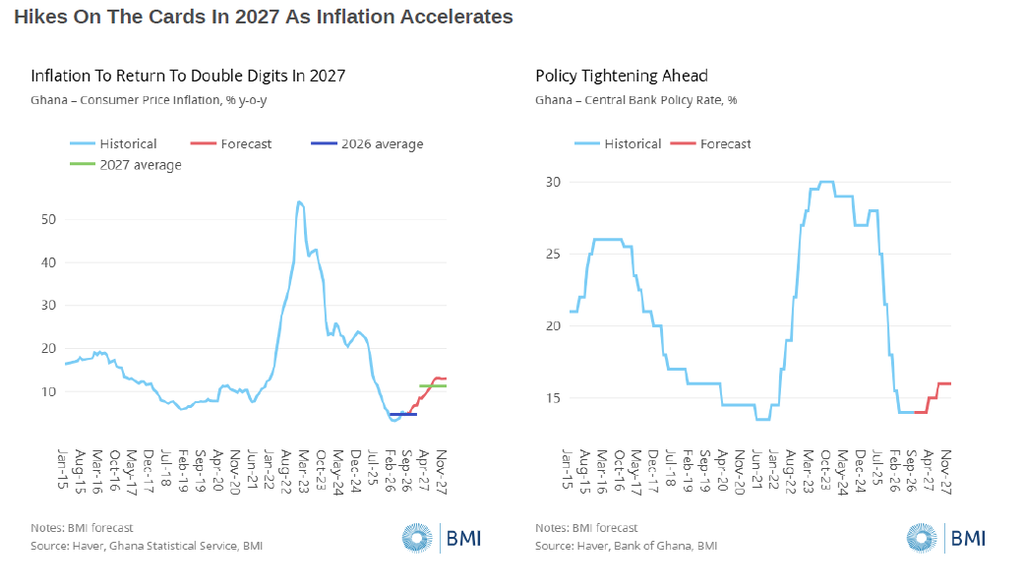
Looking ahead, analysts at Databank Research have highlighted the upcoming inflation data release as a key catalyst that is likely to shape bond market activity in the near term. Inflation figures in Ghana have been on a gradual downward trajectory after peaking at exceptionally high levels during the economic crisis, and any surprise — whether to the upside or downside — could prompt investors to quickly reprice their expectations for the Bank of Ghana's monetary policy stance.
If inflation comes in lower than expected, it could fuel optimism that the central bank may have room to cut its benchmark interest rate further, potentially pushing yields lower and boosting bond prices. On the other hand, a higher-than-anticipated reading could cause investors to hold back or demand higher yields, adding further pressure to trading volumes.
- A lower inflation print could encourage more aggressive buying in the medium-to-long end of the curve.
- A higher inflation reading may prompt investors to remain on the sidelines or shift to shorter-dated instruments.
- Pension funds and banks will likely be the first movers once the data is out, given their large fixed-income portfolios.
For everyday Ghanaians, the bond market's performance may seem distant, but it has real consequences — it influences the government's cost of borrowing, which in turn affects how much money is available for public services, infrastructure and social programmes. A healthier, more liquid bond market ultimately supports Ghana's broader fiscal recovery journey.
Source: The Ghana Report

Comments (0)
Be the first to comment.