
Ghana Rolls Out 21-Day Ebola Watch for Travellers Amid Deadly African Outbreak
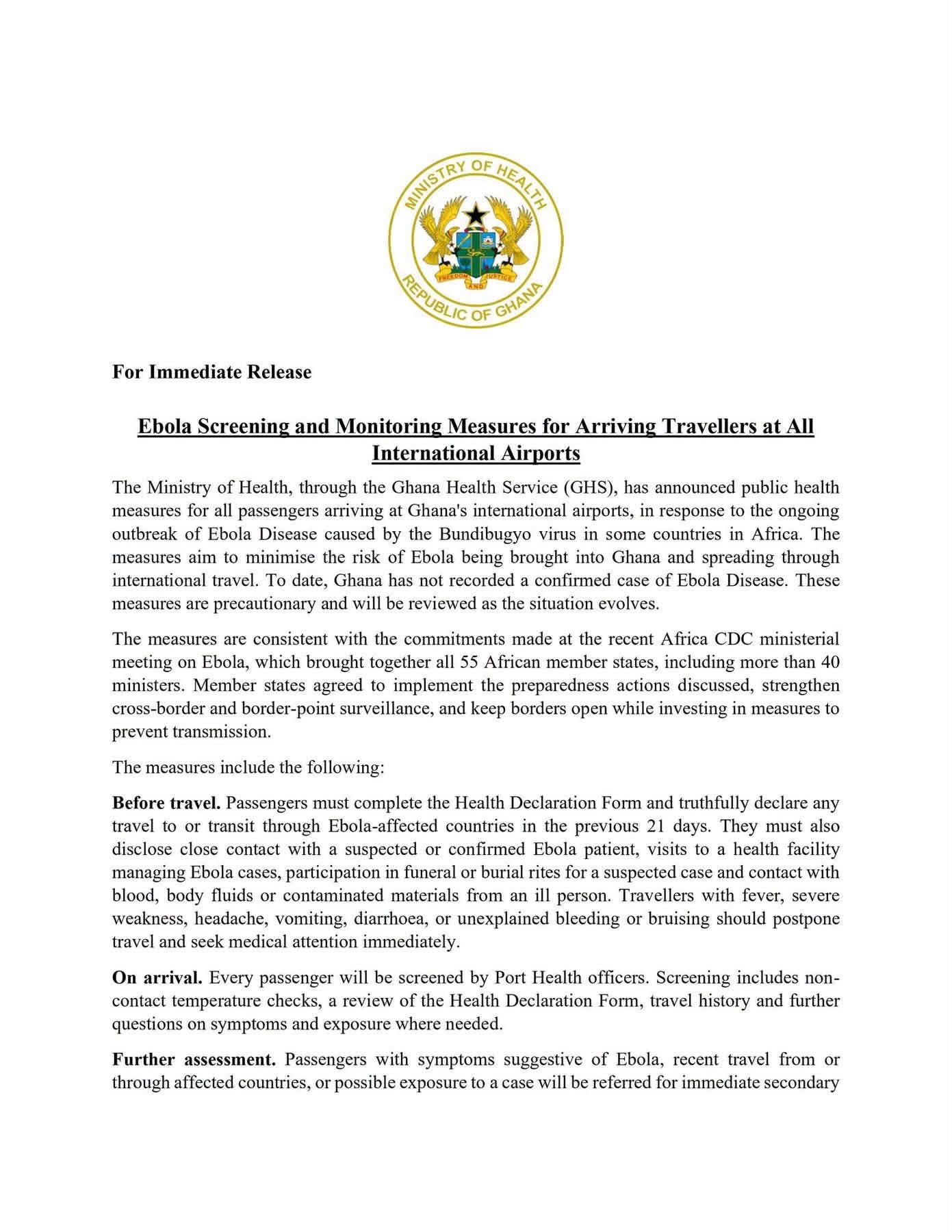

Ghana's Ministry of Health has activated a strict surveillance programme requiring all travellers arriving from Ebola-affected countries to undergo a 21-day monitoring period, as authorities move to shield the country from what has become one of the deadliest Ebola outbreaks recorded on the continent in recent years.
What the new measures involve
Under the directive, the Ghana Health Service (GHS) will proactively contact travellers identified as arriving from countries experiencing active transmission of the Bundibugyo strain of Ebola throughout the full monitoring window. Travellers are required to submit accurate and reachable contact details upon arrival and must report any emerging symptoms without delay.
All passengers entering Ghana through international airports will face mandatory screening by Port Health officers. This includes temperature checks, review of health declaration forms and an assessment of recent travel history. Anyone who has visited or transited through an Ebola-affected country within the 21 days prior to arrival must declare that information, along with any known contact with suspected or confirmed cases of the disease.
Passengers presenting symptoms — including fever, vomiting, diarrhoea, severe weakness or unexplained bleeding — will be referred for further clinical assessment and, where necessary, placed in temporary isolation for medical care.
The Ministry has also extended its net beyond airports. Hotels, conference centres and similar hospitality establishments have been directed to report guests arriving from affected countries to the nearest district health directorate and retain those guests' contact information for follow-up purposes.
Importantly, the Ministry warned that passengers who deliberately withhold travel information, conceal symptoms or refuse to cooperate with Port Health officers could face sanctions under Ghanaian public health law.
Why it matters for Ghana
Ghana currently has no confirmed Ebola cases, and the Ministry has been clear that these measures are precautionary rather than reactive. However, the scale of the ongoing outbreak elsewhere on the continent makes the precautions significant. According to the Africa Centres for Disease Control and Prevention (Africa CDC), the outbreak — declared in May — has resulted in more than 10,400 confirmed cases and over 5,300 deaths, making it an acute regional health emergency.
The Bundibugyo strain, named after the Ugandan district where it was first identified in 2007, is one of several species of the Ebolavirus genus. Like other strains, it spreads through direct contact with the blood, secretions or bodily fluids of infected individuals, making early detection and isolation critical to containing any spread.
Ghana's position as a major West African aviation hub — with Kotoka International Airport serving as a key transit point — means the country faces a genuine exposure risk when outbreaks occur elsewhere on the continent. The measures announced reflect lessons learned from previous health emergencies, including the 2014–2016 West Africa Ebola crisis, during which robust screening at points of entry proved vital in limiting cross-border transmission.
Public guidance and what to do
The Ministry of Health has urged the public to remain calm and to rely exclusively on information from official sources — specifically the Ministry itself and the Ghana Health Service — rather than sharing unverified reports or rumours about the outbreak, which could cause unnecessary panic.
- Anyone who has recently returned from a country with active Ebola transmission should monitor themselves for symptoms including fever, body weakness, vomiting or unexplained bleeding.
- Symptoms should be reported immediately to the nearest health facility or the GHS hotline rather than attempting to self-treat or delay seeking care.
- Members of the public should avoid handling the bodies of individuals who may have died from unknown causes, as Ebola can remain transmissible after death.
Health authorities have stressed that with swift and transparent cooperation between the public and health services, the risk of any outbreak taking hold in Ghana can be kept extremely low.
Source: The Ghana Report




Comments (0)
Be the first to comment.