
Free SHS Food Suppliers Set for Five-Day Accra Protest Over Unpaid 2024 Debts
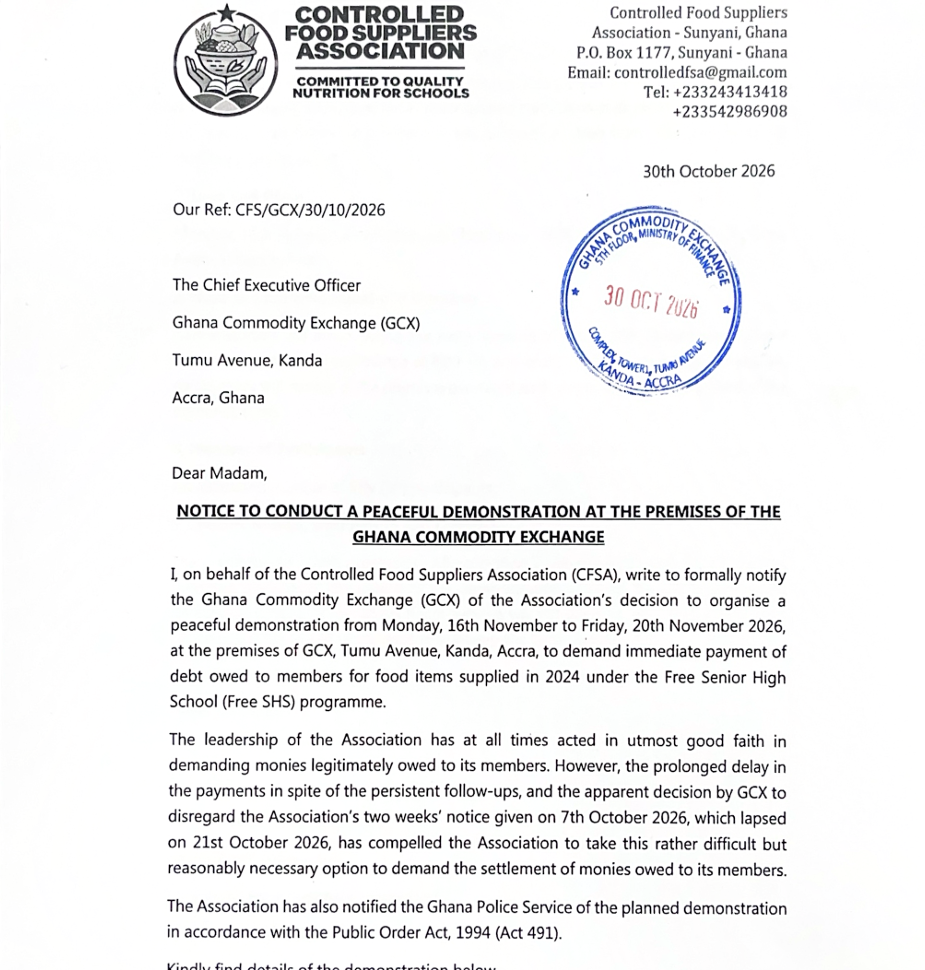

Food suppliers who delivered goods to senior high schools under Ghana's flagship Free Senior High School programme are preparing to take their frustrations to the streets of Accra, announcing a five-day demonstration at the Ghana Commodity Exchange (GCX) over debts they say have remained unpaid since 2024.
The Controlled Food Suppliers Association (CFSA) has formally notified the GCX of its intention to mount a protest from 16 to 20 November 2026, warning that its members can no longer absorb the financial strain caused by the prolonged payment delays.
How the dispute reached this point
According to the association, the payment crisis stems from food items supplied to Free SHS institutions during 2024 — supplies for which the GCX has not fully settled outstanding amounts. The CFSA says it has pursued the matter through multiple engagements and official follow-ups, all of which have failed to produce a resolution.
In what it hoped would be a decisive step, the association issued a formal two-week ultimatum to the GCX on 7 October 2026, demanding that the debts be cleared by 21 October 2026. When that deadline passed without any adequate response from the Exchange, the CFSA said it had no choice but to escalate its action.
The formal notice, signed by the association's Administrative Secretary, Cornelius Korku Logo, stated that the leadership had at all times acted in good faith in pursuing payments it described as legitimately owed to its members. It added that the apparent decision by the GCX to disregard the ultimatum had made the planned demonstration a necessary, if difficult, course of action.
Why it matters for Ghana
The Free Senior High School programme, introduced in 2017, remains one of Ghana's most consequential social interventions, providing tuition-free education to hundreds of thousands of students across the country. A critical component of the programme is the feeding arrangement, which relies on private suppliers — like those represented by the CFSA — to ensure students receive meals throughout the academic term.
When payments to these suppliers stall, the consequences can ripple far beyond the businesses themselves. Suppliers who are owed money may struggle to restock, secure credit, or continue operating, all of which could ultimately threaten the consistent supply of food to schools. The dispute therefore raises legitimate questions about the financial management and payment systems underpinning the programme.
The Ghana Commodity Exchange was established partly to bring structure and efficiency to the procurement of agricultural and food commodities, including those destined for government programmes. Its alleged failure to settle supplier debts in a timely manner could undermine confidence in that system and deter future participation by suppliers.
What happens next
The CFSA has made clear that the five-day protest is designed to apply direct pressure on the relevant authorities to act. Should the demonstration go ahead as planned, it is likely to draw public attention to the broader issue of how government-linked institutions manage obligations to private sector partners who support social programmes.
- Observers will be watching whether the GCX responds before the November deadline with any offer of payment or engagement.
- The outcome could also influence how other supplier groups — in health, education and elsewhere — approach similar disputes with state institutions.
- For the government, a visible standoff at a flagship programme's supply chain just weeks away would be an unwelcome development.
The GCX had not issued a public response to the association's notice at the time of reporting. GH Today will continue to follow developments as the November demonstration date approaches.
Source: MyJoyOnline



-800x436.webp)
Comments (0)
Be the first to comment.