
Egya Tur Goes Digital: What Ghana's New Traffic Cameras Say About Us
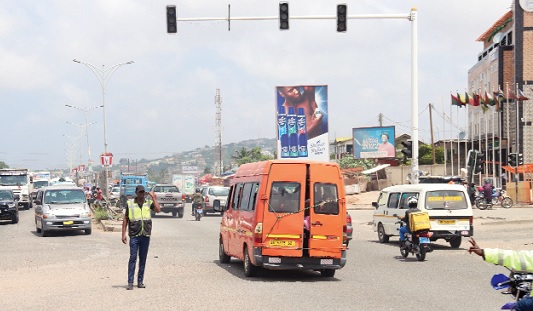

Something remarkable happened on Ghanaian roads recently. Trotros paused at zebra crossings. Drivers observed lane discipline. The usual cheerful negotiation between motorist and traffic officer was nowhere to be found. The explanation, it seems, was simple: the cameras were watching. Ghana's rollout of traffic enforcement cameras has triggered a quiet but telling transformation in road behaviour — and it raises questions that go well beyond road safety.
The camera where a bribe cannot follow
For generations, the relationship between Ghanaian motorists and traffic enforcement has been, to put it diplomatically, flexible. A police officer at a checkpoint is a human being — someone who can be greeted warmly, whose family can be enquired after, and with whom a small understanding can be reached. A camera offers no such opening. It does not accept "something small." It cannot be reminded that we are all brothers. It simply records.
This is precisely what makes the technology so significant. The behavioural change observed on Ghana's roads following the introduction of the cameras was not driven by a sudden awakening of civic virtue, nor by a newfound fear of fines — Ghanaians have historically shown little alarm at penalties that can be renegotiated. It was driven by uncertainty. Nobody quite knew what the camera would do with what it saw. And that uncertainty, ancient in its power, produced obedience.
A well-known Fante anecdote captures this perfectly. Prisoners left guarded only by an unattended cannon would not flee, even when their captors had long vanished. One by one they would address the silent weapon — "Egya tur, mereko sanchin maaba" ("Sir Cannon, I am going to urinate and return") — and dutifully return. The cannon may never have fired. Nobody wished to find out. Ghana's traffic cameras are, in this sense, the digital descendant of Egya Tur.
Why it matters for Ghana
Road safety is a serious public health concern in Ghana. The country consistently records some of the highest road traffic fatality rates in West Africa, with the National Road Safety Authority reporting thousands of deaths and tens of thousands of injuries on Ghanaian roads each year. Speeding, reckless overtaking and general disregard for traffic regulations are frequently cited among the leading causes. Human enforcement alone has proved insufficient — not because officers lack dedication, but because the system creates too many opportunities for informal resolution.
Technology-assisted enforcement, if implemented consistently and fairly, could meaningfully shift that calculus. When the consequence of a violation is a recorded image rather than a negotiable encounter, the incentive structure changes entirely. Early evidence from the camera rollout — even if anecdotal — suggests that Ghanaian drivers are capable of extraordinary discipline when they believe they are being watched impartially.
But the cameras alone will not be enough. Several practical gaps remain. Speed limit signs are missing on numerous stretches of road, leaving drivers uncertain of the precise limit they are expected to observe. It is reasonable to expect that a state with the capacity to photograph and process number plates should also have the capacity to erect and maintain legible road signs. Additionally, on many routes the infrastructure itself — cratered with potholes that have, as one observer drily noted, been enforcing speed limits for years without salary or pension — renders camera enforcement almost redundant.
The entertainment question and what comes next
The cameras form part of a broader set of new road transport regulations that also target hawking and preaching inside moving commercial vehicles. Both practices are deeply embedded in the daily texture of Ghanaian public transport. The itinerant preacher and the travelling medicine hawker have long served as an informal distraction from the heat, the noise and the general indignities of a long trotro journey. Whether enforcement of this particular rule is practical — and who will fill the resulting silence — remains an open question.
What is clear is that technology, thoughtfully deployed, has the potential to do what decades of public education campaigns and checkpoint enforcement have struggled to achieve. The challenge now is for the authorities to match the ambition of the cameras with equal attention to the basics: the signs, the roads, and the systems that give the cameras genuine meaning.
- Ghana's new traffic cameras appear to have produced an immediate, visible improvement in road behaviour.
- The effect stems from uncertainty about consequences rather than fear of fines alone.
- Experts and observers say road signs and infrastructure must improve alongside camera enforcement.
Source: MyJoyOnline



Comments (0)
Be the first to comment.