
Education Minister Haruna Iddrisu Pushes for GH¢100m GETFund Cash to Boost Local School Furniture Production
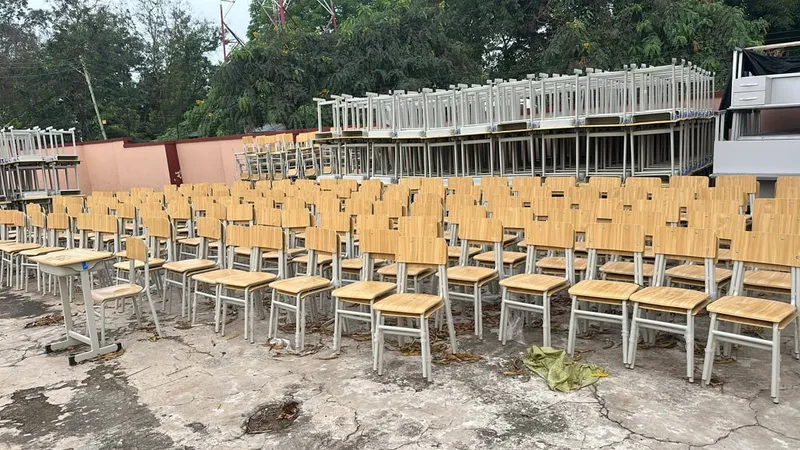

Education Minister Haruna Iddrisu has made a bold pitch to Parliament, calling for GH¢100 million from the Ghana Education Trust Fund (GETFund) to be channelled directly to local manufacturers — including St Paul's Technical Institute at Kukurantumi — to produce desks and beds for schools across the country. The proposal signals a deliberate push to solve Ghana's chronic school furniture shortage while simultaneously strengthening homegrown industries.
What Iddrisu is proposing
Speaking before Parliament, the minister argued that rather than importing school furniture or awarding contracts to outside suppliers, GETFund resources should be directed to institutions already equipped to do the work locally. St Paul's Kukurantumi, a well-known technical institution in the Eastern Region, was specifically cited as one of the facilities that could benefit from and deliver on such a mandate.
The proposal is essentially a two-in-one intervention: address the persistent shortage of desks and sleeping facilities in Ghanaian schools, while at the same time providing a sustainable source of funding and work for local technical and vocational institutions. Under the arrangement, these institutions would use the GETFund allocation to procure raw materials, engage skilled labour, and produce furniture at scale for distribution to schools in need.
Iddrisu's argument leans heavily on the logic of keeping public money within the domestic economy — a principle that resonates strongly at a time when Ghana is working to stabilise its finances and reduce import dependency. By directing GETFund resources to local producers, the government would not only furnish classrooms but also create jobs and sharpen the skills of students and workers in the technical and vocational sector.
Why it matters for Ghana
Ghana's schools, particularly in rural and peri-urban communities, have long struggled with inadequate furniture. It is not uncommon for students to sit on floors, share a single desk among several pupils, or sleep on bare concrete in boarding facilities. The situation affects learning outcomes, pupil comfort, and school enrolment — especially at the junior and senior high school levels.
GETFund was established specifically to mobilise resources for educational infrastructure, making it the natural vehicle for such an intervention. However, the fund has historically faced criticism over how its money is disbursed, with concerns about procurement irregularities and slow delivery. Iddrisu's proposal to route funds through identifiable, accountable local institutions could address some of those transparency concerns.
Beyond the classroom, there is a broader economic argument. Technical and vocational education and training (TVET) institutions like St Paul's Kukurantumi are precisely the kinds of facilities the government has repeatedly said it wants to elevate. Giving them large, government-backed production contracts would validate their role in the national economy and demonstrate that TVET graduates can contribute meaningfully to public infrastructure.
The bigger picture
The minister's proposal comes as the government seeks to align education spending with wider industrial policy goals. Ghana has committed under various frameworks to boosting local content and reducing the outflow of public funds to foreign or non-productive entities. Furniture manufacturing, while modest in scale compared to other sectors, is a practical starting point — the raw materials are largely available domestically, the skills exist in TVET institutions, and the demand from schools is enormous and consistent.
Parliament is yet to formally approve the allocation, and it remains to be seen how the proposal will fare during budget and appropriations discussions. Nevertheless, Haruna Iddrisu's intervention has renewed attention on both the state of school infrastructure and the untapped potential of Ghana's technical institutions to serve as engines of local production.
- GH¢100 million from GETFund proposed for local school furniture manufacturing.
- St Paul's Technical Institute, Kukurantumi, named as a key potential beneficiary.
- Proposal aims to tackle classroom furniture shortages while supporting local TVET institutions.
Source: 3News




Comments (0)
Be the first to comment.