
Dutch-backed horticulture project transforms Ghanaian farming with climate-smart technology and business skills
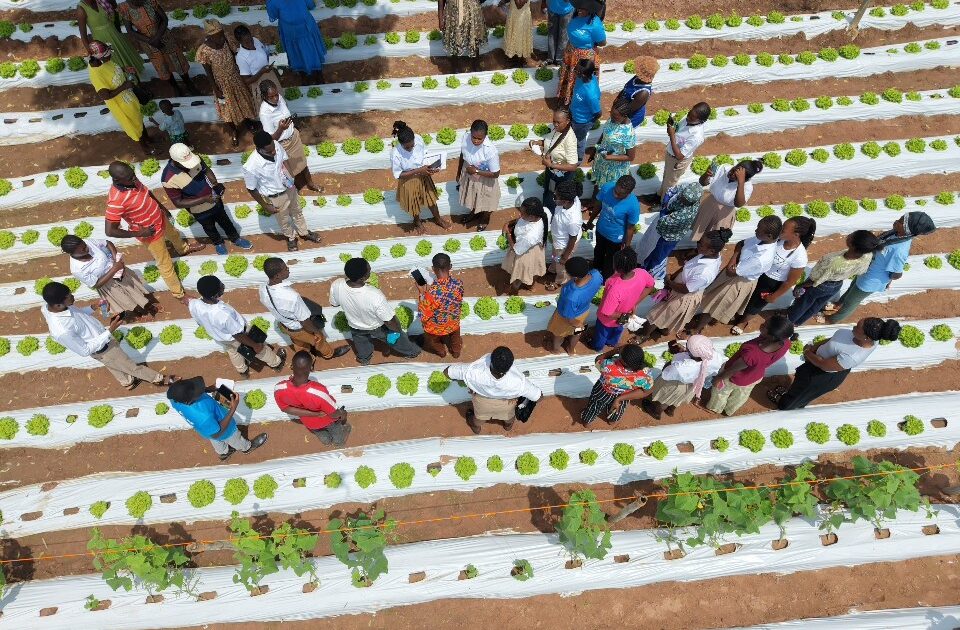

A movement to revolutionise how Ghanaian smallholder farmers work the land is gaining momentum through a four-year initiative bringing climate-smart horticulture techniques directly to demonstration farms across the country. The Agricultural Colleges for Horticulture Innovation (ACHI) Project, running from 2024 to 2028 with support from the Netherlands Enterprise Agency and implemented by TU Delft and Holland Greentech, is training students, graduates and practising farmers in methods that promise significantly higher yields from smaller plots using fewer resources.
The initiative reflects a shift in how Ghana's agricultural sector approaches the perennial challenge of land scarcity and water stress. Rather than encouraging farmers to expand cultivation into marginal lands, the project demonstrates how drip irrigation, plastic mulch, improved hybrid seeds and integrated pest management can transform productivity on existing plots. At the demonstration farm at Ejura College of Agriculture and Mechanisation Centre, trainees like Obiri Yeboah Daniel from Asante Mampong have moved beyond textbook learning to hands-on experience, dramatically increasing their confidence to adopt these methods at scale.
Building skills beyond the classroom
The ACHI Project operates across five agricultural colleges in Ghana, creating a network of learning sites where practical training bridges the gap between theory and commercial reality. Students and farmers are not simply shown how to use drip irrigation or plastic mulch; they are assigned their own demonstration plots to experiment, observe and troubleshoot. This experiential approach has proven powerful for young people uncertain about pursuing agriculture as a career.
At Ejura, farm manager Elizabeth Aboagyewa Amoah oversees a teaching garden where students learn the complete value chain—from irrigation management and crop production through harvesting, grading, quality control and marketing. The farm's produce is sorted and sold to markets in Kumasi and beyond, giving trainees exposure to the commercial realities they will face as entrepreneurs. This practical foundation is reinforced through four-month business training modules covering financial management, cost analysis and enterprise development. Several early graduates have already launched viable businesses in produce aggregation and post-harvest services, demonstrating that the model works.
Why this matters for Ghana
Ghana's agricultural sector faces mounting pressure to feed a growing urban population whilst youth unemployment and rural-to-urban migration accelerate. Many young Ghanaians view farming as a low-income, backward pursuit with little technological sophistication. The ACHI Project directly counters this perception by showing that modern, efficient horticulture can be both technically engaging and financially rewarding.
For smallholder farmers—who represent the backbone of Ghanaian agriculture—the promise of producing more from less land addresses a critical bottleneck. As climate variability increases dry seasons and water stress, technologies like drip irrigation become essential rather than optional. The project's emphasis on affordable, locally-tested solutions means the techniques are relevant to Ghana's farming conditions rather than generic imports unsuitable for local contexts.
The business dimension is equally significant. By training graduates not only in crop production but in logistics, storage and aggregation, the project opens pathways for young people who may lack capital or family land to enter agriculture profitably. This could help redirect youth energy into the horticultural value chain—an area where Ghana has competitive advantage and substantial unmet domestic demand, particularly for high-quality fresh vegetables in growing cities.
Programme manager Deborah Anobil emphasises that success depends on affordability and accessibility of technologies. Whilst the demonstration farms prove these methods work, scaling them across Ghana's diverse farming communities will require sustained support, credit schemes and perhaps subsidised input programmes to help smallholders afford initial investments in drip systems and quality seeds.
As the project progresses through 2028, attention will turn to how lessons from Ejura and other college farms can cascade into communities and cooperatives beyond the demonstration sites—and whether Ghanaian policymakers will create enabling conditions for the agricultural transformation the ACHI Project is pioneering.
Source: MyJoyOnline




Comments (0)
Be the first to comment.