
AI in Ghanaian hospitals is saving lives—but nobody is checking if it actually works for Ghanaians
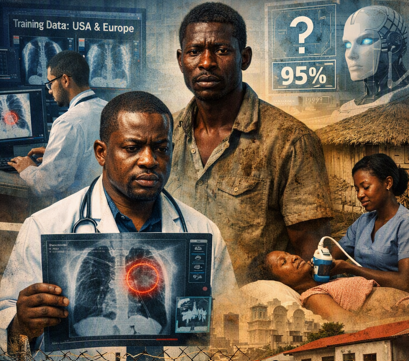

Artificial intelligence is already at work in Ghana's healthcare system, but a critical blind spot threatens patient safety: most of these diagnostic tools were trained on data from patients in Boston, Berlin and Seoul, not Bolgatanga or Accra. An investigative documentary released this week, Biased by Design: The Human Cost, reveals that Ghana's hospitals are adopting AI-assisted diagnostic systems without any framework to validate whether they work reliably for Ghanaian patients, or to establish accountability when they fail.
The issue is straightforward but urgent. When machine-learning algorithms that read chest X-rays or interpret ultrasound scans are trained on tens of thousands of images, they learn patterns of disease from that specific reference population. If that population is predominantly from wealthy, high-income countries with different disease prevalence, genetic backgrounds, and imaging standards, the algorithm's accuracy when applied to a Ghanaian patient becomes unpredictable. Yet the interface on screen shows the same confident percentage as it would for a patient in Massachusetts—creating a false sense of reliability.
AI tools are already in use across Ghana's health system
This is not a future concern. Computer-aided detection systems are currently being used to screen for tuberculosis in Ghanaian facilities. Midwives in remote areas without access to sonographers are using smartphone-based ultrasound support powered by AI. Ghanaian innovators, including MinoHealth founder Darlington Akogo, are building diagnostic models locally. Some of this deployment has genuine benefit: a midwife equipped with an AI tool to flag abnormal presentations is better resourced than one with nothing, particularly in a country facing severe specialist shortages.
But adoption has outpaced governance. The investigation found that adoption has run ahead of any meaningful regulatory framework. Clinicians at the bedside are carrying judgements that should have been made before the tool ever reached their facility—by a regulator, a procurement officer, or a validation study conducted on local populations.
Three critical gaps nobody has answered
The documentary identifies three unanswered questions that expose Ghana's regulatory vacuum:
- Approval: When a Ghanaian hospital installs an AI tool, which body authorised it? Medical devices fall under regulatory regimes, but clinical software sits in a grey zone that most countries, Ghana included, are still defining. If no regulator has validated the tool's performance on Ghanaian populations, hospitals rely entirely on vendor claims.
- Accountability: A radiologist who misses a diagnosis answers to a professional body. An algorithm does not. Liability chains running through vendors, hospitals, clinicians and procurement officers remain untested, and nobody wants to be the first case that tests them.
- Data ownership: Many AI systems improve by learning from cases they process. If Ghanaian patient data is used to refine models owned abroad, Ghanaians are supplying raw material for products they later pay to license—a standard commercial model now operating largely unregulated.
Why this matters for Ghana
Ghana's healthcare system faces real constraints: specialist radiologists, sonographers and trained diagnosticians are scarce, particularly outside urban centres. AI tools promise to extend expertise to remote facilities. That potential should not be lost. But deploying powerful diagnostic systems without understanding their limitations for Ghanaian patients, without clear accountability structures, and without data protection, inverts the logic of healthcare innovation. Tools designed to extend capacity become tools that extend risk—and those risks fall on patients least able to contest them.
The more hopeful finding is that the correction is being attempted from within the continent itself. Ghanaian researchers and founders are building models trained on local data within local institutions, with Ghanaian populations in the reference set. This work is happening but faces an enormous challenge: a global AI pipeline backed by vast capital competing for procurement contracts. Without procurement rules that demand validation, local-led alternatives struggle to compete.
The documentary's core insight is stark: this is not fundamentally a technology story. It is a governance story. Ghana's hospitals need clear rules—about who approves AI tools, who answers when they fail, and how patient data is used and protected. Those rules should exist before the next algorithm arrives at a hospital door.
Source: MyJoyOnline
-1200x675.webp)



Comments (0)
Be the first to comment.