
When Construction Sites Become Public Hazards: Ghana's Safety Crisis in Plain Sight
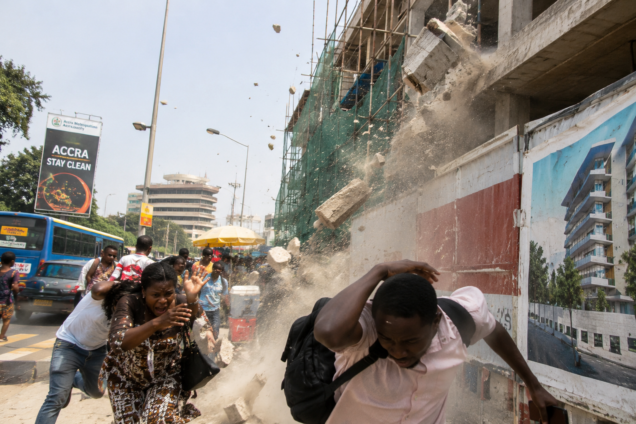

A falling block of concrete from a half-built high-rise should not be a death sentence for a pedestrian simply passing by. Yet across Accra and other Ghanaian cities, this terrifying scenario is becoming an increasingly familiar risk. A recent incident at a high-rise development near the Tetteh Quarshie Interchange in the Villaggio area of Accra, where construction materials fell from upper floors onto the street below, has forced an urgent conversation about who is responsible when building sites endanger the public — and what the law actually says about it.
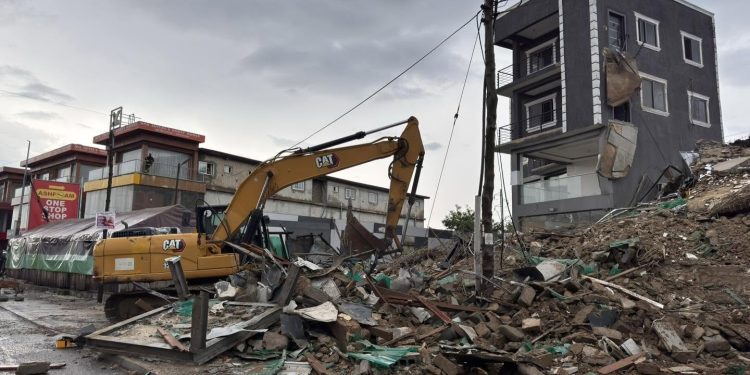
Fortunately, no lives were lost in that particular incident. The same cannot be said for building collapses reported at Avenor and Adenta in June 2026, which resulted in deaths, injuries, and damage to neighbouring properties. Taken together, these events paint a troubling picture of a construction industry expanding rapidly but not always safely.
The growing danger beyond the fence
Ghana's urban centres — Accra and Kumasi chief among them — are experiencing intense construction activity driven by rising demand for housing and commercial space. Multi-storey developments routinely rise directly beside occupied homes, schools, offices, and public roads, with little physical buffer between active building work and everyday life.
This proximity creates serious hazards that go well beyond the workers on site. Falling debris, unsecured scaffolding, uncontrolled demolition, excessive dust and vibration, deep excavations left without proper barriers, and heavy construction vehicles navigating public roads all pose real dangers to pedestrians, motorists, and residents nearby.
The situation is particularly acute in brownfield developments — projects that involve renovating or expanding properties that are already in use, often while surrounding buildings and roads remain fully occupied. In these settings, the margin for error is especially narrow, and the consequences of poor site management can be immediate and severe.
Experts draw an important distinction between occupational safety, which focuses on protecting workers inside a site, and public safety, which extends that duty of care to everyone who may be affected by construction activity — whether they ever set foot on the site or not. A construction hoarding or fence, in this framing, is not the outer limit of a contractor's responsibility; it is merely the first barrier between hazardous work and an unsuspecting public.
What Ghana's laws actually require
Ghana is not without legal frameworks on this matter. The Factories, Offices and Shops Act, 1970 (Act 328), specifically addresses safety in building and civil engineering operations. The Labour Act, 2003 (Act 651) requires employers to provide safe and healthy working conditions, while the National Building Regulations, 1996 (LI 1630) set out requirements for hoarding, scaffolding, and precautions during demolition to protect the public and adjoining properties.
On the contractual side, the Public Procurement Authority's Standard Tender Document for Major Works contains provisions — including Sub-Clause 4.8 on safety procedures and Sub-Clause 6.7 on health and safety arrangements — that place explicit obligations on contractors to protect members of the public and adjoining landowners.
Beyond statute, the common law of tort also applies. A contractor who fails to exercise reasonable care and causes foreseeable harm may face liability in negligence. Construction activities that unreasonably disturb neighbours through noise, dust, or vibration can amount to nuisance, while materials or equipment that encroach on neighbouring land may constitute trespass. The legal architecture, in short, already demands responsible behaviour. The question is whether it is being enforced.
Why it matters for Ghana
Ghana's construction sector is a significant engine of economic activity, and the country needs new housing, infrastructure, and commercial space. But unchecked expansion at the cost of public safety is not development — it is a gamble with lives.
The incidents at Villaggio, Avenor, and Adenta are not isolated anomalies; they are symptoms of a wider pattern in which regulatory oversight struggles to keep pace with the speed and scale of urban construction. When a building collapses or debris rains down on a public street, the victims are often ordinary people — traders, school children, commuters — who had no say in how the project was managed and no warning of the danger.
- Stronger, more consistent enforcement of existing building regulations is urgently needed from the relevant municipal and district assemblies.
- Developers and contractors must be held to account not just for what happens inside the hoarding, but for the full impact their work has on surrounding communities.
- Members of the public who suffer loss or injury as a result of negligent construction have legal avenues available to them — a fact that is not widely known and deserves greater public awareness.
Ghana has the laws. What is needed now is the institutional will to apply them consistently, and a cultural shift in the construction industry that treats public safety not as an afterthought, but as a fundamental professional obligation.
Source: The Ghana Report



Comments (0)
Be the first to comment.