
Masked Menace: Why Ghana's Motorcycle Number Plate Concealment Crisis Threatens Road Safety
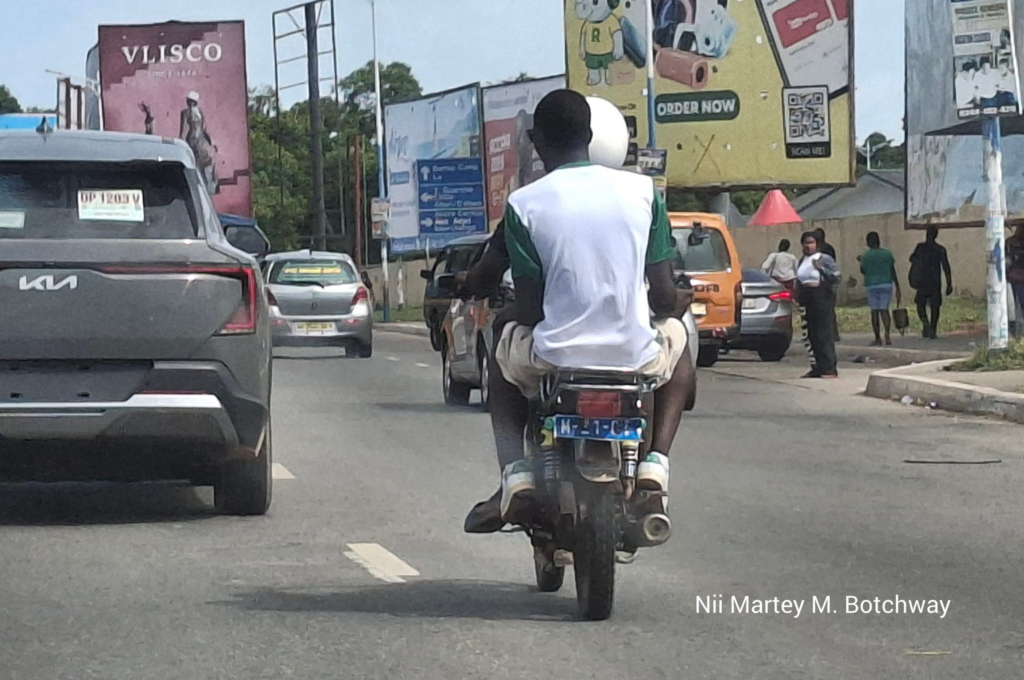

A troubling trend is emerging on Ghana's busier roads: motorcyclists deliberately obscuring, tilting, or covering their registration number plates to evade detection. From Accra's congested streets to other urban centres, the practice is becoming increasingly common, creating serious headaches for traffic authorities and raising fundamental questions about accountability on Ghanaian roads.
Riders are employing various techniques to render plates illegible—tilting them sharply upwards, draping material over them, or positioning them at angles that defeat the purpose of identification. While individual acts may seem minor, the collective impact threatens the effectiveness of Ghana's entire road enforcement system and public safety infrastructure.
The Law Enforcement Problem
For the Ghana Police Service and traffic management agencies, a clearly visible registration plate is the critical link between a motorcycle and its owner. Without legible plates, officers cannot establish accountability when a rider commits a traffic offence, causes an accident, or flees the scene of a crime. This is particularly problematic as Ghana increasingly adopts technology-enabled enforcement systems using cameras and electronic monitoring devices.
When registration numbers are concealed, these automated systems become useless. A motorcycle can disappear into traffic before manual identification becomes possible. The rider knows this, which is precisely why some choose concealment. The practice effectively creates a class of vehicles that operate beyond the reach of law enforcement—at least temporarily—undermining decades of regulatory effort.
The consequences extend beyond routine traffic violations. Motorcyclists involved in hit-and-run incidents, armed robbery operations, or other criminal activities have found that obscured plates provide a crucial layer of protection. Without clear identification, investigations stall and accountability evaporates.
Why It Matters for Ghana
Ghana's road safety statistics are already concerning, with motorcycles representing a significant proportion of traffic fatalities and injuries. Weaker enforcement mechanisms—enabled by concealed plates—only exacerbate the problem. When riders believe they can evade consequences, risky behaviour intensifies.
The issue also reflects a deeper challenge in Ghana's regulatory environment: the gap between rules on paper and their enforcement in practice. Registration plate visibility requirements exist in Ghana's traffic regulations, yet compliance remains inconsistent. This erodes public confidence in the system and signals that regulations are optional rather than binding.
For ordinary Ghanaians and legitimate road users, the problem is equally urgent. When a reckless motorcyclist causes an accident and vanishes, victims are left without recourse. Insurance claims become complicated. Families struggle to seek justice. The concealment of plates, therefore, is not merely a technical infringement—it is a tool that enables harm and prevents accountability.
As Ghana transitions to more sophisticated, technology-driven traffic management systems, concealed plates represent a regression. These systems promise better road safety through consistent, camera-based enforcement that removes human discretion. But they only work if vehicles are identifiable. Plate concealment directly undermines this investment and modernisation effort.
What Needs to Happen
The Ghana Police Service and the Driver and Vehicle Licensing Authority (DVLA) must prioritise enforcement of existing plate visibility regulations. This requires visible, consistent penalties for concealment—not as one-off operations, but as sustained compliance efforts on major roads.
Public awareness campaigns should emphasise that plate concealment is not a victimless act; it enables crime, complicates justice, and puts lives at risk. Community cooperation is essential: ordinary Ghanaians can report vehicles with obscured plates, and this information should feed into enforcement priorities.
Technology also offers solutions. Traffic cameras should be deployed with sufficient image quality to detect concealment, and fines should be issued automatically. This removes the human element that sometimes allows infractions to slide.
Ultimately, Ghana's road safety depends on accountability. Concealed number plates are a direct attack on that principle—and they must be treated as the serious threat they are.
Source: MyJoyOnline



Comments (0)
Be the first to comment.