
Ghana Sets Two-Year Minimum Wage Plan: GH¢25.04 in 2027, GH¢28.79 in 2028
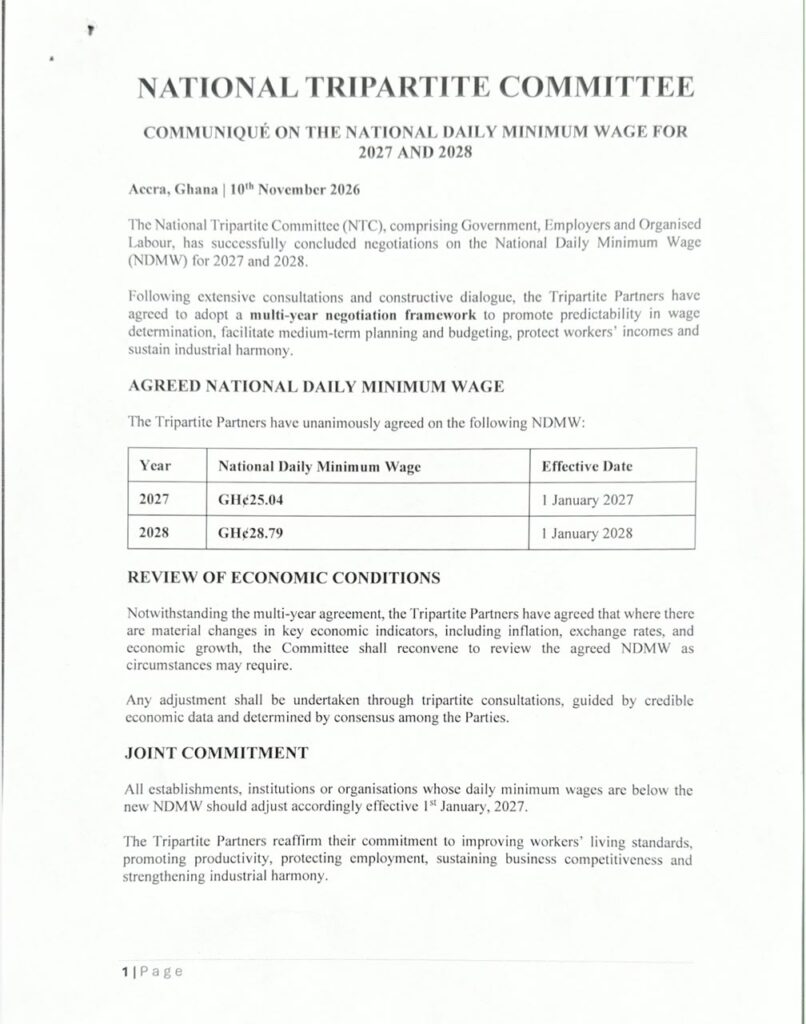

Ghanaian workers are set to see meaningful increases in their take-home pay after the National Tripartite Committee (NTC) reached a landmark two-year wage agreement, pushing the National Daily Minimum Wage (NDMW) to GH¢25.04 from January 2027 and further to GH¢28.79 from January 2028. The deal — formalised in a communiqué dated 10th November 2026 — marks a significant shift in how Ghana approaches wage negotiations, moving away from annual talks towards a medium-term planning model.
A New Approach to Wage Determination
The National Tripartite Committee, which brings together representatives from government, employer groups and organised labour, said the multi-year framework was deliberately chosen to bring greater predictability and stability to wage setting in Ghana. For years, annual minimum wage negotiations have been a source of tension and uncertainty, with businesses struggling to plan budgets and workers anxious about whether increases would keep pace with the cost of living.
By locking in rates for two consecutive years at once, all three parties hope to reduce the friction of yearly bargaining, give employers sufficient notice to plan staffing costs, and provide workers with a clearer picture of their earnings trajectory. The agreement was signed by the Minister for Labour, Jobs and Employment, Emmanuel Kwadwo Agyekum; Deputy Minister for Finance, Thomas Nyarko Ampem; President of the Ghana Employers' Association, Nana Dr. Emmanuel Adu-Sarkodee Afrifie; and Trades Union Congress (TUC) Secretary-General, Joshua Ansah.
The Committee has also instructed all employers — whether private firms, public institutions or civil society organisations — whose current daily minimum wages fall below the new threshold to adjust their pay scales upward with effect from 1st January 2027. Non-compliance with the agreed minimum wage is therefore not an option.
Why It Matters for Ghana
Ghana's minimum wage has historically struggled to keep pace with inflation, particularly during periods of economic turbulence. The country experienced significant currency depreciation and high inflation in recent years, which eroded the real purchasing power of low-income earners. A pre-agreed, two-year wage schedule offers some protection against sudden economic shocks — though the Committee has wisely built in a safety valve, noting it may reconvene to review the agreed rates if there are material changes in key economic indicators such as inflation, exchange rates or GDP growth. Any such review would be driven by credible data and reached by consensus.
One particularly significant demand within the communiqué is the call for the National Daily Minimum Wage to be made tax-exempt. The Committee urged the government to act on this, arguing that taxing the minimum wage effectively claws back gains made for the lowest-paid workers. If implemented, this exemption could meaningfully boost the net earnings of workers at the bottom of the pay scale — a move that labour advocates have long championed.
For ordinary Ghanaian workers in sectors such as retail, agriculture, domestic service and small-scale manufacturing, these increases represent more than just numbers. With the cost of food, transport and utilities continuing to rise, even modest wage improvements can have a tangible impact on household welfare. The two-year visibility also helps workers and their families plan ahead with greater confidence.
What Employers and Labour Can Expect Next
Businesses across Ghana should begin reviewing their payroll structures now to ensure full compliance by the January 2027 deadline. The Ghana Employers' Association's participation in and endorsement of the agreement signals broad buy-in from the private sector, which should ease implementation.
Organised labour, led by the TUC, is expected to monitor compliance closely and has the backing of the tripartite process to flag any employer violations. The Committee's reaffirmation of the shared commitment to improving workers' living standards while sustaining business competitiveness reflects the delicate balance that underpins Ghana's industrial relations framework.
As Ghana continues its economic recovery path, the success of this two-year wage agreement could set a useful precedent — demonstrating that government, employers and workers can reach durable, forward-looking agreements that serve the broader national interest.
Source: MyJoyOnline



.jpg)
Comments (0)
Be the first to comment.