
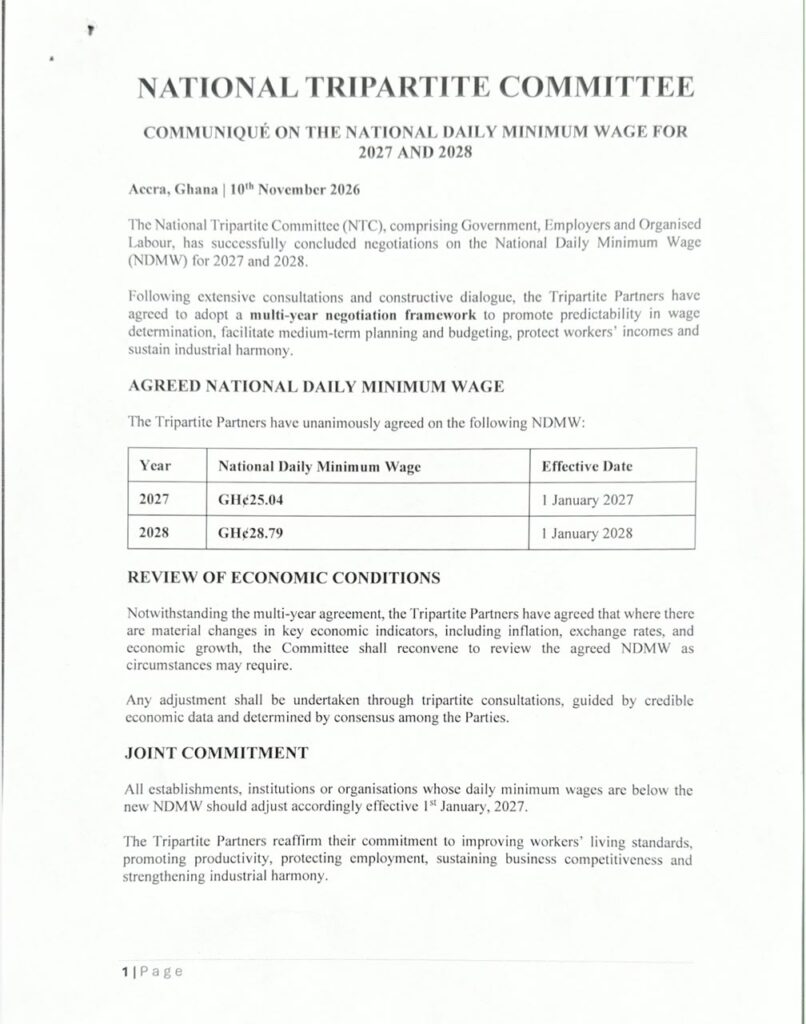
Ghana's Minimum Wage Set to Rise to GH¢25.04 in 2027 and GH¢28.79 in 2028 Under New Two-Year Deal


Ghanaian workers on the lowest rung of the pay scale are set for back-to-back wage increases after the Tripartite Committee reached a landmark two-year agreement on the National Daily Minimum Wage (NDMW). The deal fixes the daily minimum wage at GH¢25.04 effective 1 January 2027, rising further to GH¢28.79 from 1 January 2028 — giving both workers and employers a rare period of certainty in an economy that has been battered by inflation and a depreciating cedi.
What the agreement covers
The Tripartite Committee — which brings together representatives of government, organised labour, and employers — announced that the new rates will apply across all establishments, institutions, and organisations in Ghana. Any employer currently paying a daily minimum wage below the stipulated figures will be legally required to adjust upwards by the respective effective dates.
The two-year structure is itself notable. Historically, minimum wage negotiations in Ghana have been conducted on an annual basis, often producing late agreements that delay implementation and create uncertainty for businesses trying to plan their payroll budgets. By locking in figures for both 2027 and 2028 in a single sitting, the committee is signalling a shift toward a more stable, predictable framework for wage-setting.
The percentage increase between the two years — roughly 15 per cent — broadly reflects the committee's expectation that inflation will remain elevated but gradually moderate over the period, in line with projections from the Bank of Ghana and the International Monetary Fund as the country continues its IMF-supported recovery programme.
Why it matters for Ghana
Ghana's minimum wage directly affects hundreds of thousands of workers in sectors such as agriculture, domestic service, construction, and informal trade — many of whom have no collective bargaining agreement to fall back on. For these workers, the NDMW is the only formal floor protecting their income.
The timing is significant. Ghana has been navigating one of its most difficult economic periods in decades, with the cedi losing substantial value against major currencies and the cost of food, fuel, and utilities climbing sharply. Wage increases, even modest ones, can help low-income households maintain some purchasing power. Critics, however, may argue that the new rates still lag behind actual living costs, particularly in Accra and other urban centres where the cost of renting a room, feeding a family, and paying for transport has risen steeply.
From an employer's perspective — especially small and medium-sized enterprises — the advance notice of two years' worth of wage floors is a welcome planning tool. Business associations have long complained that last-minute annual announcements make it difficult to price goods and services or prepare annual budgets.
What happens next
Employers across both the formal and informal sectors are expected to review their current pay structures ahead of 1 January 2027. Labour inspectors under the Ministry of Employment and Labour Relations are empowered to enforce compliance, and businesses found paying below the NDMW can face sanctions under Ghana's Labour Act.
Trade unions are likely to use the new NDMW as a baseline in sector-specific collective bargaining negotiations scheduled for later in the year. Unions representing teachers, health workers, and public sector employees typically anchor their own demands to movements in the national minimum wage, meaning the ripple effects of this agreement could be felt well beyond the lowest-paid workers.
- Workers and advocacy groups will be watching closely to see whether the government accompanies the wage deal with complementary measures — such as subsidies on essential goods or expanded social protection — to ensure the increases translate into genuine improvements in living standards rather than being quickly eroded by inflation.
- The Tripartite Committee is expected to publish full details of the agreement, including the methodology used to arrive at both figures, in the coming days.
Source: 3News



Comments (0)
Be the first to comment.