
Ghana's Plastic Crisis Is Strangling James Town Fishermen and Their Way of Life
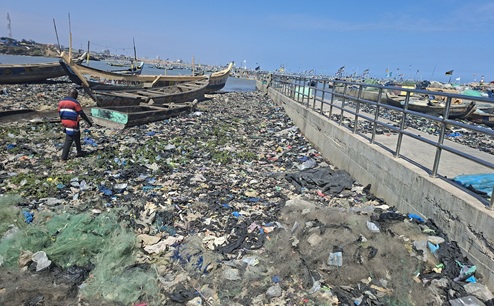

Walk towards Accra's historic James Town Fishing Harbour and the ocean breeze is quickly overpowered by something far less welcoming — the acrid smell of decomposing waste piled metres deep along what was once a productive and cherished shoreline. Crushed water sachets, sun-bleached plastic bags, tangled fishing nets, and discarded bottles now carpet the golden sand, turning a once-thriving cradle of marine life into what many locals describe as an open-air landfill. For the hundreds of artisanal fishermen who depend on these waters, the consequences are no longer theoretical — they are devastating and daily.
Fishermen returning with more plastic than fish
At James Town, the story is told most painfully by the men who live it. Sammy Okine, a 37-year-old fisherman, says he and his colleagues are forced to repair their nets two or three times a week because of the sheer volume of plastic debris trapped in the water. His colleague Daniel Otoo says catches have dwindled so severely that many fishermen can no longer return from sea with enough fish to feed their own families, let alone sell a surplus at market.
The Nae Wulomo — the Highest Chief Priest of the Ga State — Nuumo Kwaa Mensah III, has spoken bluntly about what this means for the community. He noted that deploying 20 canoes may yield less than a tonne of fish combined, with plastic outnumbering the catch. Yet he was equally clear about where responsibility lies: the sea, he said, is simply returning what people have put into it. "The plastics are from somewhere; the people of James Town do not manufacture plastics; they come from the markets and other places — so it is a chain that must be looked at holistically," he said.
Nana Joojo Solomon, President of the Ghana National Canoe Fishermen Council, added a striking dimension to the crisis, pointing out that fishermen themselves contribute to the problem. With an estimated 14,000 canoes at sea, each potentially discarding multiple bags of sachet water waste per trip, the cumulative pollution from fishing communities alone is enormous. "That is why the ocean is so angry with us," he said.
Why this matters for Ghana
The crisis at James Town is not an isolated local problem — it is a vivid symptom of a national emergency. Ghana generates over one million tonnes of plastic waste annually, according to data from the Environmental Protection Authority (EPA), yet less than 10 per cent of that waste is ever collected or recycled. The overwhelming majority flows through open drains, into rivers, and eventually into the Atlantic Ocean along Ghana's roughly 550-kilometre coastline, where it threatens marine ecosystems, fish stocks, and the livelihoods of coastal communities stretching well beyond Accra.
The United Nations Environment Programme (UNEP) has warned that without urgent global action, the volume of plastic waste entering aquatic and marine ecosystems could nearly triple by 2040. By 2050, projections suggest the world's oceans could contain more plastic by weight than fish — a scenario with catastrophic implications for a country where fish remains a primary source of protein and artisanal fishing supports hundreds of thousands of jobs.
Research published by the Council for Scientific and Industrial Research-Water Research Institute (CSIR-WRI), titled Plastic on the Menu: Microplastics in Aquatic Foods and Beach Coastal Waste in Ghana, found that between 80 and 93 per cent of beach plastic is land-based, arriving through drains, markets, and households. The study also detected a high presence of microplastics inside local fish species, with researchers warning that consuming fish gills and guts carries direct health risks for Ghanaian consumers.
What must change
The scale of the crisis demands action at multiple levels simultaneously. Coastal communities — including fishermen who acknowledge their own role in the problem — need practical alternatives to single-use plastics and accessible waste collection systems at sea and on land. Ghana's broader waste management infrastructure requires significant investment, particularly in collection networks that currently fail to capture over 90 per cent of the country's plastic waste before it reaches waterways.
Beyond infrastructure, enforcement of existing environmental regulations and genuine accountability across the plastic supply chain — from manufacturers and packagers to market traders and consumers — will be essential. The plight of James Town's fishermen is a warning that time is running short. If nothing changes, it is not only a historic fishing community that will be lost, but a critical piece of Ghana's food security, cultural heritage, and coastal economy.
Source: MyJoyOnline
-1200x535.webp)




Comments (0)
Be the first to comment.